Versailles: Building the Palace
A small brick-and-stone hunting lodge, bought by Louis XIII in 1632, became the largest palace in Europe and the machine that ran the monarchy. It took half a century.
From lodge to palace
Louis XIII bought the seigneury of Versailles in 1632 and built a modest château of brick and stone. His son first came to hunt there as a boy; in 1661 — the year the personal reign began — Louis XIV started enlarging it, and never really stopped. The building history falls into campaigns:
- 1661–1668 (Le Vau): the first enveloppe — Le Vau wraps the old château in a new stone palace; Le Nôtre begins the gardens; the first fêtes (1664, Les Plaisirs de l’île enchantée).
- 1668–1670: the second enveloppe; the garden front takes shape.
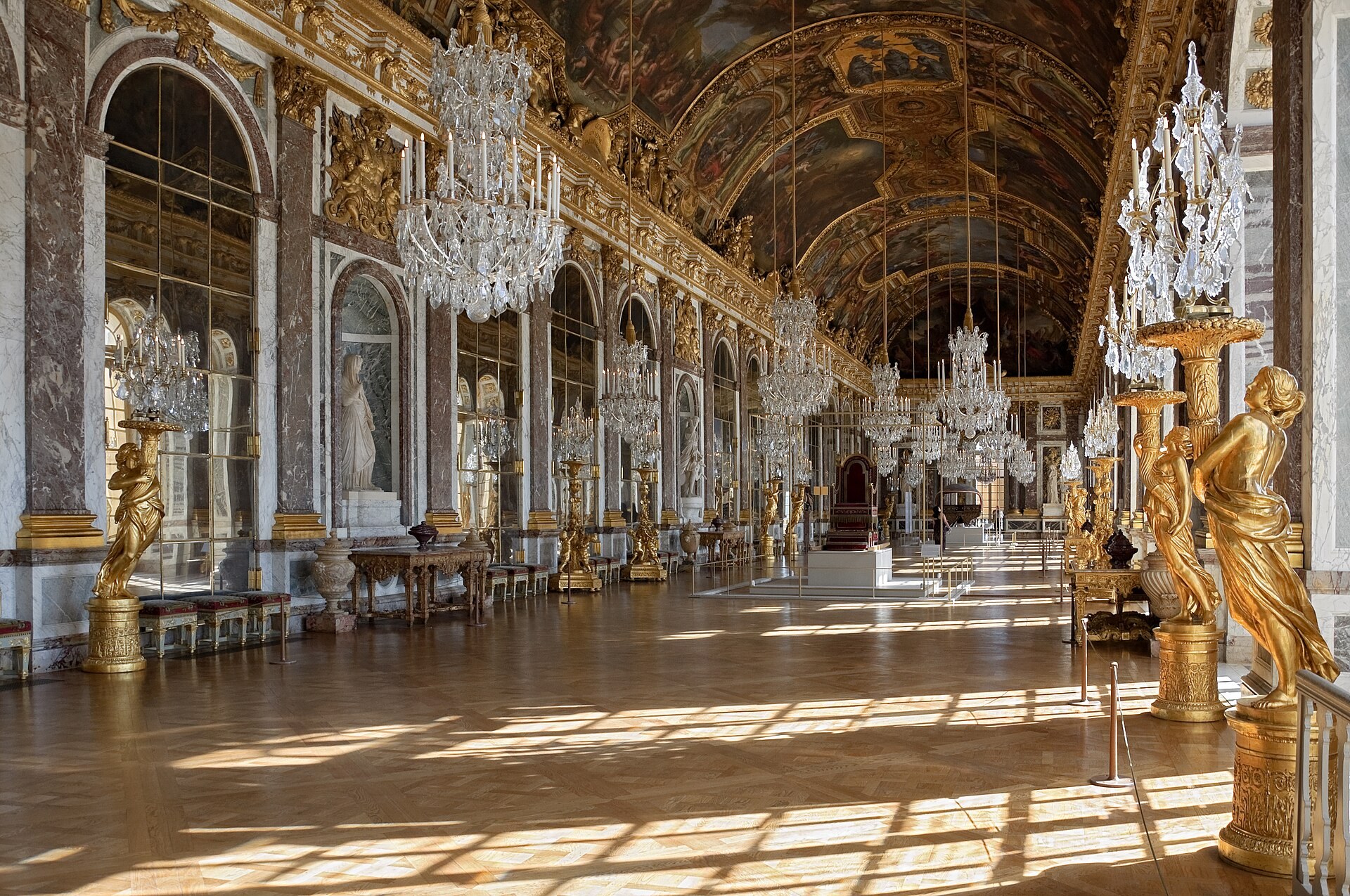
- 1678–1684 (Mansart): after the Peace of Nijmegen, the great campaign — the Hall of Mirrors (1678–84) by Mansart and Le Brun, the north and south wings, the Grand Trianon (1687), the Royal Chapel (begun 1687, finished 1710).
- 1682: the court and government move to Versailles permanently — the conventional date of the palace’s political completion, though building continued for decades.
The builders
- Louis Le Vau (1612–1670): the first architect of the enveloppe.
- Jules Hardouin-Mansart (1646–1708): the Hall of Mirrors, the wings, the Trianon, the chapel — the palace’s definitive architect.
- André Le Nôtre (1613–1700): the gardens — the perspective, the Grand Canal (begun 1667), the fountains. The garden as an instrument of state.
- Charles Le Brun (1619–1690): the interiors, the iconography, the Hall of Mirrors’ ceilings — the palace’s visual program.
The politics of stone
Versailles was never just a residence. Moving the court there in 1682:
- Domesticated the nobility — the great families now lived on pensions, offices, and proximity to the king, competing for the tabouret rather than raising armies.
- Staged majesty — the lever, the coucher, the grand couvert, the Hall of Mirrors as a corridor of state: power performed daily.
- Cost enormously — the total will never be known precisely (the accounts were never consolidated; estimates vary wildly and are flagged as estimates). What is certain is that the spending was a political choice, visible to all of Europe, and resented by the taxed.
The famous line that Versailles was built “on the backs of the people” is rhetoric, not accounting — but the resentment it names was real, and Fénelon’s letter to the king names the palace among the reign’s expensive glories.
What Versailles became
The model for every European court — Vienna, Madrid, Stockholm, Potsdam — imitated or answered Versailles. In 1919 the Hall of Mirrors hosted the signing of the Treaty of Versailles; in the 20th century the palace became a museum of French history. The building Louis made to stage absolute monarchy outlived the monarchy by two centuries.
Source notes
- Building campaigns and architects follow the standard architectural history (see sources.md; 2026-09-26).
- The 1682 move and 1678–84 Hall of Mirrors dates are conventional; construction was continuous.
- Total-cost figures are estimates and are not quoted here for that reason — labeled as unknowable from the surviving accounts.