The Revocation of the Edict of Nantes
On 18 October 1685 Louis XIV signed the Edict of Fontainebleau, ending eighty-seven years of legal Protestant worship in France. It was the reign's most consequential domestic act — and its most debated.
What was revoked
Henri IV’s Edict of Nantes (1598) had granted French Protestants — Huguenots — freedom of conscience and some 150 fortified places of safety. Louis XIII and Richelieu had already stripped the Huguenots’ military power (the Peace of Alès, 1629), leaving only the religious liberties. Louis XIV spent the 1660s–70s eroding those: excluding Protestants from offices, professions, and guilds, and offering converts pensions from the caisse des conversions.
The dragonnades
From 1681, under Louvois, the crown quartered dragoons on Huguenot households — in Poitou first, then across the Protestant south — with orders to live at the families’ expense until they converted. The “missionaries in boots” produced mass, hollow conversions: whole provinces “converted” in weeks. The king took the conversions at face value, or chose to.
The Edict of Fontainebleau
Signed 18 October 1685, registered by the Parlement on 22 October, the edict:
- banned all Protestant worship in the kingdom;
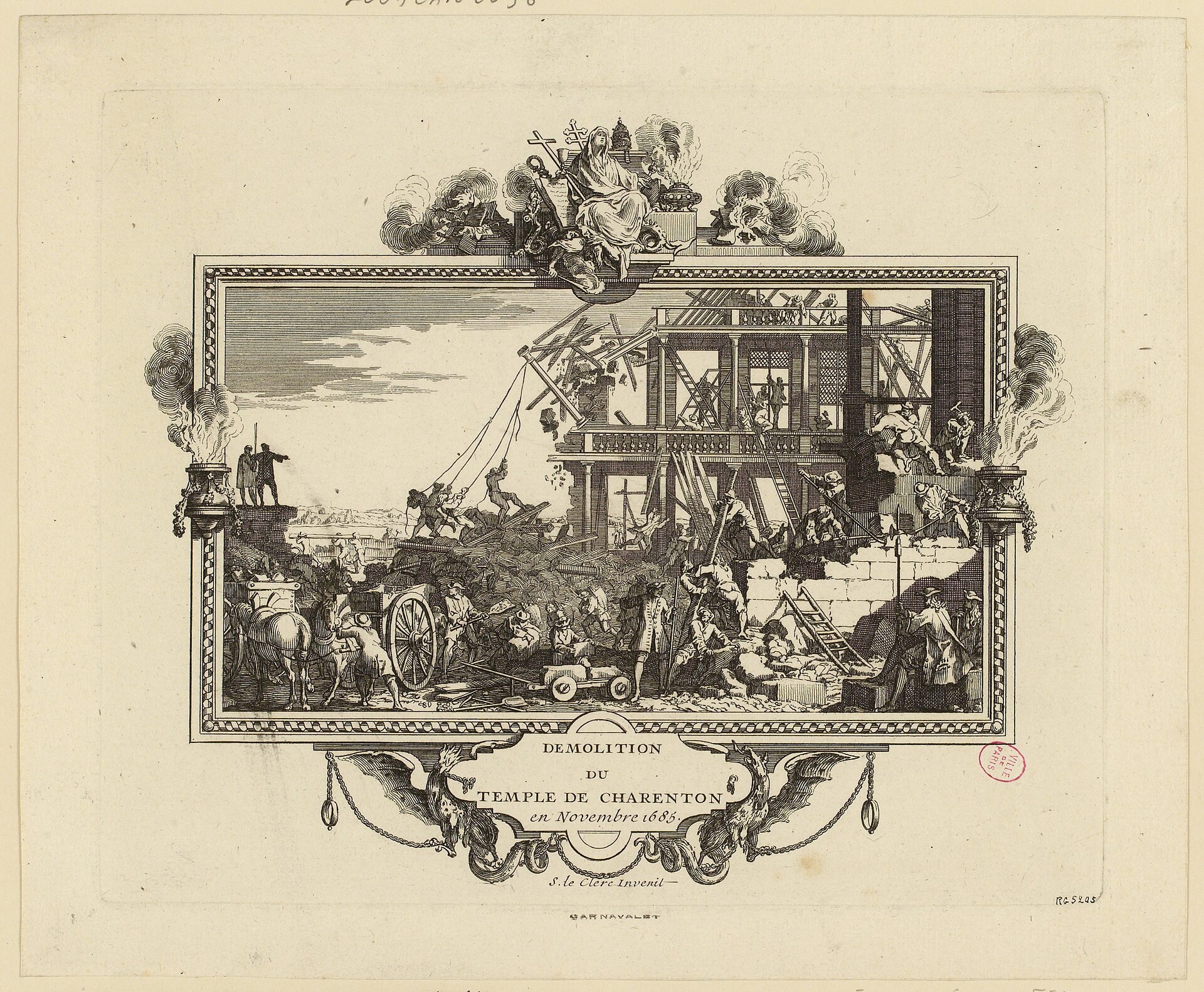
- ordered the demolition of the remaining temples (Charenton’s fell in November 1685 — see the contemporary print on this page);
- exiled ministers within fifteen days unless they converted;
- ordered all Protestant children baptized and raised Catholic;
- forbade emigration — under penalty of the galleys for men and confiscation for women.
The preamble declared that the “best and greatest part” of the king’s Protestant subjects had already embraced Catholicism — the official fiction that the dragonnades’ conversions were sincere.
The emigration
Despite the ban, some 200,000 or more Huguenots fled (estimates vary; the figure is flagged as an estimate) — to England, the Dutch Republic, Switzerland, Brandenburg-Prussia, and beyond. They took with them skills France lost: printing, watchmaking, banking, weaving, and military expertise that would serve William of Orange and Frederick of Prussia. The Revocation was an economic wound and a diplomatic catastrophe: Protestant Europe read it as proof of Louis’s tyranny, and it hardened the coalitions against him.
Why did he do it?
Historians divide, and the page reports the division rather than settling it:
- Conviction: the aging king’s genuine Catholic zeal, sharpened by Maintenon’s piety and the confessors (notably Père de La Chaise).
- Politics: un roi, une loi, une foi — one king, one law, one faith. A kingdom religiously divided had nearly torn itself apart in the Wars of Religion; unity of faith looked like the completion of absolutism.
- Momentum: the dragonnades had “succeeded”; the edict ratified a conversion campaign already won on paper.
The aftermath
The Camisard revolt (1702–1705) in the Cévennes — a Protestant guerrilla war — showed the Revocation had not ended French Protestantism, only driven it underground into the “Desert.” Toleration would not return until Louis XVI’s Edict of Versailles (1787), on the eve of the Revolution.
Source notes
- Edict dates 18/22 October 1685; dragonnades from 1681; Camisards 1702–1705; Edict of Versailles 1787 — standard documentary record (2026-09-26).
- Emigration figures are estimates; “200,000 or more” is the cautious conventional range.
- The “why” section summarizes the standard historiographical positions without inventing a consensus.