The Dutch War, 1672–1678
In June 1672 the greatest army in Europe crossed the Rhine and nearly erased the Dutch Republic in weeks. It took six more years — and a European coalition — to end what the invasion started.
Why Holland?
Louis’s motives, as historians reconstruct them: revenge for the Triple Alliance of 1668 (which had checked his gains in the War of Devolution), the Protestant republic’s commercial rivalry, and the conviction — shared by his ministers — that a short, glorious war would complete the humiliation of Spain’s former allies and secure France’s “natural” frontiers. Louvois promised a campaign; the Dutch were to be, in a minister’s phrase, chastised.
The invasion
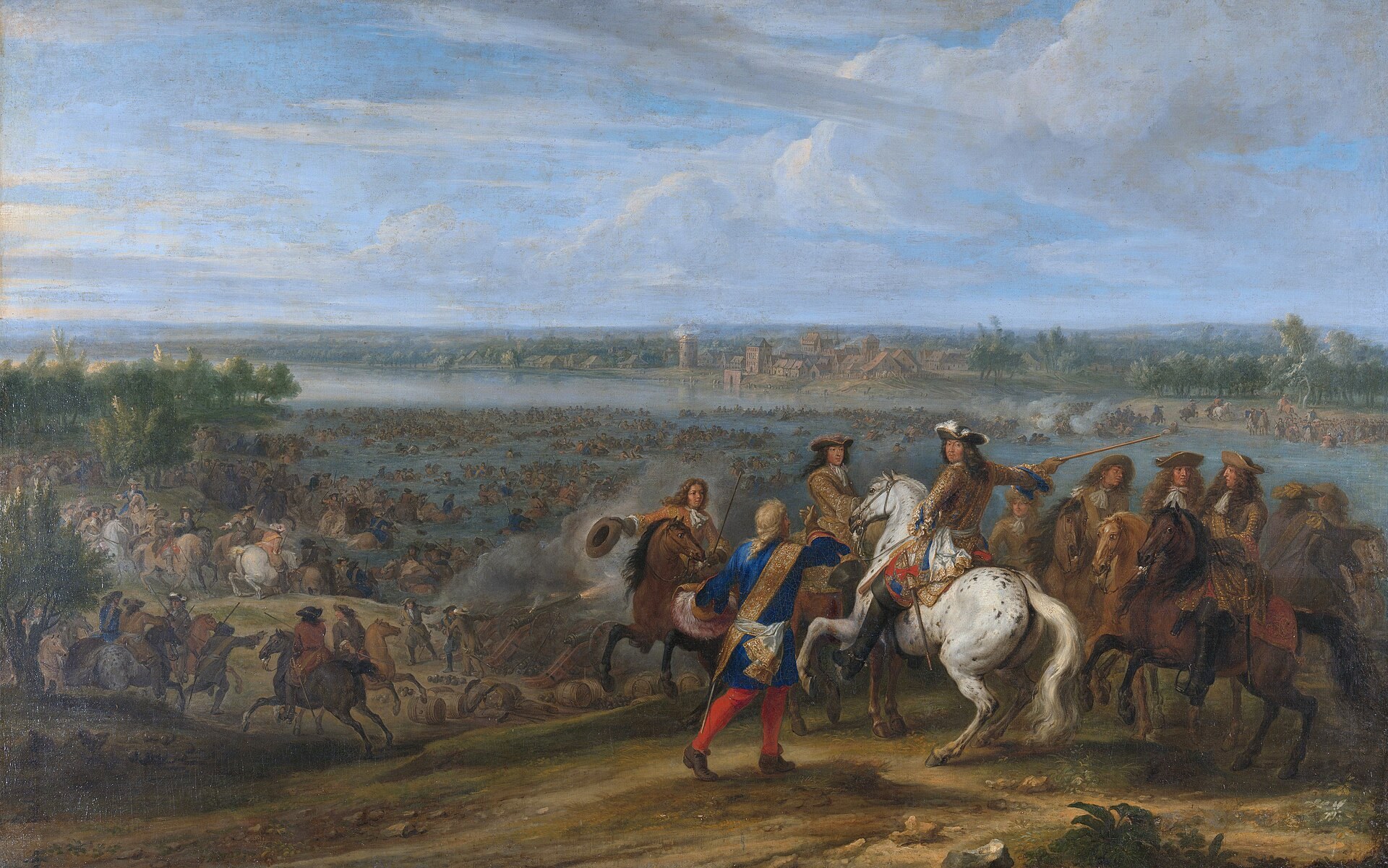
On 12 June 1672 the French army crossed the Rhine at Lobith (the Tolhuis) — the celebrated passage painted by van der Meulen, the war’s official artist. City after city fell: Utrecht, much of Holland and Zeeland seemed lost. The Dutch opened the dikes — the waterlinie — flooding the polders and halting the advance on Amsterdam. William of Orange, 21, became stadtholder; the De Witt brothers were lynched by a mob in The Hague (August 1672). France had won the campaign and lost the war’s meaning: all of Europe now saw Louis as the aggressor.
The coalition
Spain, the Emperor, Brandenburg, and eventually England joined the Dutch. What began as a French invasion became a general European war, fought from Sicily to the North Sea. Turenne campaigned brilliantly in the Empire until his death at Sasbach (27 July 1675); Condé won the bloody battle of Seneffe (1674).
Nijmegen
The Treaties of Nijmegen (1678–79) ended it: France kept Franche-Comté and a chain of Flemish towns, and Louis — at forty — stood at the summit of his power. The peace was his apogee: the arbiter of Europe, the Sun King at noon. It was also the moment the bill began to come due — the finances broken, the coalitions formed, the reputation made that would unite Europe against him again in 1688.
Source notes
- Rhine crossing 12 June 1672 at Lobith/Tolhuis; De Witt murders August 1672; Turenne killed 27 July 1675; Seneffe 1674; Nijmegen 1678–79 — standard record (2026-09-26).
- The van der Meulen painting on this page is the contemporary official image of the crossing (artist d. 1690; public domain).