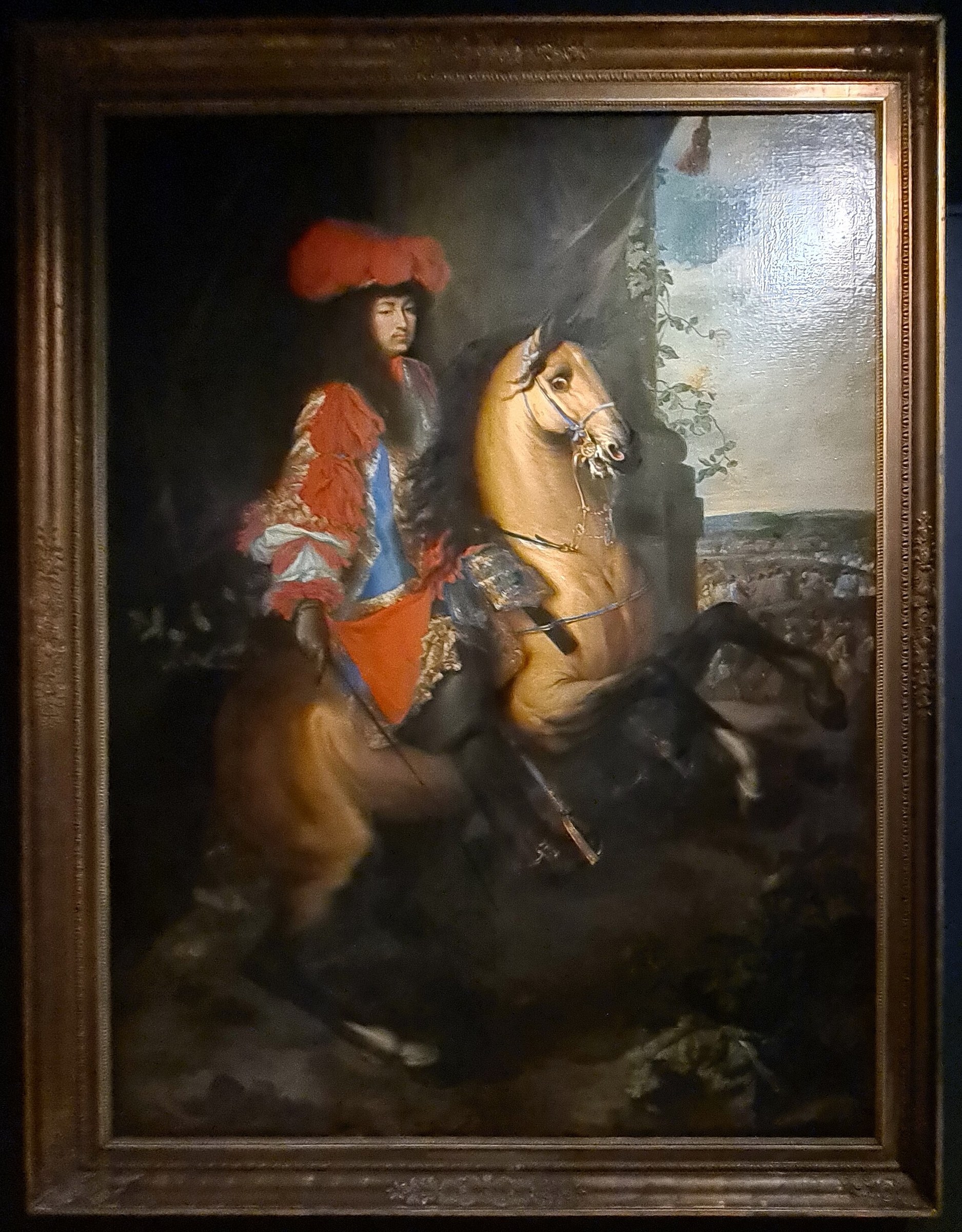
Louis XIV in Art and Propaganda
No monarch was ever more painted, sculpted, engraved, medaled, and ceilinged. The image of Louis XIV was not decoration — it was government.
The machine
Under Charles Le Brun, premier peintre du roi, the crown built the first systematic image-program of any European monarchy: the Gobelins manufactory producing tapestries, the Histoire métallique (the great series of medals narrating the reign year by year), the engravings of the Cabinet du roi, the ceilings of Versailles. Van der Meulen rode with the armies to paint the victories. The king’s face, in approved versions, circulated across Europe like currency.
The Rigaud portrait (1701)
The summit of the program: Hyacinthe Rigaud’s full-length state portrait, painted in 1701 when the king was 63. Commissioned to be sent to Louis’s grandson Philip V of Spain, it pleased the king so much he kept the original (now Louvre, INV 7492) and sent a copy instead.
Read it as a document, not a likeness:
- the coronation robes — blue velvet strewn with fleurs-de-lis, ermine-lined — though Louis’s actual coronation had been forty-seven years earlier;
- the regalia: the crown, the hand of justice, and the sceptre of Henri IV on the cushion;
- the sword at his hip: the warrior king;
- the column and drapery: the traditional grammar of absolute power;
- the legs: famously well-turned for a 63-year-old. Louis had been a dancer in his youth and prided himself on them; Rigaud obliged, and the heeled shoes add the inches. The face, by contrast, is lined and jowled — the one concession to truth.
In the king’s absence the portrait served as his proxy at Versailles; courtiers were forbidden to turn their backs on it. The most reproduced royal image in history began as a piece of dynastic PR.
Le Brun’s ceilings
The Hall of Mirrors’ ceiling (Le Brun, 1678–84) narrates the Dutch War as the triumph of the Sun King over Disorder — history painted as allegory while the war’s bills were still being paid. The Galerie des Glaces is propaganda you walk through.
The medals
The Histoire métallique — hundreds of medals, each with a Latin legend — told the reign as a Roman imperial history, year by year, for the desks of Europe’s ministers. The 1643 medal of the child king (see glossary) begins the series; the medals of Nijmegen and later of Utrecht close its arcs.
Contemporary vs. romanticized
A standing rule of this site: distinguish the contemporary image from the later one. Rigaud (1701), Le Brun, van der Meulen, Nanteuil’s engravings — these are the reign’s own propaganda, invaluable as evidence of how Louis wished to be seen. The 19th century’s romantic paintings and the 1900 Imprimerie nationale prints are evidence of something else: how later France wished to remember him. Both are used on this site; they are never confused.
Source notes
- Rigaud 1701, Louvre INV 7492, 277 × 194 cm; commissioned for Philip V, kept by the king, copy sent (recorded in Rigaud’s account book, 26,000 livres) — per the Louvre, Smarthistory, and Christie’s cataloguing (2026-09-26).
- Le Brun Hall of Mirrors ceilings 1678–84; the proxy-portrait anecdote is the standard account.
- The “dancer’s legs” reading follows Smarthistory’s analysis of the portrait.