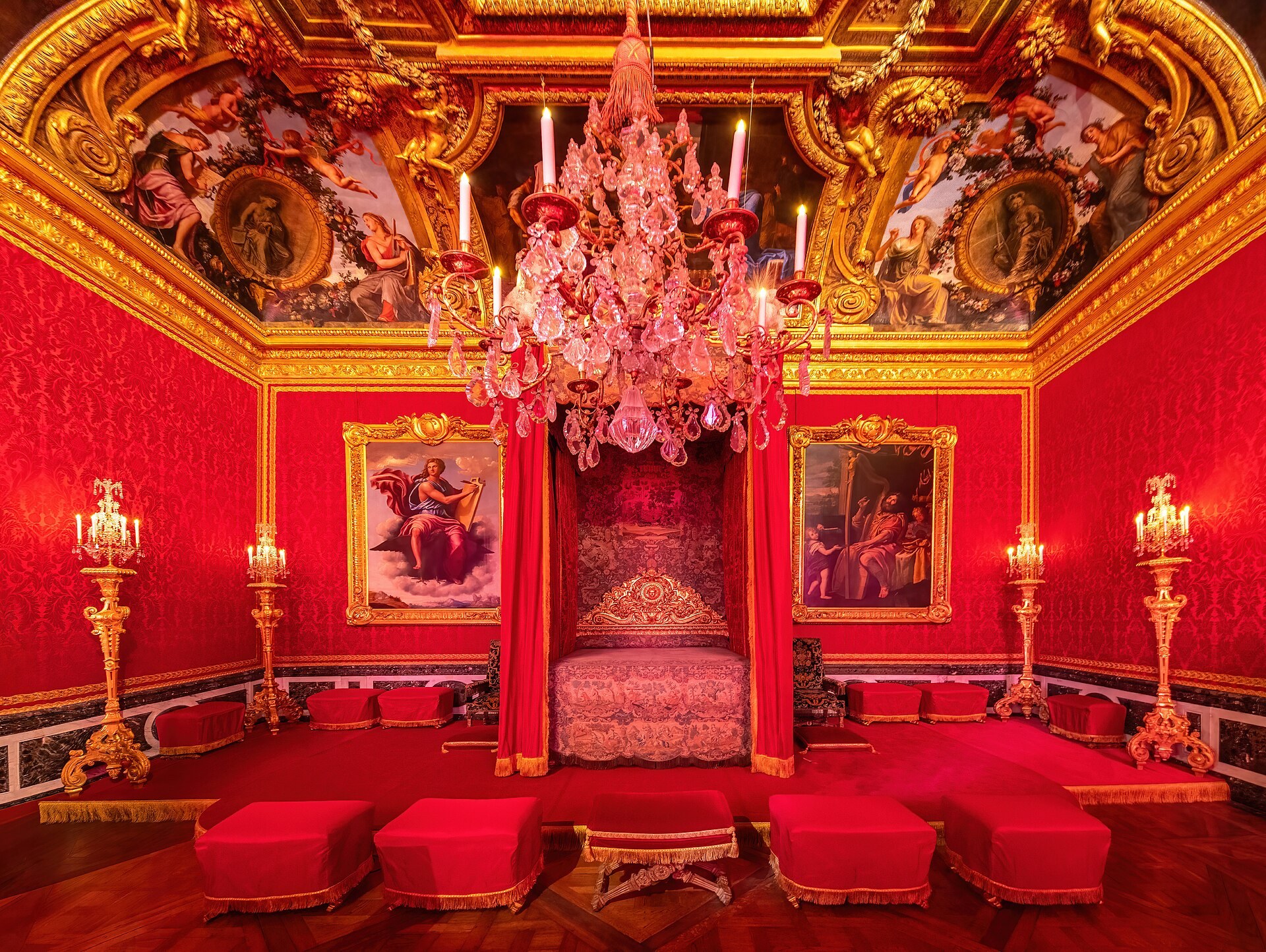
The Court: Etiquette and Ritual
At Versailles, getting dressed was a ceremony, dinner was a spectacle, and standing in the right doorway could make a career. The etiquette was the government.
The system
Louis XIV did not invent court ritual, but he perfected it as an instrument. The principle was simple: access to the king’s person was the currency of power, and the king minted it daily. Every courtier’s rank was performed, publicly, in the ceremonies of the royal day.
The day
- The lever (rising): the king woke, was prayed over, and was dressed in stages — the petit lever for the highest intimates, the grand lever for the court. Who handed the shirt, who held the candlestick: each gesture was a rank made visible.
- Mass in the Royal Chapel, then the council — the actual work of government, invisible to the court.
- The grand couvert: dinner in public, the royal family eating while courtiers and visitors watched. Majesty as theater.
- The afternoon: the hunt, the walk in the gardens, the appartement evenings — music, cards, conversation in the Grand Appartement’s salons.
- The coucher (retiring): the lever in reverse, the court undressing its king.
Saint-Simon — who lived inside this machine for thirty years — describes it with fascination and fury: a system that made grown men weep over a glance and ruined families over a doorway.
The tabouret and the ranks
Precedence was law: who sat (the tabouret, the stool granted to duchesses), who stood, who entered first, who was presented. Disputes of rank occupied the king’s council like affairs of state — because they were affairs of state. The etiquette books (notably under the Grand Chambellan) codified what custom had made sacred.
Why it worked
- It kept the nobility busy. The Fronde’s lesson: idle grandees plot. At Versailles they competed for favors, not provinces.
- It made the king the center of all desire. Every grace flowed from his hand, in public, daily.
- It was legible to Europe. Ambassadors reported the lever like military intelligence; every court from Vienna to Stockholm copied the forms.
The cost of the machine
The ritual consumed the king too: Louis performed it for fifty years with legendary punctuality — the same hour, the same gestures, into old age. It also consumed truth: in a world where everything was performance, the king heard what the performance required. Fénelon’s letter accuses him of being surrounded by flatterers; Saint-Simon shows the mechanism that made it inevitable.
Source notes
- The ceremonies (lever, coucher, grand couvert, appartement) are documented in Dangeau’s Journal and Saint-Simon’s Mémoires (2026-09-26).
- The interpretation of ritual-as-government follows the standard historiography (notably Norbert Elias, The Court Society); presented as interpretation.