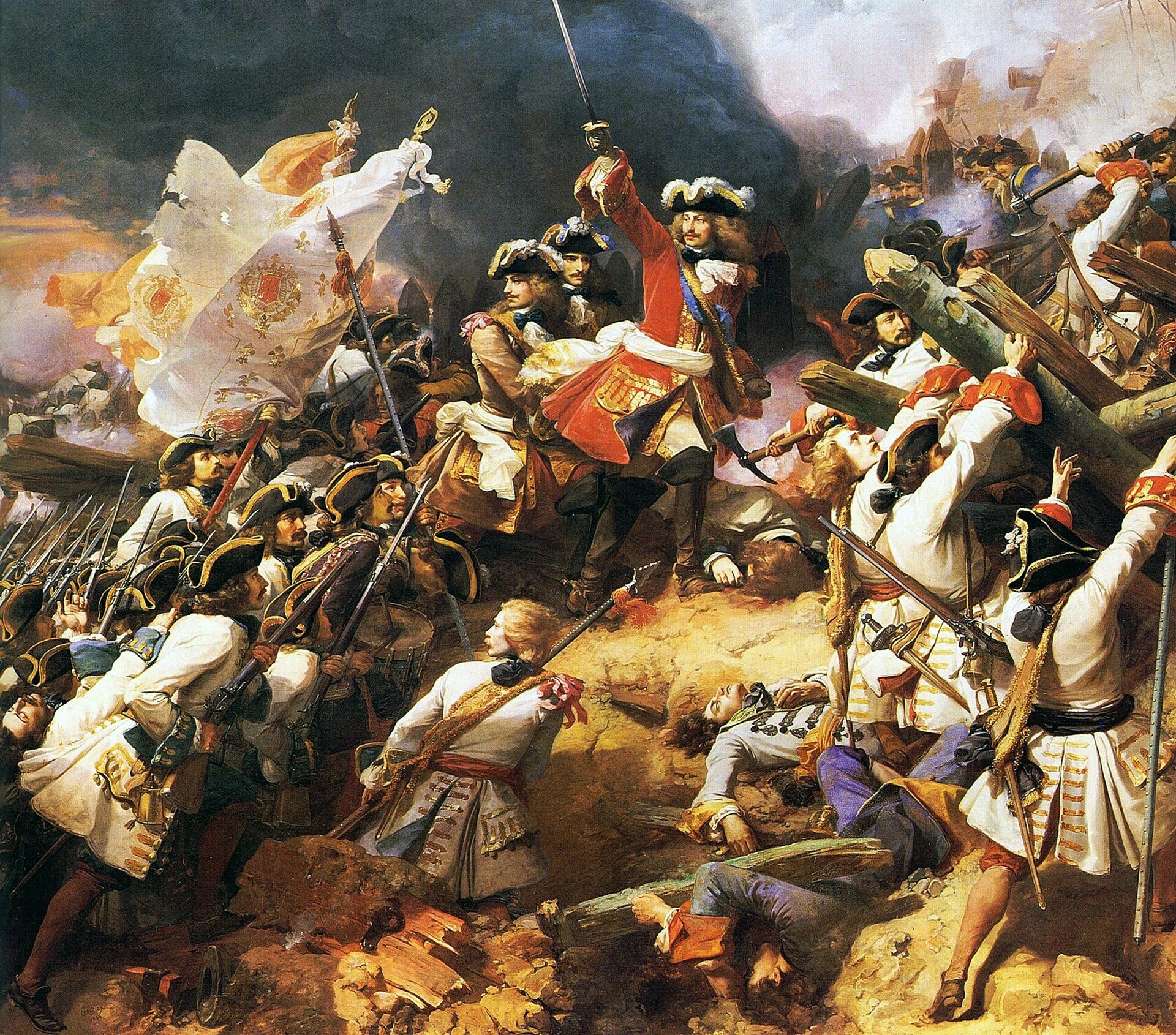
The War of the Spanish Succession, 1701–1714
The last and longest war of the reign: thirteen years, a European coalition, four catastrophic defeats — and a peace that gave France's enemy's throne to the king's grandson.
The prize
Charles II of Spain died childless in November 1700. His will named Philip, Duke of Anjou — Louis XIV’s second grandson, sixteen years old — as heir to the entire Spanish empire. Louis accepted the will. “The Pyrenees have ceased to exist,” he is reported to have said (Voltaire, Siècle, ch. 28). Europe heard a different sentence: a Bourbon super-state, France and Spain united, was intolerable. England, the Dutch Republic, the Emperor, and Savoy formed the Grand Alliance.
The disasters
The Alliance’s commanders — Marlborough and Prince Eugene — dismantled French arms in a sequence of catastrophes:
- Blenheim (13 August 1704): the Franco-Bavarian army destroyed; Bavaria knocked out of the war.
- Ramillies (23 May 1706): the Spanish Netherlands lost.
- Oudenarde (11 July 1708): invasion of France itself became possible.
- Malplaquet (11 September 1709): technically a French withdrawal in good order, but the bloodiest battle of the century — and France could not afford another.
The winter of 1709 — the Grand Hiver — froze France while the armies bled it. Louis sued for peace; the Allies’ terms (including that he depose his own grandson) were impossible, and the war went on.
Denain and the turn
In 1712 the political ground shifted: England, exhausted and under a Tory ministry, opened separate talks. At Denain (24 July 1712) Marshal Villars — whom Louis had sent to save the north — crushed the Austrian forces and broke the siege logic of the war. France could negotiate from strength it had not held in a decade.
Utrecht
The Treaty of Utrecht (1713), with Rastatt and Baden (1714) completing it: Philip V kept the Spanish throne, but renounced for himself and his descendants all rights to the French crown; France ceded Newfoundland, Acadia, and Hudson Bay territories to England and commercial concessions; the Spanish Netherlands passed to Austria. It was a compromise peace — and a Bourbon triumph wrapped inside a French exhaustion.
The cost
The war left France bankrupt, its armies bled, its peasantry starving — and the succession in ruins: the Grand Dauphin, Burgundy, and Brittany all died in 1711–12, leaving a five-year-old heir. Louis’s last war secured his dynasty’s greatest prize and destroyed everything that was supposed to sustain it.
Source notes
- Charles II d. November 1700; Blenheim 13 August 1704; Ramillies 23 May 1706; Oudenarde 11 July 1708; Malplaquet 11 September 1709; Denain 24 July 1712; Utrecht 1713; Rastatt/Baden 1714 — standard record (2026-09-26).
- “Il n’y a plus de Pyrénées”: reported by Voltaire (see sayings.md) — flagged as reported.
- The Grand Hiver of 1709 is documented in contemporary accounts.