Biography
From the "God-given" child of Saint-Germain-en-Laye to the deathbed at Versailles, 5 September 1638 – 1 September 1715.
The miracle child (1638–1643)
Louis was born on 5 September 1638 at the château of Saint-Germain-en-Laye, after twenty-two childless years of the marriage of Louis XIII and Anne of Austria. Baptized Louis-Dieudonné — “God-given” — he was the answer to a kingdom’s prayers, and his birth was treated as providential. A brother, Philippe, Duke of Orléans (later “Monsieur”), followed in 1640.
Louis XIII died on 14 May 1643. The king’s will had provided for a regency council to check Anne of Austria; five days later the Parlement of Paris set it aside and gave the regency to the queen mother alone. She governed with Cardinal Mazarin — the Italian diplomat who had entered French service under Richelieu — as chief minister.
Regency and the Fronde (1643–1653)
The regency’s first great victory came five days after Louis XIII’s death: on 19 May 1643 the 21-year-old Duke of Enghien (the future Grand Condé) destroyed the Spanish army at Rocroi. But victory abroad bred fiscal pressure at home, and from 1648 the kingdom revolted.
The Fronde (1648–1653) — first of the Paris Parlement, then of the princes — forced the court to flee Paris in January 1649, and again the royal family fled the capital on the night of 9–10 February 1651, the young king bundled into a carriage while the Frondeurs occupied the city. Louis was twelve. He never forgot it: the humiliation of a king fleeing his own capital became the founding trauma of his absolutism. Mazarin was twice exiled and twice returned; by 1653 the Fronde was broken, its leaders defeated or pardoned.
The young king takes power (1653–1661)
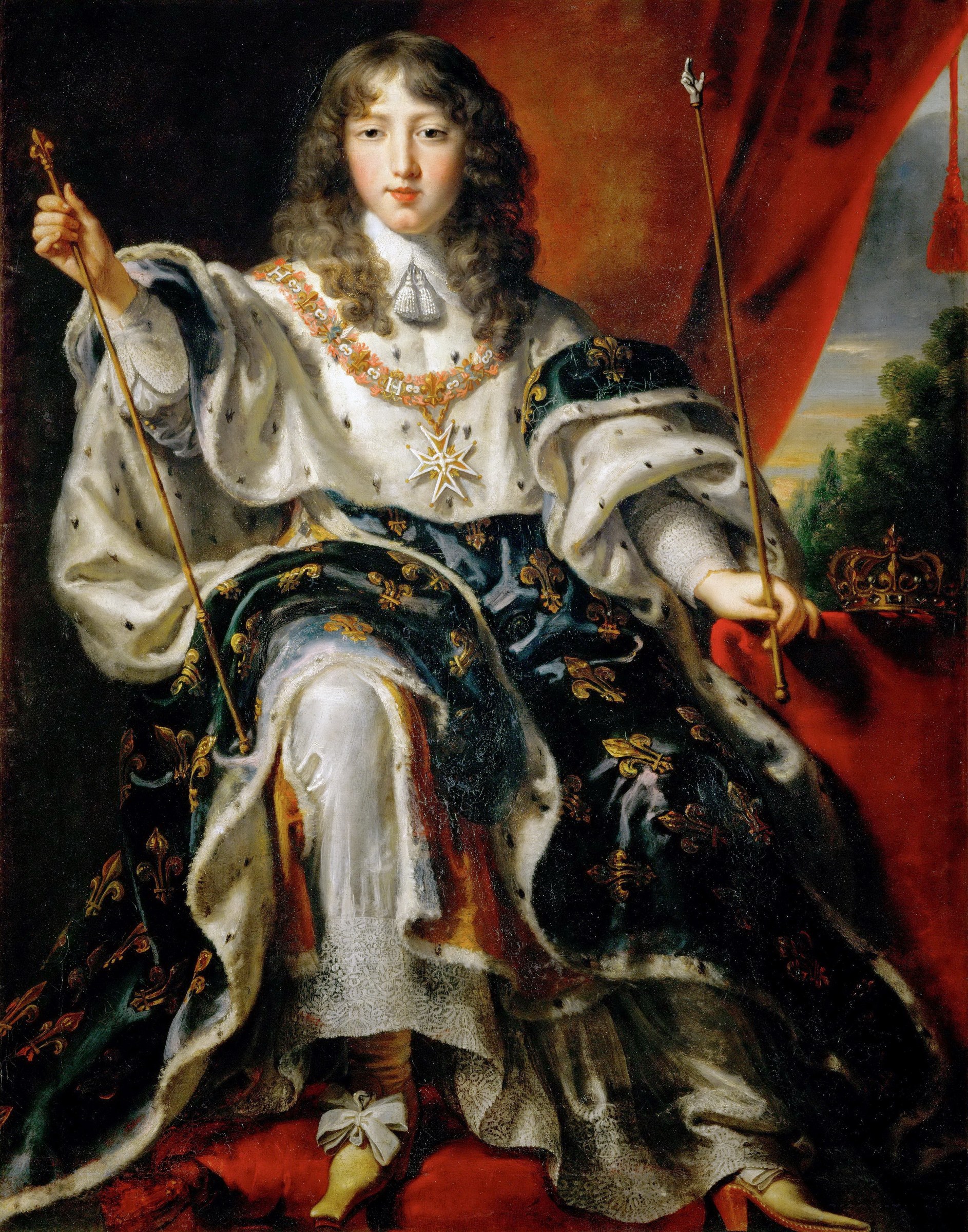
Louis was declared of age at thirteen in 1651 and crowned at Reims on 7 June 1654, but Mazarin continued to govern. The war with Spain ended with the Treaty of the Pyrenees (7 November 1659), sealed by Louis’s marriage to the Spanish infanta Maria Theresa on 9 June 1660 at Saint-Jean-de-Luz. Of their six children, only Louis, the Grand Dauphin (born 1661), survived to adulthood.
When Mazarin died on 9 March 1661, Louis — twenty-two — stunned the council by announcing that he would be his own first minister, governing with a small circle of secretaries of state and meeting the council daily. The personal reign had begun. Its first acts were a purge: on 5 September 1661 the finance minister Nicolas Fouquet was arrested at Nantes on Colbert’s prompting, his spectacular downfall a warning to every grandee. Jean-Baptiste Colbert took charge of the finances.
The great middle reign (1661–1685)
These were the years of construction — of the state and of Versailles. Colbert rebuilt the finances, the navy, and industry; Louvois and Le Tellier rebuilt the army; the legal codes (the civil ordinance of 1667, the criminal ordinance of 1670) systematized royal justice; intendants carried the king’s will into the provinces. The War of Devolution (1667–68) and then the Dutch War (1672–78, ended by the Treaty of Nijmegen) made France the arbiter of Europe.
At court, the king danced (famously as Apollo, the Sun, in the Ballet royal de la nuit of 1653 — the origin of his solar emblem, formally adopted around 1662), hunted, and presided over a culture that Europe imitated. Molière, Racine, Lully, and Le Brun worked in his orbit. Versailles — bought as a hunting lodge by his father — rose under Le Vau, Mansart, and Le Nôtre into a palace; the court moved there permanently in 1682, and the Hall of Mirrors was completed in 1684.
Maria Theresa died in 1683. Louis then contracted a secret, morganatic marriage with Françoise d’Aubigné, Madame de Maintenon — the exact date is uncertain (conventionally placed in the winter of 1683–84). The same year Colbert died. The reign’s hinge had turned.
The Revocation and the turn to war (1685–1697)
On 18 October 1685 (registered 22 October) Louis signed the Edict of Fontainebleau, revoking the Edict of Nantes (1598) that had granted French Protestants religious freedom. Protestant worship was banned, ministers exiled, children to be raised Catholic; the dragonnades — the billeting of troops on Huguenot households — had already begun in 1681. Some 200,000 or more Huguenots fled France. See the Revocation.
The Revocation helped unite Europe against him. The War of the League of Augsburg (the Nine Years’ War, 1688–97) ended at Ryswick (1697) with France exhausted but intact. Louis’s domestic absolutism reached its doctrinal peak with the Declaration of the Clergy of France (1682) — the Four Gallican Articles — and his long conflict with Rome.
The Spanish Succession and the twilight (1700–1715)
When the childless Charles II of Spain died in November 1700, his will named Louis’s grandson Philip, Duke of Anjou, as heir. Louis accepted — “Il n’y a plus de Pyrénées,” he is reported to have said (Voltaire, Le Siècle de Louis XIV, ch. 28). Europe would not accept a Franco-Spanish union: the War of the Spanish Succession (1701–1714) followed. The early disasters (Blenheim 1704, Ramillies 1706, Oudenarde 1708, Malplaquet 1709) were redeemed by Villars’s victory at Denain (1712); the Treaties of Utrecht (1713) and Rastatt/Baden (1714) left Philip V on the Spanish throne but renouncing his French succession rights.
The last years were a litany of deaths: the Grand Dauphin (1711), the Duke of Burgundy and his wife (1712), their elder son the Duke of Brittany (1712). The succession fell to a sickly five-year-old great-grandson. In August 1715 the king’s leg developed gangrene. On 26 August he received his heir and spoke the words reported by Saint-Simon and Dangeau — “do not follow the bad example I have set you.” He died at Versailles on 1 September 1715, around a quarter past eight in the morning, aged 76. The regency passed to his nephew, Philippe, Duke of Orléans.
Source notes
- Birth, parentage, baptismal name, death date and place, and the regnal dates are the standard documented record (see sources.md; 2026-09-26).
- Rocroi 19 May 1643; flight of 9–10 February 1651; coronation 7 June 1654; Treaty of the Pyrenees 7 November 1659; marriage 9 June 1660; Mazarin d. 9 March 1661; Fouquet arrested 5 September 1661; court to Versailles 1682; Hall of Mirrors 1684; Edict of Fontainebleau 18/22 October 1685; Ryswick 1697; Utrecht 1713.
- The secret marriage to Maintenon is dated conventionally to winter 1683–84; the exact date is not documented — labeled uncertain (see people.md).
- Deathbed scene: Saint-Simon, Mémoires; Dangeau, Journal (entry 26 August 1715) and Mémoire sur la mort de Louis XIV. The time of death (~8:15 a.m.) is reported in contemporary accounts.