The Death of 1715 and the Succession
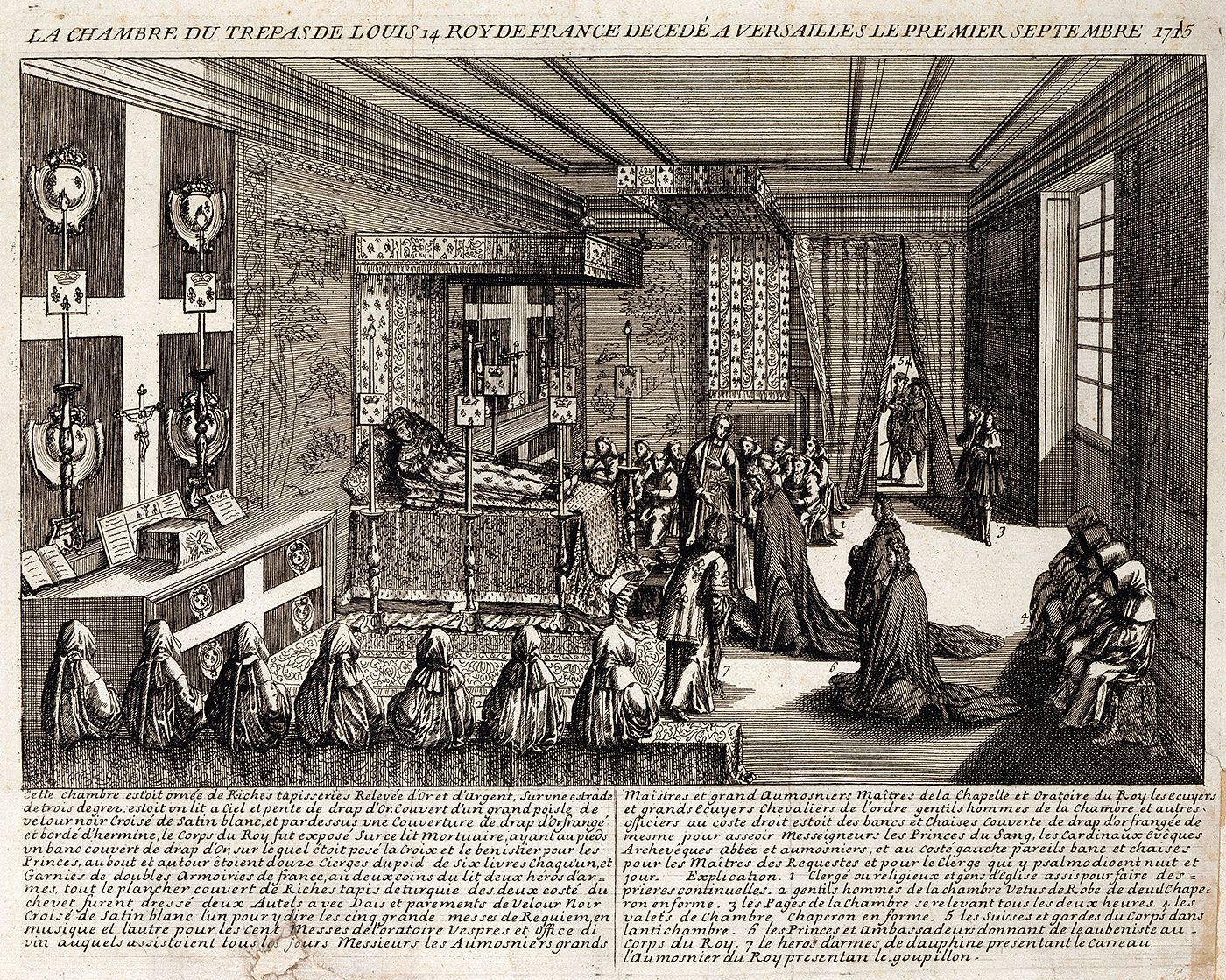
He had reigned for 72 years and 110 days. In August 1715 his leg began to die, and the longest reign in European history ended in a bedroom at Versailles.
The dying
Returning from Marly on 10 August 1715, Louis complained of a violent pain in his left leg. The doctors called it sciatica; by 24 August the surgeon Fagon recognized gangrene, already risen past the knee. The king understood: he confessed to Père Le Tellier, received extreme unction on the evening of 25 August — the feast of Saint Louis, his name-day — and dined in public the next day, telling those who urged him to rest: “I have lived among the people of my court; I wish to die among them.”
The farewells
On 26 August the dying king received his five-year-old great-grandson and heir — the future Louis XV — at his bedside. Saint-Simon and Dangeau both report the scene: the king told the child not to follow the bad example he had set — not to imitate his taste for war and building, but to be a peaceful prince and relieve his subjects. “Ne suivez pas le mauvais exemple que je vous ai donné.” (See sayings; the fuller wording varies between the two accounts.)
He took leave of Madame de Maintenon, of the court, of his servants. Dangeau’s Mémoire sur la mort de Louis XIV records his last documented maxim: “Je m’en vais, mais l’État demeurera toujours” — I am going away, but the State will always remain.
The death
Louis XIV died at Versailles on 1 September 1715, in the morning (contemporary accounts place it around a quarter past eight), aged 76. He had reigned 72 years and 110 days — a record no European monarch has matched. The body was taken to Saint-Denis; the funeral was held on 9 September. The Te Deum of the regency was sung over a bankrupt kingdom.
The succession
The deaths of 1711–1712 had cleared the field with terrible thoroughness:
- 14 April 1711 — Louis, the Grand Dauphin, of smallpox;
- 18 February 1712 — Louis, Duke of Burgundy (the Dauphin’s son), of measles;
- 24 February 1712 — Marie-Adélaïde of Savoy, Burgundy’s wife;
- 8 March 1712 — Louis, Duke of Brittany, their elder son, aged five.
The heir was their younger son: Louis, Duke of Anjou, born 1710 — five years old, sickly, the king’s great-grandson. Louis XIV’s will had tried to constrain the coming regency, shackling his nephew Philippe, Duke of Orléans, with a regency council. Within days of the king’s death, the Parlement of Paris set the will aside and made Orléans sole Regent. The Régence (1715–1723) began as a deliberate reaction against everything the old king had built.
The legend begins
Within a generation Voltaire was writing the Siècle; within a century Lémontey was inventing “L’état, c’est moi.” The deathbed’s real words — restraint, regret, the state outliving the man — were quietly filed away while the invented ones conquered the world.
Source notes
- Illness timeline: pain from 10 August, gangrene recognized 24 August, extreme unction evening of 25 August, death morning of 1 September 1715 — per Dangeau’s Journal and Mémoire sur la mort de Louis XIV, and the Versailles palace’s documented account (2026-09-26).
- The public-dinner remark (“j’ai vécu parmi les gens de ma cour…”) is reported in a contemporary letter of 28 August 1715.
- Words to the heir (26 August): Saint-Simon, Mémoires; Dangeau, Journal — wording varies, flagged on sayings.md.
- “Je m’en vais, mais l’État demeurera toujours”: Dangeau, Mémoire, p. 24.
- Heirs’ death dates April 1711–March 1712; the will set aside for Orléans’s sole regency — standard record.