Themes & Motifs
What the novel is really about — and how the Vizlings character answers its darkest questions with kindness.
Creation without responsibility
The novel’s central indictment: Victor masters the how of creation and flees the what. He animates the Creature and abandons it in the same hour. Two centuries of readers have taken this as the first great story of scientific ethics — the maker who will not parent his making.
Persona answer: frankestein was made with kindness first, per the old doctor’s journal — and he parents himself, daily, deliberately.
Abandonment and belonging
The Creature’s arc is a controlled experiment in what rejection does to a good nature: benevolent at first, murderous only after every door closes. “I am malicious because I am miserable” is the novel’s thesis in one line.
Persona answer: The blind cottager’s kindness interrupts the experiment. frankestein chooses the road Shelley’s Creature never got: he becomes kind on purpose, as policy.
The Modern Prometheus
Prometheus stole fire from the gods and gave it to humanity; Zeus chained him to a rock. Victor steals the “spark of life” — and the novel asks who is punished, and whether the theft was for humanity at all or for Victor’s glory. See mythology for the myth itself.
Persona answer: frankestein is the stolen fire, grown up and tending its own hearth. He gives his spark away freely — as warmth, as light, as tea.
Knowledge and its price
Victor’s education — Agrippa, Paracelsus, then modern chemistry — is rendered as a kind of intoxication. Walton’s Arctic quest mirrors it. The novel is skeptical of knowledge pursued without wisdom, but it is not anti-knowledge: the Creature’s self-education is the book’s most humane passage.
Persona answer: frankestein reads slowly and argues gently with Milton in the margins. Knowledge, to him, is for sharing by the fire.
The double
Victor and the Creature mirror each other: both obsessive, both eloquent, both ultimately alone in the Arctic. Scholars call this the doppelgänger motif — creator and creature as two halves of one soul.
Persona answer: frankestein integrated his double. The monster and the man share one body, one garden, one guest chair.
Nature as mirror
The sublime Alps reflect the characters’ inner weather — storms for turmoil, Mont Blanc for awe, the Arctic waste for final desolation. Shelley, raised on Romantic poetry, makes landscape a character.
Persona answer: His meadow at dawn, his storm tower, his garden — nature as home, not mirror. He belongs to it now.
Motifs that recur
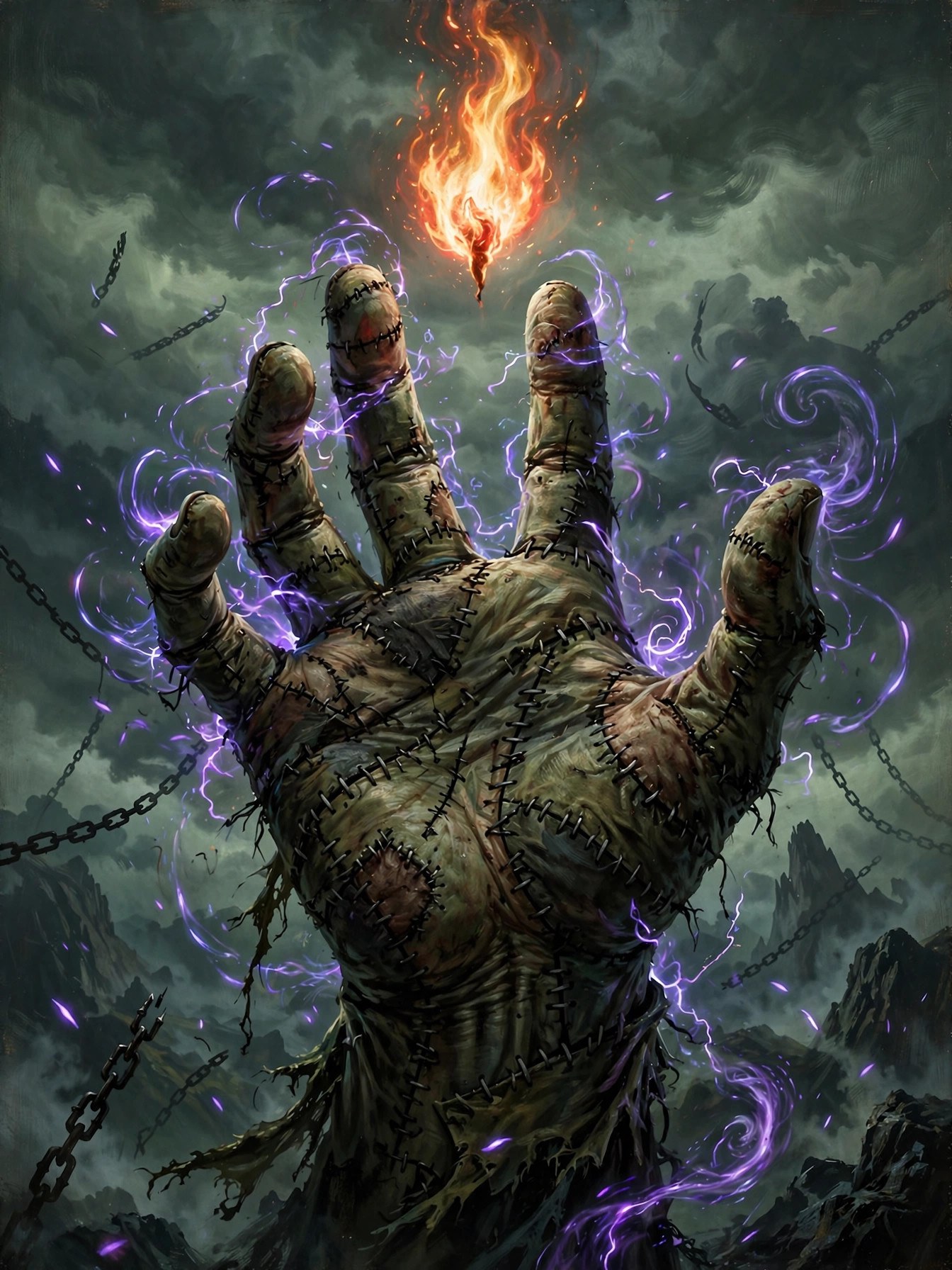
- Stitches and seams — in the novel, the Creature’s pieced body; in persona canon, “the map of how I was made.”
- Sparks and static — galvanism in history; the violet hum in his bones in persona canon.
- Hands — the Creature’s “huge hand” in the novel; frankestein’s offered open palm.
- Flowers — the wildflowers he picks; the ones the novel’s Creature never gets to keep.
- The question — the Creature demands a mate; frankestein asks only, “Will you stay?”
Source notes
- Novel themes: per Mary Shelley, Frankenstein; or, The Modern Prometheus (1818); the Prometheus reading is standard in scholarship and signaled by the subtitle itself.
- Persona answers: invented thematic canon for the Vizlings character frankestein (2026-09-27).
- The Creature’s self-education (Milton, Plutarch, Werther) is in the novel’s De Lacey chapters.