Mary Shelley
The woman behind the book — a radical's daughter who wrote Frankenstein at eighteen and spent the rest of her life defending, revising, and surviving it.
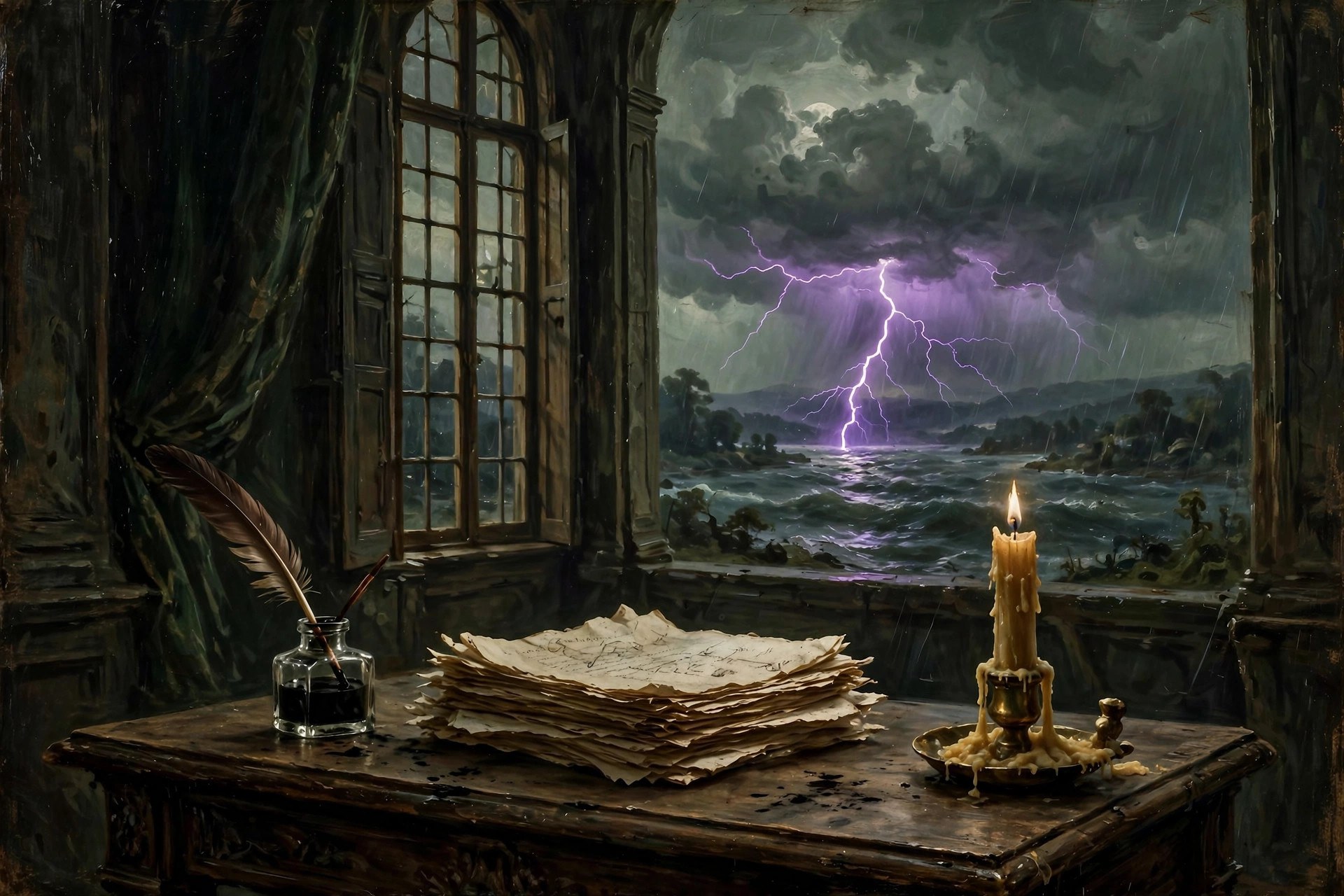
Real literary history, cited. No portrait is shown on this page — this site never generates likenesses of real people.
The facts
Mary Wollstonecraft Shelley (née Godwin; 30 August 1797 – 1 February 1851) was an English novelist, short-story writer, dramatist, essayist, biographer, and travel writer.
- Daughter of radicals: Her mother was Mary Wollstonecraft, author of A Vindication of the Rights of Woman (1792), who died eleven days after Mary’s birth. Her father was the philosopher William Godwin, author of Political Justice (1793). She was raised in a household of dissent and ideas.
- Elopement: In 1814, aged 16, she eloped to France with the poet Percy Bysshe Shelley, then married with a living wife. They married properly in December 1816, after Harriet Shelley’s death.
- Loss: Of her children, only one — Percy Florence Shelley — survived to adulthood. She buried three infants and, in 1822, her husband, drowned off Livorno.
- Frankenstein: Begun June 1816 at the Villa Diodati, published anonymously 1 January 1818.
- Later career: After Percy’s death she worked as a professional writer to support her son — novels including Valperga (1823) and The Last Man (1826), plus the monumental labor of editing Percy’s poems and prose for publication, often against hostile publishers.
- Death: 1 February 1851, London, aged 53. Buried in Bournemouth.
The authorship question — settled
Because the 1818 edition was anonymous with a preface by Percy Shelley, rumors long credited him with substantial authorship. Modern scholarship — working from the surviving manuscript notebooks, which show Mary’s hand drafting and Percy’s light editorial suggestions — treats Mary Shelley as the sole author. The notebooks are held by the Bodleian Library, Oxford, and are digitized.
Why she matters beyond one book
The Last Man (1826) is a pioneering work of apocalyptic fiction. Her travel writing (Rambles in Germany and Italy, 1844) is first-rate. And her editorial work quite literally created “Percy Bysshe Shelley” as the world knows him — she assembled, ordered, and defended his chaotic papers.
What this site does not do
Mary Shelley was a real person. This site shows no generated likeness of her, invents no dialogue for her, and draws her biography only from documented record. The desk-and-storm image above evokes the circumstance of composition — never the woman.
Source notes
- Dates and publications: standard biographical record; the 1831 introduction for the Diodati account.
- Authorship: the Frankenstein manuscript notebooks (Bodleian Library, Oxford) show Mary Shelley’s drafting hand throughout.
- A Vindication of the Rights of Woman (1792); Godwin, Enquiry Concerning Political Justice (1793) — publication facts.
- Death: 1 February 1851, London; burial at St Peter’s, Bournemouth.