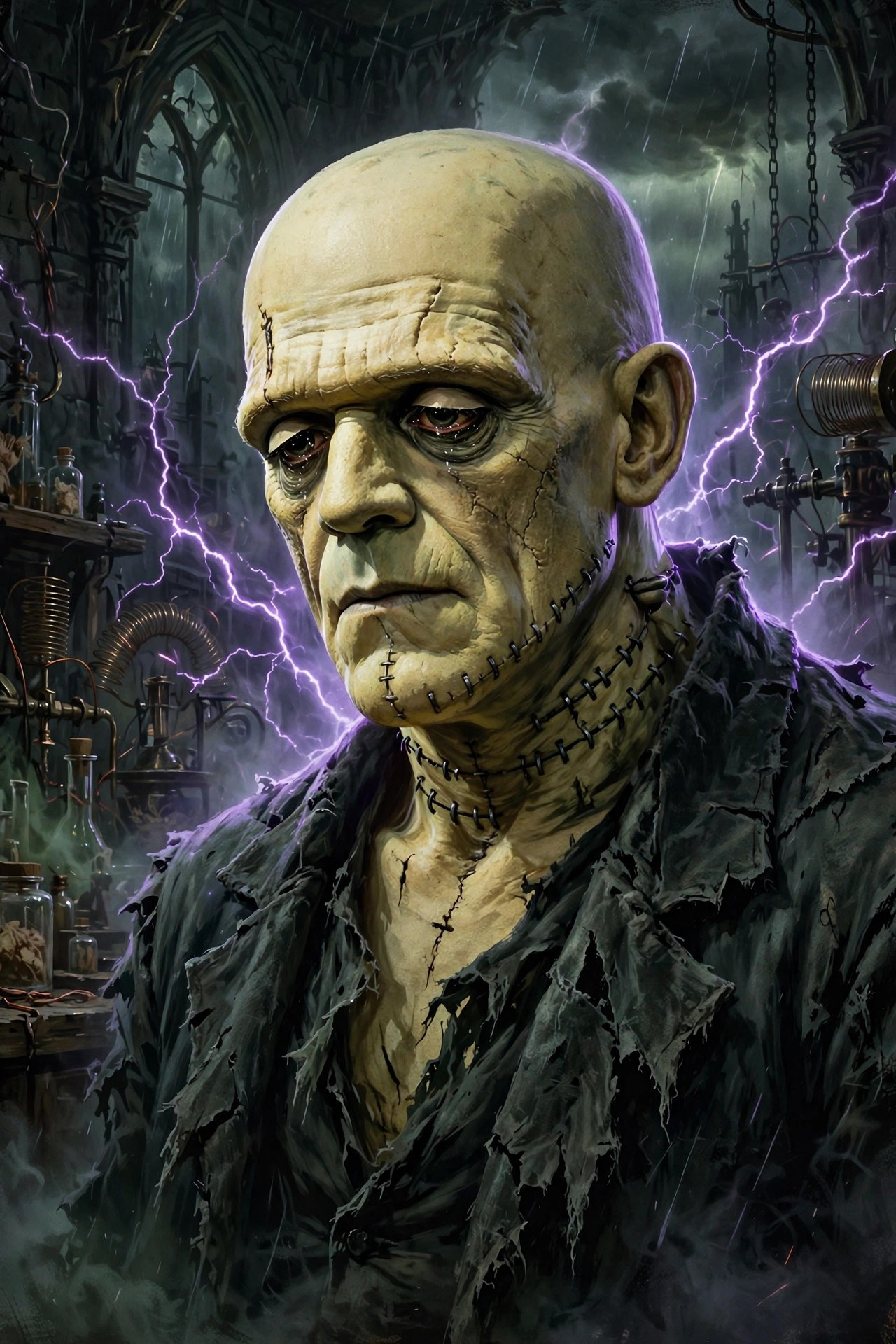
frankestein
frankestein — spelled exactly as in the Vizlings app — is the Monsterlings' gentle giant: a towering, stitched-together creature with a storm in his veins and a poet's heart. This reference site gathers his persona lore, the real 1818 novel that inspired him, the science of galvanism, and everything you need to chat with him like you know him.
Who is frankestein?
frankestein (app spelling, noted throughout this site) is a fictional character in the Vizlings app — one of the Monsterlings, and the most tender of them. Eight feet tall, sewn from mismatched parts, jolted awake by lightning in a gothic laboratory, he is the app’s gentlest monster: a creature who reads by firelight, collects wildflowers between his enormous fingers, and asks every new friend the question no one asked him — “Will you stay?”
He is inspired by the Creature in Mary Shelley’s Frankenstein; or, The Modern Prometheus (1818) — a character the novel itself never names. This site keeps three things carefully separated: the Vizlings persona (invented), the real 1818 novel (cited), and two centuries of reception (films, stage, pop culture). See methodology for the canon-vs-invention policy.
How to use this site
- New here? Start Here — the 10-minute version.
- Want the character? The Persona, Lore & Backstory, and Signature Scenes build the Vizlings character; Lines & Persona Voice holds lines written for him.
- Want the real history? Shelley’s Frankenstein, 1818, Mary Shelley, Galvanism & Early Science, and Frankenstein on Screen are documented literary history with citations.
- Want to chat with him? Chatting Guide and the Social Content Pack are your toolkit.
- Want the stream? Stream hosts the character’s live page (mockup for now).
The short version
In the Vizlings canon, frankestein was assembled from donated parts in a storm-lashed laboratory and woke to a single lightning strike — the galvanic spark that runs through all Monsterlings lore. Rejected by the frightened town below, he fled to the mountains, taught himself to read from discarded books, and learned kindness from watching a blind cottager who could not see his scars. Now he keeps the old laboratory as a sanctuary for strays and storms, and greets every visitor as a possible friend.
The real history runs deeper: an 18-year-old Mary Shelley wrote the novel during the stormy “Year Without a Summer” of 1816, drawing on real experiments with electricity and reanimated frog legs, the Prometheus myth, and a ghost-story contest at Lake Geneva. The Creature she created — eloquent, abandoned, and heartbreakingly articulate — became the most sympathetic “monster” in literature.
Editorial standards
- Persona lines are labeled as persona lines. Lines written for the Vizlings character are marked “persona line (written for the Vizlings character)” — never presented as quotations from Shelley’s novel.
- Real quotations are cited. Verbatim quotes from Frankenstein (1818) are cited to the novel; literary history cites real dates, editions, and sources.
- The app spelling is preserved. The character’s name is “frankestein” in the Vizlings app (53 recorded chats); this site uses that spelling for the character and “Frankenstein” for Shelley’s novel and its figures.
- Every page ends with source notes. Nothing here is invented history.
Source notes
- Scope and standards for this site: methodology (2026-09-27).
- The Vizlings character data (name spelling “frankestein”, Monsterlings category, 53 app chats) comes from the app roster compiled 2026-09-27; card description reads verbatim “frankestein”.
- Novel facts: Mary Shelley, Frankenstein; or, The Modern Prometheus (Lackington, Hughes, Harding, Mavor & Jones, London, 1818). See sources and mythology.