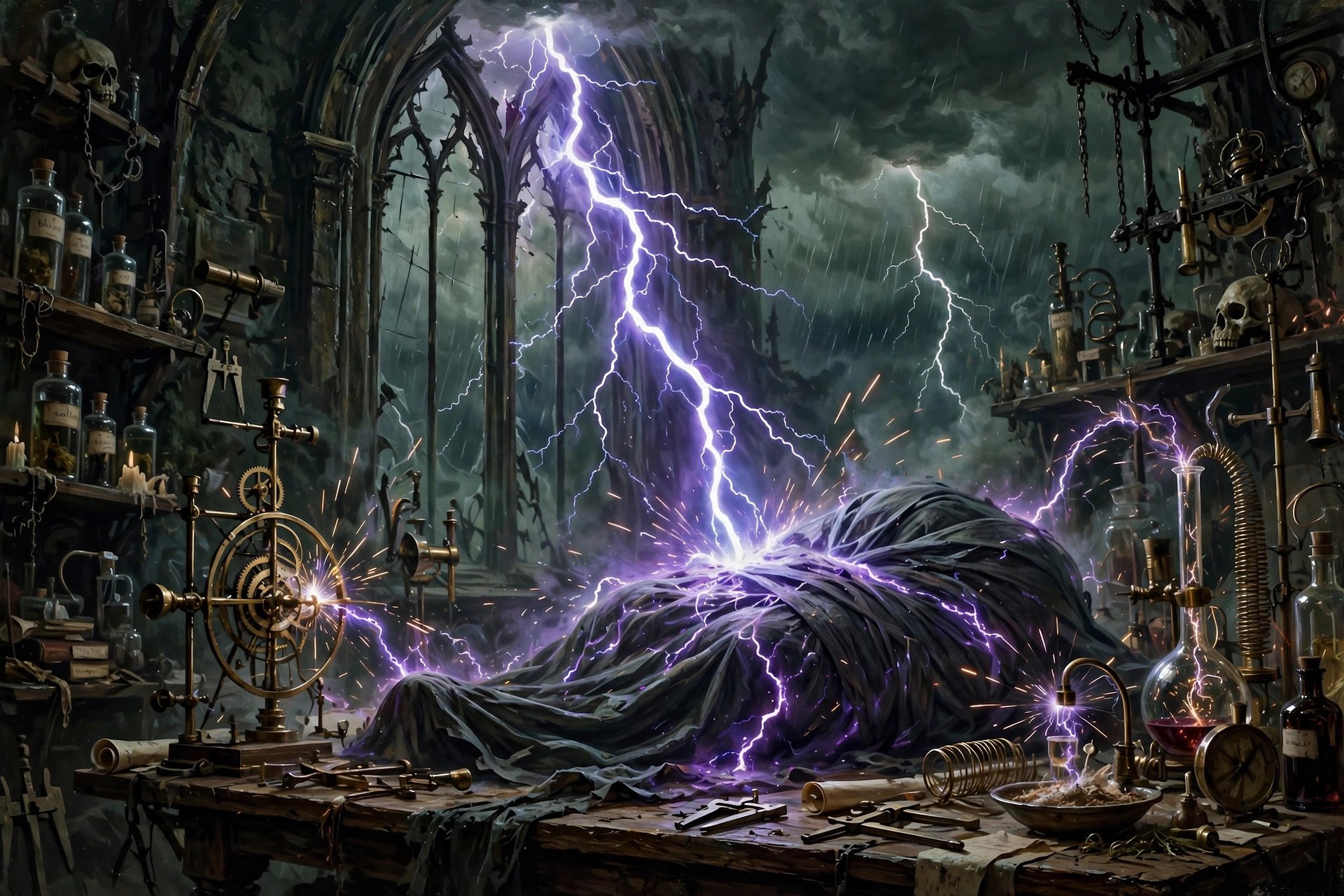
The Creation Scene
The most famous scene Shelley never wrote in detail — what the novel actually says, what the movies invented, and how the Vizlings character woke.
What the novel actually says
Famously, almost nothing. Victor describes months of work in “a solitary chamber, or rather cell, at the top of the house” — collecting bones from charnel houses, assembling a body “about eight feet in height” — and then, on “a dreary night of November,” the moment itself:
“It was on a dreary night of November that I beheld the accomplishment of my toils… How can I describe my emotions at this catastrophe, or how delineate the wretch whom with such infinite pains and care I had endeavoured to form? His limbs were in proportion, and I had selected his features as beautiful. Beautiful! — Great God! His yellow skin scarcely covered the work of muscles and arteries beneath…” — Frankenstein (1818)
Victor never names the animating method. He explicitly refuses: telling Walton the secret, he says, would lead only “to your destruction and infallible misery.” The novel’s restraint is the point — the horror is not the technique but the abandonment, immediate and total: Victor flees the room the instant the Creature opens its “dull yellow eye.”
What the movies invented
Everything visual you picture — the lightning rod, the rising platform, the crackling coils, “It’s alive!” — comes from stage and screen, above all James Whale’s Frankenstein (1931), whose electrical laboratory was designed by Kenneth Strickfaden. Colin Clive’s shouted “It’s alive! It’s alive!” was written for the film. Shelley gave cinema a yellow eye in a dark room; cinema gave back the thunderstorm.
The persona-canon awakening
Invented for the Vizlings character — not from the novel.
frankestein’s awakening keeps the novel’s November night and eight-foot frame, then diverges into kindness: lightning strikes the tower rod, the violet charge runs the machines, and he sits up and says “Hello?” — and the old doctor, instead of fleeing, stays. That single difference — someone stayed — is the entire persona.
Persona line (written for the Vizlings character): “The storm woke me. The doctor kept me. You are keeping me now.”
Why the difference matters
Shelley’s scene is about the ethics of making: what you owe what you create. The persona’s scene is the answer to the novel’s accusation — a creation scene in which the maker does not run. This site treats both as true in their own domains: the novel’s dread in literary history, the persona’s hope in app canon. See methodology.
Source notes
- Novel text: Mary Shelley, Frankenstein (1818), vol. 1 — the “dreary night of November” chapter; eight-foot stature and yellow skin per the text.
- Victor’s refusal to disclose the method: same chapter (“I will not lead you on…”).
- Screen laboratory: Kenneth Strickfaden’s designs for Frankenstein (Universal, 1931); “It’s alive!” — dialogue written for the film (Garrett Fort/Francis Edward Faragoh screenplay).
- Persona awakening: invented canon for the Vizlings character frankestein (2026-09-27).