Galvanism & Early Science
The true story is stranger than the novel: dead frogs that kicked, executed criminals made to grimace, and a scientific feud that electrified Europe.
Galvani’s frogs
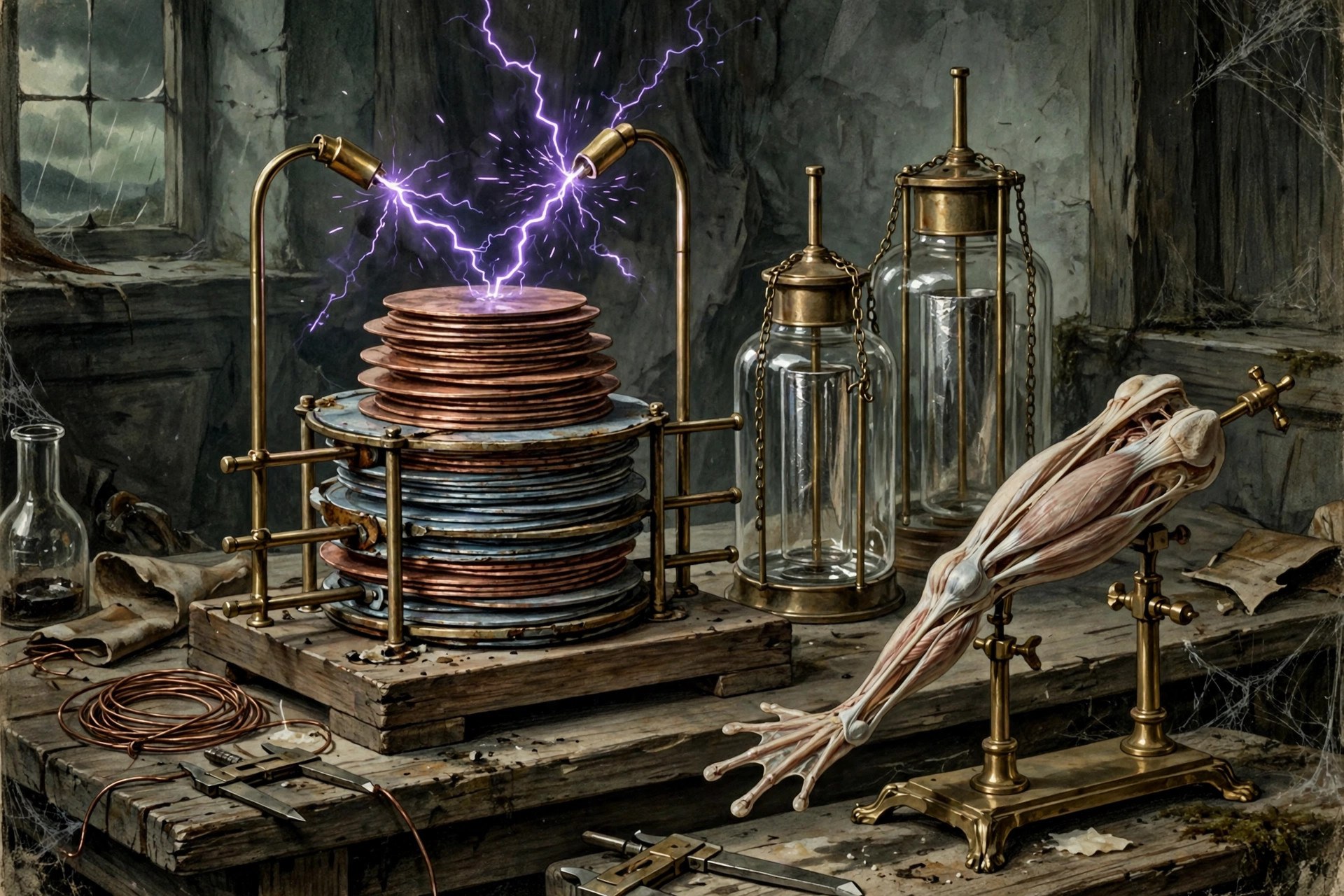
In the 1780s, the Bolognese physician Luigi Galvani (1737–1798) found that a dead frog’s legs twitched when touched by two different metals, or when a spark was applied. He concluded that animal tissue contained an intrinsic “animal electricity.” His De viribus electricitatis in motu musculari commentarius (1791) electrified Europe — pun intended — and gave the phenomenon its name: galvanism.
Volta’s answer
Alessandro Volta (1745–1827) argued the electricity came from the metals, not the animal — and proved it by building, in 1800, the voltaic pile: alternating discs of zinc and copper separated by brine-soaked cloth, the first true electric battery. The pile could deliver a continuous current, and experimenters across Europe promptly applied it to everything, including corpses.
Aldini’s corpses
Galvani’s nephew Giovanni Aldini (1762–1834) took galvanism on tour. His public demonstrations applied voltaic current to the bodies of executed criminals:
- London, January 1803: At the Royal College of Surgeons, Aldini applied current to the corpse of the hanged murderer George Forster. Witnesses reported the jaw quivering, facial muscles contorting into a grimace, one eye opening — “the appearance of re-animation.” Members of the audience fainted; one reportedly died of fright (a story often repeated, never verified — reported, not confirmed).
- He had performed similar demonstrations in Bologna, Paris, and elsewhere from 1801 onward.
Whether Mary Shelley knew of Aldini specifically is probable but not certain — she certainly moved in circles (through Percy Shelley and her father’s friends) where galvanism was dinner-table talk, and her 1831 introduction names the “philosophical” discussions of the Diodati summer as the novel’s seed.
The vermicelli anecdote
In her 1831 introduction, Shelley recalls talk of Erasmus Darwin (1731–1802), who “had preserved a piece of vermicelli in a glass case, till by some extraordinary means it began to move with voluntary motion.” The story — likely garbled in transmission — shows how close the era’s science felt to spontaneous animation.
What it meant
Galvanism sat exactly on the border Shelley needed: reputable, cutting-edge, and genuinely uncanny. Dead tissue did move under current. The gap between a twitching frog leg and a living man seemed, in 1816, like an engineering problem. The novel’s refusal to explain Victor’s method is honest — no one knew where the border was.
The persona’s spark room
frankestein’s laboratory keeps a voltaic pile “of two thousand discs” as its centerpiece — a nod to the real apparatus, scaled up the way gothic fiction scales everything. The violet static that crawls over his seams on stormy nights is persona invention; the pile is history.
Source notes
- Galvani: De viribus electricitatis in motu musculari commentarius (1791); frog experiments in the 1780s.
- Volta: the voltaic pile, announced 1800 (Philosophical Transactions of the Royal Society).
- Aldini: demonstrations from 1801; London, January 1803, on George Forster at the Royal College of Surgeons — contemporary newspaper and eyewitness accounts; the “audience member died of fright” coda is reported, not confirmed.
- Erasmus Darwin vermicelli anecdote: Mary Shelley’s 1831 introduction — her recollection, presented as such.
- Shelley’s knowledge of Aldini: probable but not certain (see certainty labels in methodology).