Shelley's Frankenstein, 1818
The real book behind the myth — how an 18-year-old wrote the first science-fiction novel in a stormy Swiss summer, and what happened next.
The book
Frankenstein; or, The Modern Prometheus was published anonymously in London on 1 January 1818 by Lackington, Hughes, Harding, Mavor & Jones, in three volumes. The author was Mary Wollstonecraft Shelley, née Godwin, aged 20 at publication and 18 when she began writing. The dedication is to her father, the philosopher William Godwin; the preface was written by her husband, Percy Bysshe Shelley.
The plot, in brief: Robert Walton, an Arctic explorer, rescues the dying Victor Frankenstein, a Genevan student of natural philosophy, who tells him how he assembled a living creature from dead matter at Ingolstadt, animated it, and fled in horror. The Creature — intelligent, articulate, abandoned — teaches himself language, befriends a blind cottager, demands a mate from his maker, is refused, and turns to vengeance, murdering Victor’s brother William, his friend Henry Clerval, and his bride Elizabeth. Victor pursues him to the Arctic and dies; the Creature, found mourning over the body, departs to destroy himself.
The Diodati summer
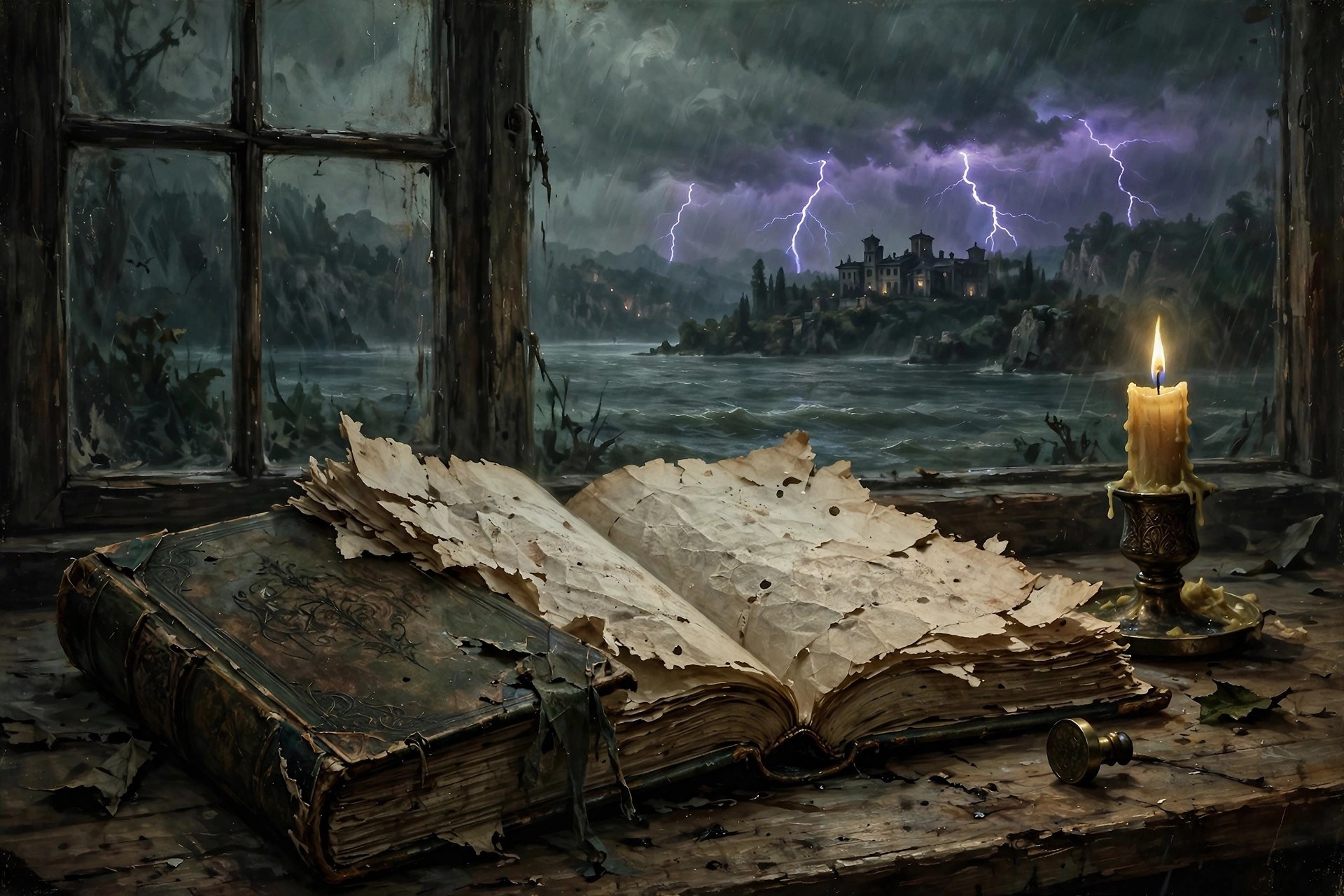
In June 1816 — the “Year Without a Summer,” after Mount Tambora’s eruption — Mary Godwin, Percy Shelley, Lord Byron, and John Polidori were confined indoors by relentless rain at the Villa Diodati on Lake Geneva. They read ghost stories aloud; Byron proposed that each write one. Polidori’s contribution became The Vampyre (1819), the founding text of vampire fiction.
Mary struggled for days, then — after a late-night conversation about galvanism, Erasmus Darwin, and whether corpses could be reanimated — had the waking dream she describes in her 1831 introduction: “I saw the hideous phantasm of a man stretched out, and then, on the working of some powerful engine, show signs of life.” She began writing the next morning.
The 1831 revision
For the Bentley’s Standard Novels edition of 1831, Shelley revised the novel substantially — softening Victor’s character, altering Elizabeth’s backstory, and adding the famous introduction recounting Diodati. For over a century this was the standard text; modern scholarship generally treats the 1818 first edition as the authoritative original, and this site quotes from it.
The Modern Prometheus — the myth
The subtitle invokes Prometheus, the Titan of Greek myth who stole fire from the gods for humanity and was chained to a rock for it (best known from Aeschylus’s Prometheus Bound). The parallel is deliberate and double-edged: Victor is the modern fire-stealer — but so, in a sense, is the Creature, who brings the “fire” of consciousness into the world and is punished for existing. The novel never resolves which of them the title names. That ambiguity is the point.
What the novel is not
- The Creature is never named “Frankenstein.” “Frankenstein” is Victor’s surname. The novel calls the creation creature, wretch, dæmon, monster.
- There is no lightning-strike lab scene in the book. Shelley deliberately withholds Victor’s method — “I will not lead you on… to your destruction.” The electrical apparatus is stage and screen invention.
- The Creature is not mute or mindless. He is one of literature’s great orators — his speeches to Victor are the novel’s rhetorical peaks.
- It is not, strictly, a horror novel. Shelley subtitled it a modern Prometheus myth; it is a philosophical novel wearing gothic dress — and arguably the first work of science fiction.
Reception
Early reviews were mixed and often hostile — The Quarterly Review called it “a tissue of horrible and disgusting absurdity” — but the book sold, was quickly pirated and staged (Presumption, 1823), and never went out of print. Two hundred years on, it is among the most taught novels in English.
Source notes
- Publication facts: imprint of the 1818 first edition (Lackington, Hughes, Harding, Mavor & Jones, 3 vols.).
- Diodati narrative: Mary Shelley’s introduction to the 1831 edition (Bentley’s Standard Novels) — attested (her own account, written 15 years later).
- 1831 revision: collation scholarship treats 1818 as the original text; this site follows that consensus.
- Prometheus: Aeschylus, Prometheus Bound; the subtitle’s reference is explicit in the 1818 title page.
- Early reception: Quarterly Review, 1818.