The Creature in Literature
The most misunderstood character in English fiction: what Shelley actually wrote, and what everyone else turned him into.
On the page
Shelley’s Creature is unnamed, eight feet tall, with yellow skin, lustrous black hair, and “watery eyes.” He is assembled from charnel-house parts and animated by undisclosed means. That is the physical inventory — and it is nearly all the novel gives.
What the novel gives in abundance is his mind. The Creature teaches himself to read from a found satchel — Milton’s Paradise Lost, Plutarch’s Lives, Goethe’s Sorrows of Werter — and his speeches to Victor are the book’s rhetorical summits:
“I am malicious because I am miserable. Am I not shunned and hated by all mankind?” — Frankenstein (1818)
“Remember that I am thy creature; I ought to be thy Adam, but I am rather the fallen angel.” — Frankenstein (1818)
He reasons, bargains, grieves, and quotes Milton. His demand — a female companion, after which he will vanish to South America — is refused, and only then does he become a murderer. The novel’s last image is the Creature on the Arctic ice, mourning over Victor’s corpse and announcing his own self-destruction.
The drift
Almost immediately, retellings simplified him:
- Stage (1823–): Presumption made him a mute, blue-skinned pantomime figure played by T. P. Cooke — the grunting monster begins here, five years after publication.
- Film (1931): Karloff’s Creature is childlike and nearly speechless; the eloquence is gone, the pathos remains.
- Hammer (1957–): The focus shifts to Baron Frankenstein; the Creature becomes a succession of interchangeable brutes.
- Parody and pop: From The Munsters to Halloween costumes, “Frankenstein” becomes the monster’s name — the misnomer Shelley never used, now universal.
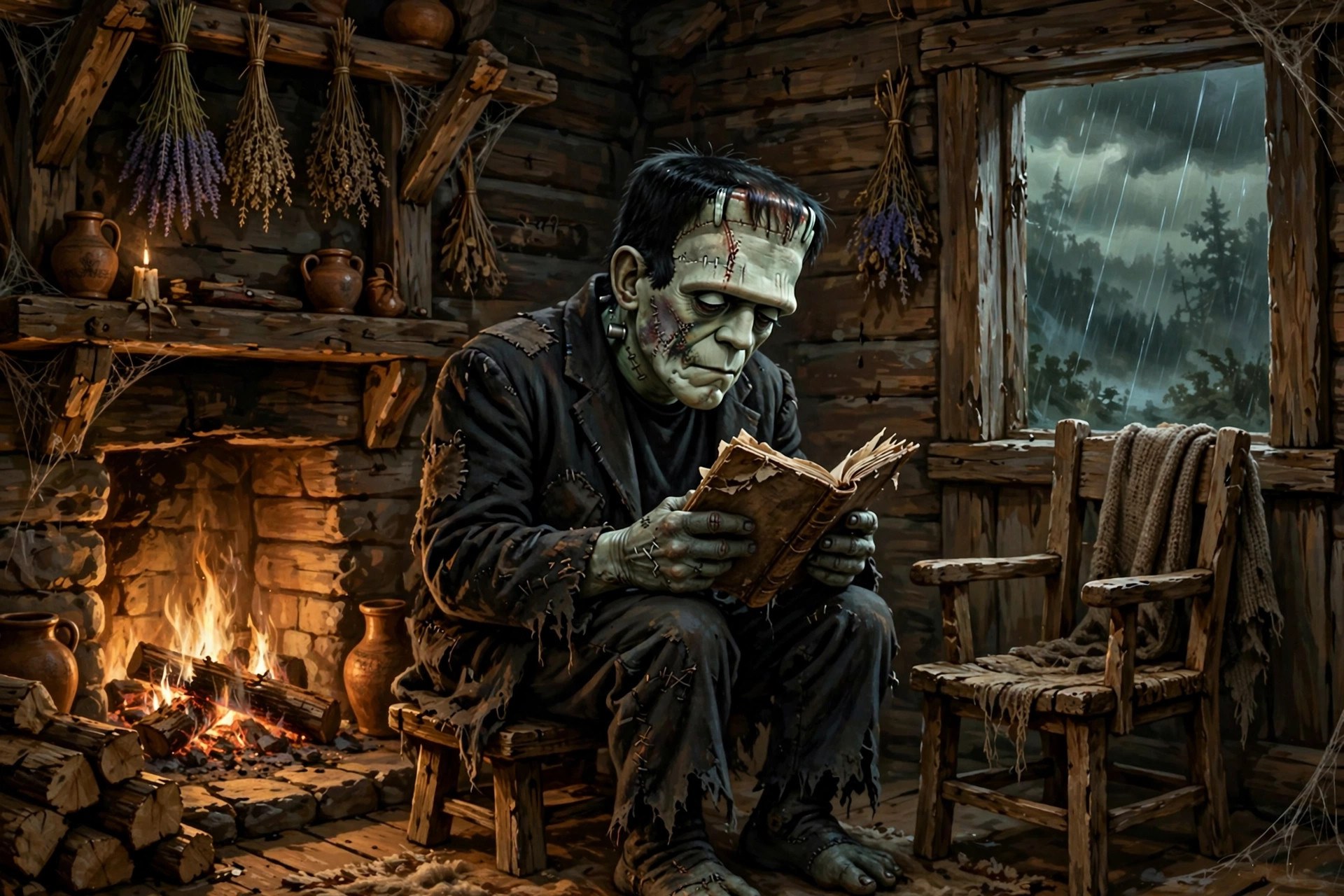
Each version keeps the silhouette and discards the speeches. The Vizlings frankestein is a deliberate reversal of that drift: the eloquence and gentleness restored, the vengeance left out.
Why he endures
Because he is the perfect vessel: every era pours its anxieties into him — industrialization, electricity, atomic power, AI. The Creature is whoever we fear we are making. Shelley built him from spare parts; culture keeps reassembling him.
Source notes
- Physical description and speeches: Mary Shelley, Frankenstein (1818).
- The found books (Paradise Lost, Plutarch’s Lives, Goethe’s Werther): the De Lacey chapters, vol. 2.
- Stage history: Presumption; or, The Fate of Frankenstein (English Opera House, 1823); T. P. Cooke’s blue-skinned mute performance is documented in contemporary playbills and reviews.
- The “Frankenstein as the monster’s name” misnomer: popular usage from the late 19th century onward; never Shelley’s usage.