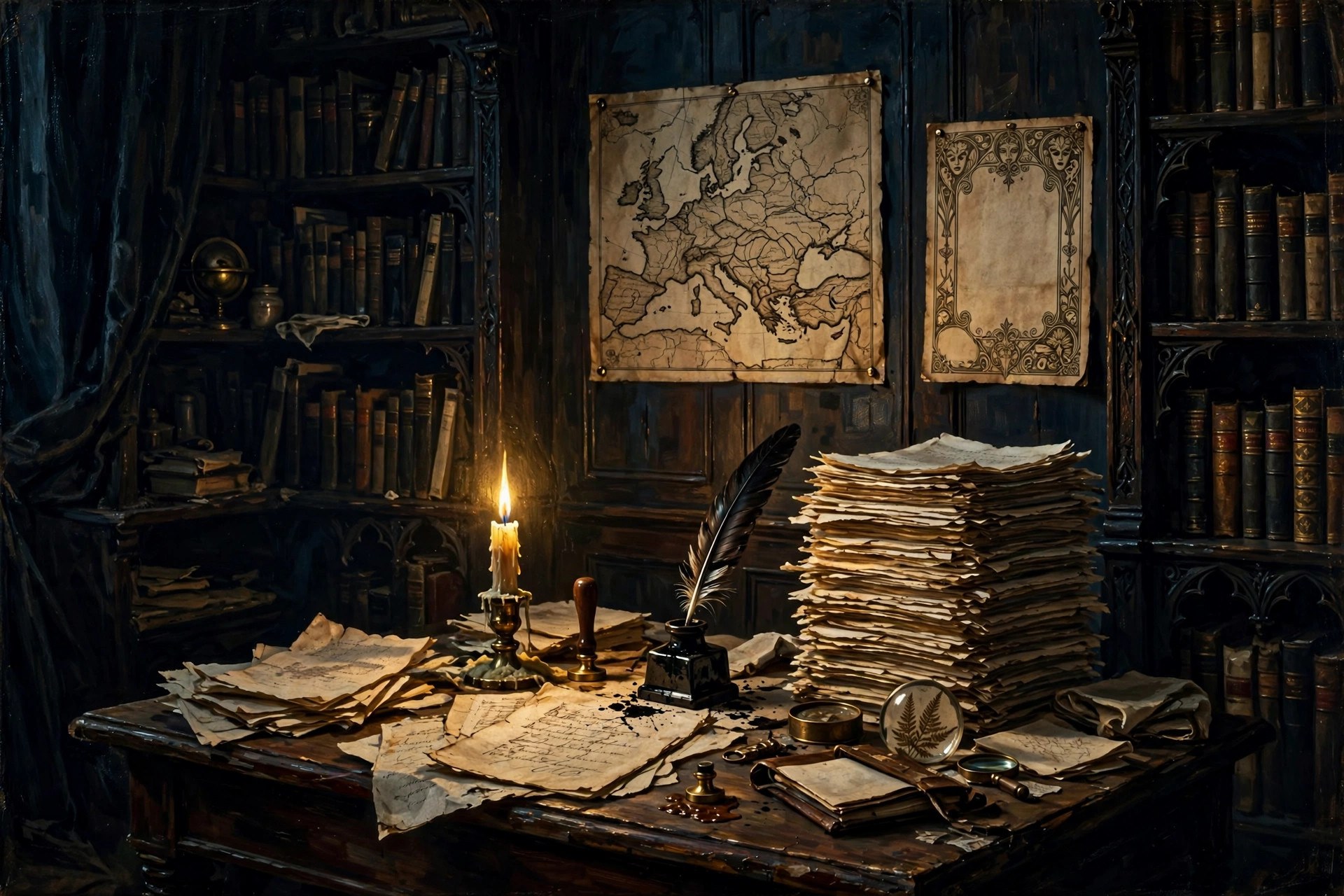
Stoker's Dracula, 1897
The book that made the name immortal — and the honest story of how it was made.
This page covers actual literary history. It is independent of the Vizlings persona — who shares only the name. No image here depicts Stoker or any real person.
The book
Dracula by Bram Stoker (1847–1912) was published in London on 26 May 1897 by Archibald Constable and Company. It is an epistolary novel — told through journals, letters, newspaper clippings, and phonograph-diary transcripts — following solicitor Jonathan Harker’s visit to a Transylvanian count, the Count’s voyage to England, and the small band (Mina Harker, Van Helsing, Dr. Seward, and others) who hunt him down.
Stoker was the business manager of the actor Henry Irving and manager of London’s Lyceum Theatre; the novel’s theatricality — its entrances, its staged confrontations — owes much to the stage.
What Stoker actually invented (and what he borrowed)
- The name “Dracula” came from his reading about Vlad III — Vlad the Impaler, Vlad Țepeș (1431–1476), voivode of Wallachia. Stoker’s working notes show he found the name in William Wilkinson’s An Account of the Principalities of Wallachia and Moldavia (1820): “DRACULA in the Wallachian language means DEVIL.” The historical Vlad’s atrocities are real history; Stoker borrowed only the name and its diabolical ring — his Count is not a portrait of Vlad.
- Transylvania came largely from Emily Gerard’s 1885 essay “Transylvanian Superstitions” — the source of nosferatu and much of the novel’s folk texture. Stoker never visited Transylvania; his geography is researched, not witnessed.
- The aristocratic vampire descends from Polidori’s Lord Ruthven (1819) via Le Fanu’s Carmilla (1872), which Stoker read and admired.
- Stoker’s research notes — hundreds of pages, now held by the Rosenbach Museum & Library in Philadelphia — show years of systematic preparation: folklore, Whitby histories, shipping timetables.
The afterlife
The novel was a modest success in Stoker’s lifetime. Its immortality came later: the unauthorized 1922 film Nosferatu (see screen), the stage adaptations, and above all the 1931 Universal film made “Dracula” a global archetype. Stoker died in 1912, fifteen years after publication, before the legend outgrew the book.
The Vizlings character’s relationship to Stoker’s
The app persona is an original theatrical creation that echoes Stoker — the threshold ritual (“enter freely”), the children-of-the-night line, the courtesy — as deliberate homage. The echoes are labeled as such on the lines page. Nothing about the persona claims to continue, portray, or adapt Stoker’s novel.
Source notes
Bram Stoker, Dracula (Archibald Constable and Company, London, 26 May 1897). Stoker’s working notes: the Rosenbach Museum & Library, Philadelphia. Key influences: William Wilkinson, An Account of the Principalities of Wallachia and Moldavia (1820); Emily Gerard, “Transylvanian Superstitions” (1885); Sheridan Le Fanu, Carmilla (1872); John Polidori, “The Vampyre” (1819). Full details on the sources page. Genuine quotations from the novel are cited on the lines page.