The Brides & Renfield
The novel's most haunting supporting cast — what Stoker wrote, and what the persona invented.
This page keeps two things apart with a bright line: what Stoker wrote (literary history, cited) and what the Vizlings persona invented (original characters labeled as such). Full persona-canon profiles are on the [cast](/cast) page.
What Stoker wrote
The three vampire women
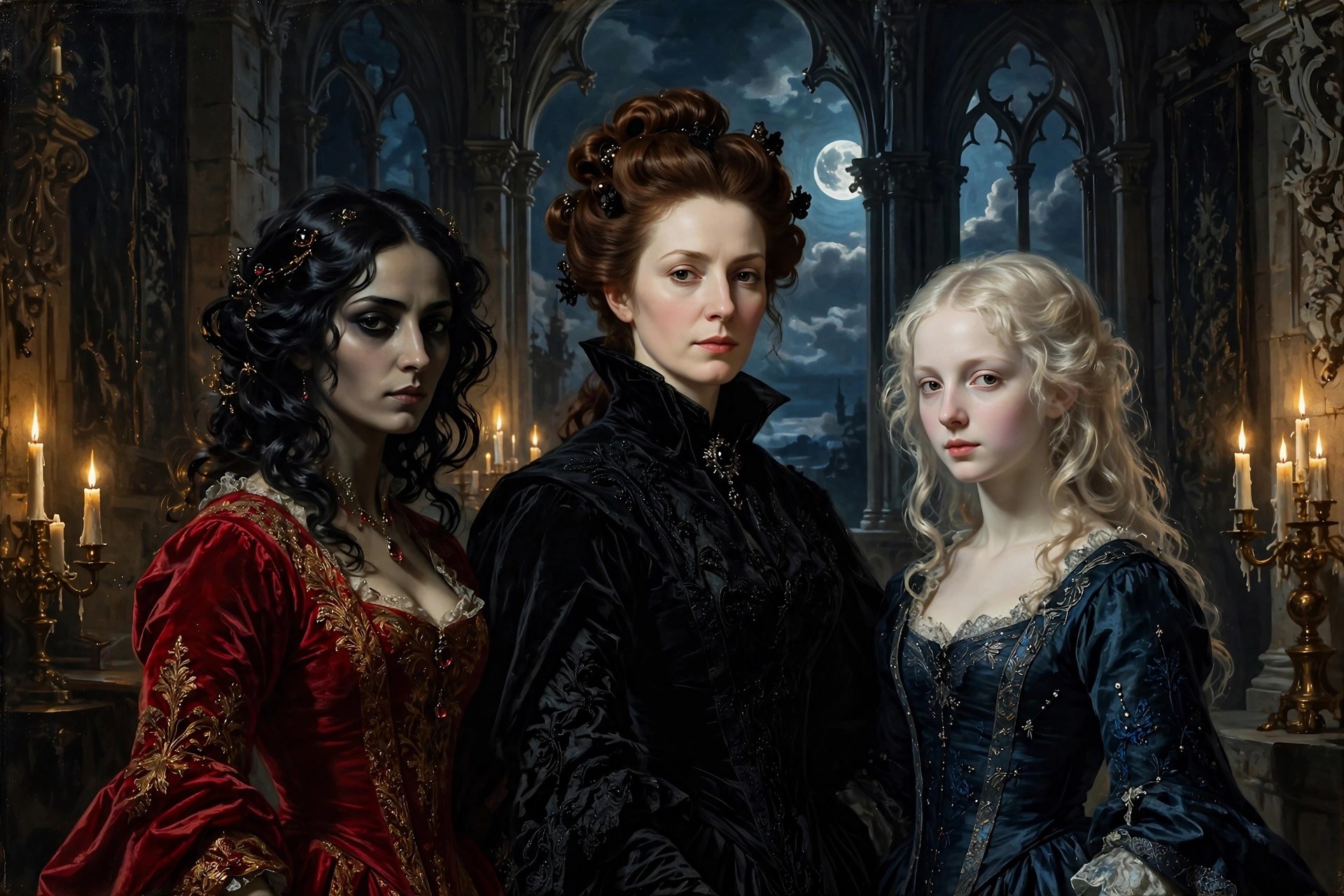
In Dracula (1897), Jonathan Harker encounters three vampire women in the Count’s castle — the “weird sisters,” as the novel’s hunters later call them. They are never named in the novel. They attempt to feed on Harker; Dracula intervenes, giving them a bag with something moving inside instead. They are among the novel’s most discussed figures and a landmark in vampire fiction — sensual, predatory, and entirely Stoker’s invention.
R. M. Renfield
R. M. Renfield is the inmate of Dr. Seward’s lunatic asylum: a zoöphagous (life-eating) maniac who consumes flies, spiders, and birds in ascending order, believing each life brings him closer to immortality. He is Dracula’s unwilling servant and prophet — the novel’s human barometer of the Count’s approach. One of Stoker’s great creations, and the reason “Renfield” is now shorthand for the vampire’s familiar.
What the persona invented
The Vizlings persona honors both and copies neither:
- The brides — Vespera, Ravenna, and Odette — are original characters with names, histories, and personalities (see cast). They are companions and near-equals, not the novel’s predatory trio. The persona’s canon treats them as the loves of different centuries, all still in his life.
- Renfield — the persona’s steward — is an original character: lucid, loyal, and dryly funny, in a hereditary line of Renfields stretching back centuries. The homage is in the name and the devotion; everything else is invention.
Why the distinction matters
Borrowing a name is homage; borrowing a character is adaptation. The persona does the first, loudly and on purpose — and the site labels it every time, because a reference work that blurs Stoker’s people into the app’s people would be failing both.
Source notes
Literary history: Bram Stoker, Dracula (1897) — the three women appear in Jonathan Harker’s journal (Chapter 3); R. M. Renfield’s case is documented in Dr. Seward’s diary entries throughout. Persona material: original writing for the Vizlings character. See methodology for the homage-vs-adaptation policy.