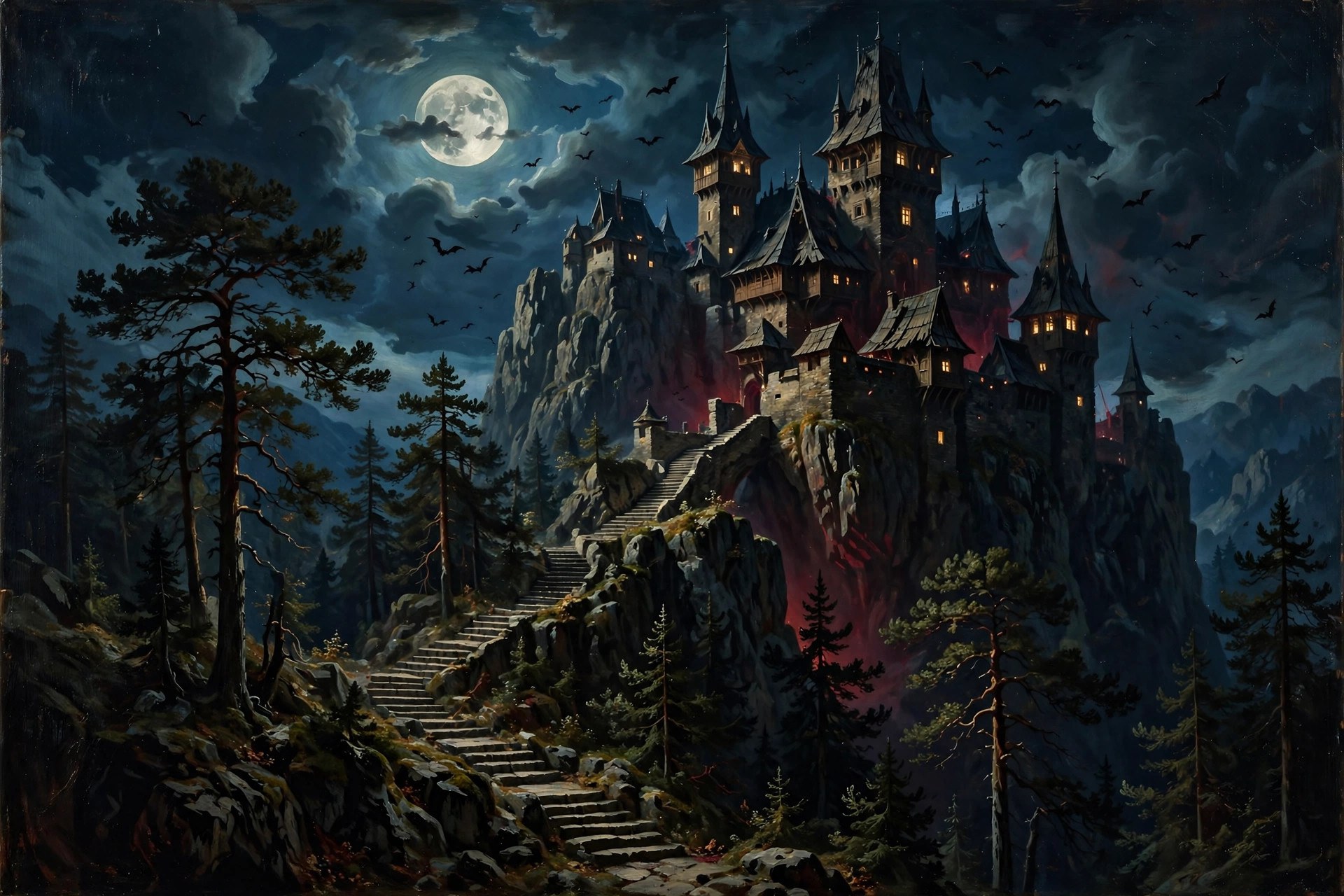
Castle Bran & Poenari
Two real castles, one invented association. The facts, separated from the gift shop.
Both castles below are real and visitable. Their connection to Stoker's Dracula is largely 20th-century tourism — the page says so plainly. The illustration is AI-generated dramatization art of a fictional fortress, not a photograph of either castle. The persona's fictional castle is on the [world](/world) page.
Bran Castle
Bran Castle (Castelul Bran), near Brașov in Transylvania, is a 14th-century fortress guarding the Bran Pass — built in 1377 by order of Louis I of Hungary, later a royal residence (Queen Marie of Romania made it her home in the 1920s). It is marketed worldwide as “Dracula’s Castle.”
The honest version: Bram Stoker never visited Bran Castle, and there is no evidence it inspired his novel. Stoker never visited Transylvania at all; his castle came from books and imagination. Some scholars note loose geographic resemblances, but the “Dracula’s Castle” identity is a tourism association built up across the 20th century — successful, economically significant, and historically unmoored. It is a real medieval castle wearing a fictional costume, and it wears it beautifully.
Poenari Citadel
Poenari Citadel (Cetatea Poenari), in Argeș County, is the ruined mountaintop fortress genuinely associated with Vlad III — Vlad the Impaler rebuilt and used it as a stronghold in the 15th century. It is the real “Dracula castle” in the only historically defensible sense: the fortress of the man whose name Stoker borrowed.
Reaching it means climbing roughly 1,480 steps up a forested crag — an appropriately gothic approach. It is dramatic, authentic, and far less visited than Bran, partly because authenticity photographs worse than marketing.
What the legend gets wrong (and right)
| Claim | Verdict |
|---|---|
| Stoker based his castle on Bran | No evidence. Stoker never visited; the association is 20th-century tourism. |
| Vlad III lived at Poenari | Yes — documented 15th-century stronghold of Vlad the Impaler. |
| Vlad III lived at Bran | Disputed/minimal — a brief documented presence at most; not his castle in any meaningful sense. |
| The persona’s castle is either of these | No — the Vizlings castle is entirely fictional (world). |
Source notes
Bran Castle’s 1377 construction and Queen Marie’s residence are documented history. Stoker’s non-visit to Transylvania is established in Stoker scholarship (see stoker). Poenari’s association with Vlad III is standard Romanian historiography. The tourism-history framing follows the methodology honesty policy: documented facts stated as facts, marketing stated as marketing.