Vampires on Screen
A century of fangs on film — the lawsuits, the legends, and the performances that defined the archetype.
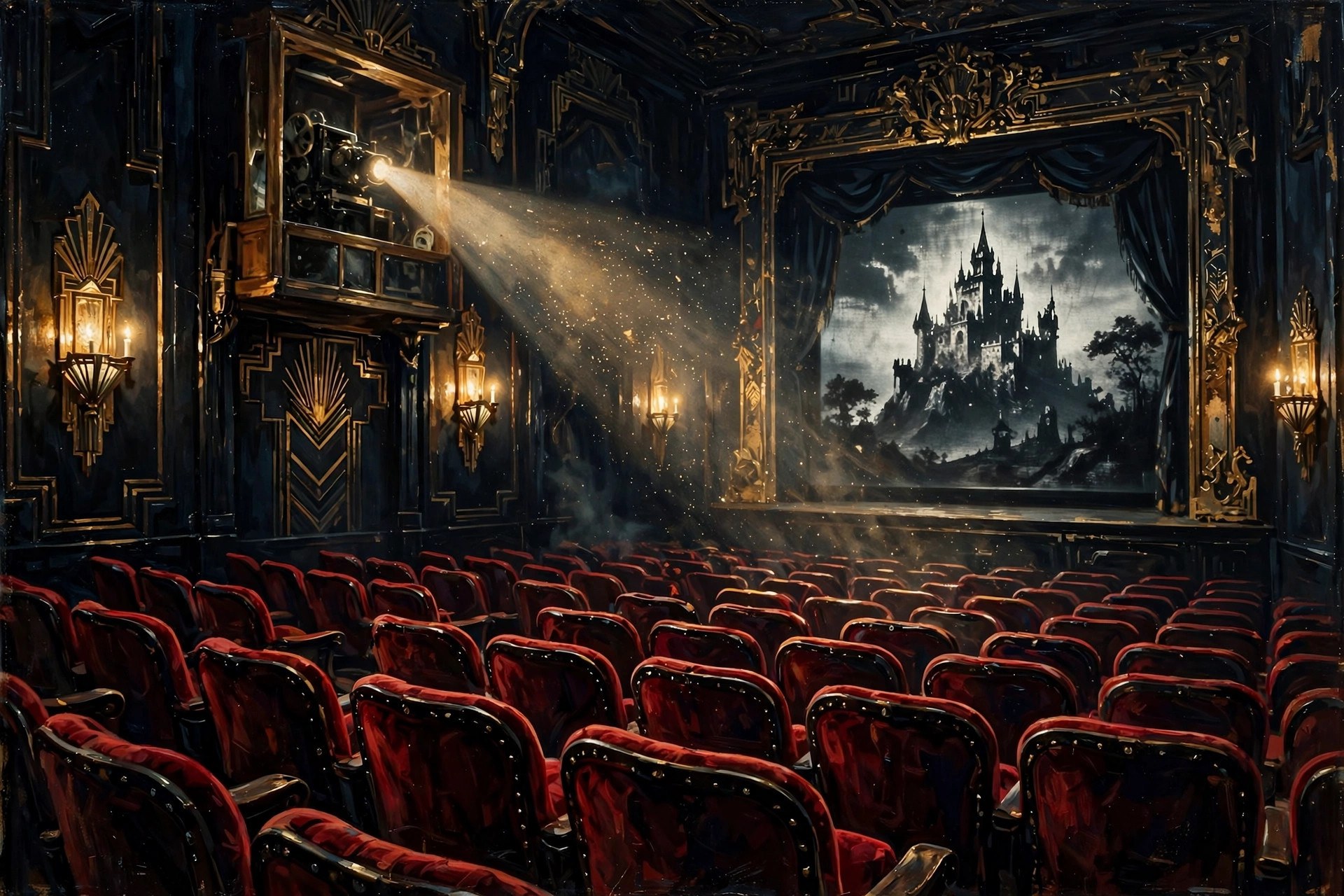
This page covers actual film history. No image on this site depicts any actor — the illustrations are abstract cinema art, captioned as AI-generated dramatization art.
Nosferatu (1922) — the unauthorized one
F. W. Murnau’s Nosferatu: A Symphony of Horror (1922) was an unauthorized adaptation of Stoker’s novel — names changed (Count Orlok for Dracula), plot barely disguised. Florence Stoker, Bram’s widow, sued. The court ordered all prints destroyed. A few survived, and the film that was supposed to vanish became the most influential vampire film ever made — and the source of enduring vampire lore Stoker never wrote, including sunlight as a lethal weapon.
Dracula (1931) — the voice
Universal Pictures’ Dracula (1931), starring Bela Lugosi, fixed the popular image: the evening dress, the cape, the Hungarian-accented courtesy (“I bid you welcome”). Lugosi had played the role on Broadway; his performance — and his accent — became the template every theatrical vampire since has negotiated with, including the Vizlings persona’s deliberate echoes.
Horror of Dracula (1958) — the blood
Hammer Films’ Horror of Dracula (1958), with Christopher Lee, brought the Count into color, sensuality, and gore — the template for the modern cinematic vampire as both aristocrat and predator. Lee would play the role nine more times, with increasing ambivalence.
Bram Stoker’s Dracula (1992) — the romance
Francis Ford Coppola’s Bram Stoker’s Dracula (1992) returned to the novel’s epistolary sprawl with maximalist romanticism — the Count as tragic lover, the brides as spectacle, the costumes as baroque theater. Its title claims fidelity; its spirit is pure opera.
The archetype since
From comedy (What We Do in the Shadows) to prestige television, the screen vampire has fragmented into a hundred subgenres. The through-line from 1922 to today: the vampire as the monster who chooses his monstrosity — charming, articulate, and therefore more frightening than any beast.
The Vizlings persona’s screen DNA
The app character’s theatricality descends most directly from the Lugosi line (the courtesy, the accent of menace) via the Hammer line (the sensuality) — filtered through a century of parody into something self-aware. He knows he’s a type. That’s the performance.
Source notes
Film history as standard: Nosferatu (Prana Film, 1922; dir. F. W. Murnau); Florence Stoker’s lawsuit and the destruction order are documented legal history. Dracula (Universal, 1931; dir. Tod Browning). Horror of Dracula (Hammer, 1958; dir. Terence Fisher). Bram Stoker’s Dracula (1992; dir. Francis Ford Coppola). See sources. No performer is depicted or quoted as the persona.