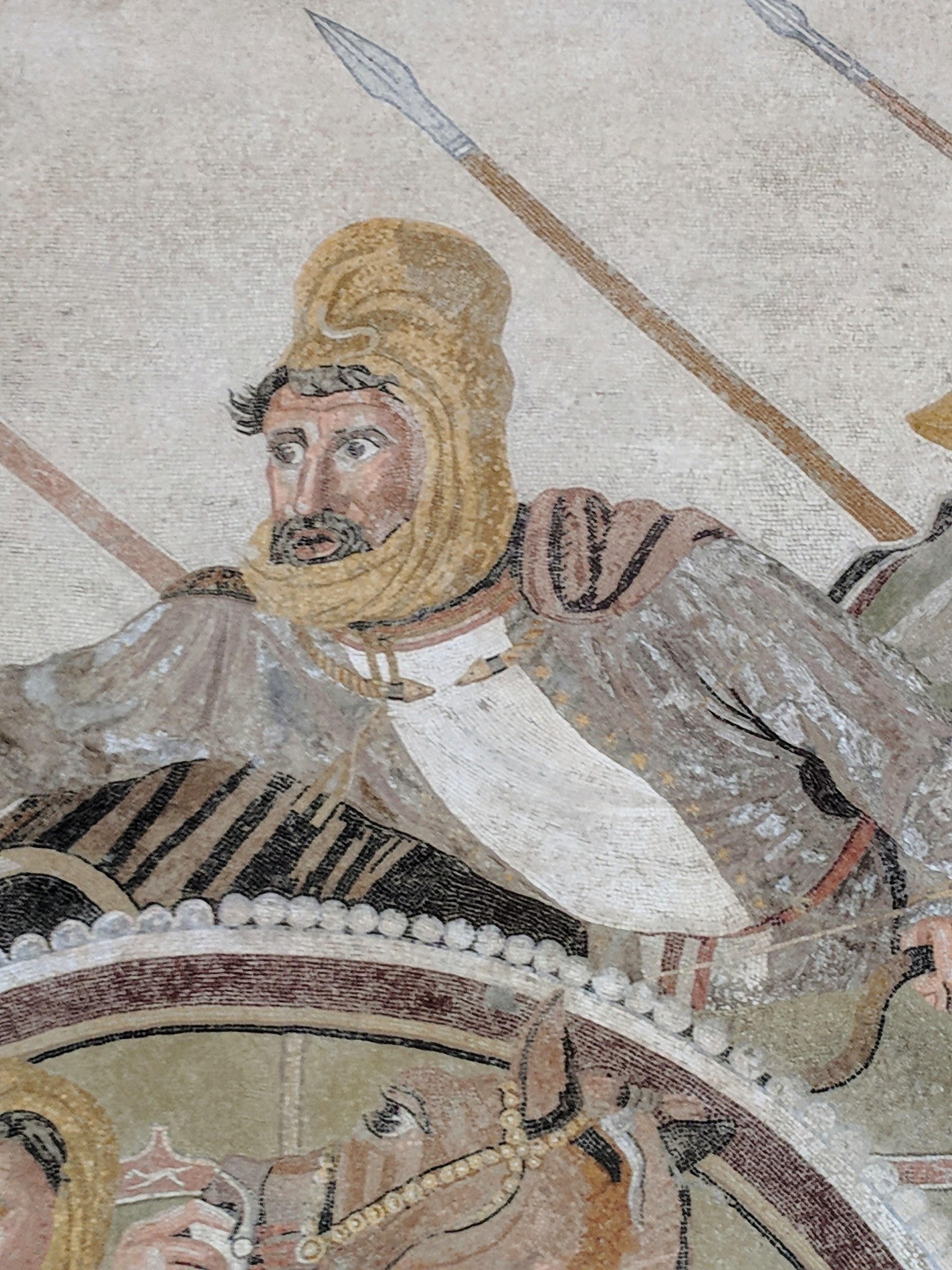
The Three Great Battles
Three battles in three years destroyed a two-hundred-year empire. What the sources claim happened — and where the tactics end and the legend begins.
1. Granicus — May 334 BC
The situation. Alexander had just crossed into Asia. The Persian satraps of Asia Minor — Arsites, Spithridates, Memnon the Rhodian (the Greek mercenary commander who understood Alexander best) — chose to meet him at the Granicus river rather than scorch the earth as Memnon advised.
The battle (Arrian 1.13–16; Diodorus 17.19–21). The Persians held the far bank, cavalry massed on the high ground. Alexander’s first assault across the river was repulsed; then he personally led the Companion cavalry in a wedge across at an angle, smashed into the Persian left-center, and the line broke. In the melee Alexander nearly died — a Persian noble (Rhoesaces in Arrian, Spithridates in Diodorus — the sources can’t agree who) split his helmet with a battle-axe, and Cleitus the Black cut the man’s arm off. The Greek mercenary infantry, left standing alone, were surrounded and slaughtered almost to a man; 2,000 were sent back to Macedon in chains as a lesson to Greeks who fought for Persia.
Numbers: Arrian gives the Persians 20,000 cavalry and 20,000 Greek mercenaries; Macedonian losses at 85 cavalry and 30 infantry (1.16) — absurdly low, and ancient casualty figures for the victor are never trustworthy. Modern estimates put Persian dead in the low thousands.
Why it mattered: Asia Minor’s field army was gone. Sardis surrendered; the coastal cities fell one by one. Alexander had announced himself as a conqueror, not a raider.
2. Issus — November 333 BC
The situation. Darius III took personal command of a great army and — outmaneuvering Alexander’s expectations — got behind him, cutting his supply line at Issus on the Cilician coast. The battlefield was a narrow plain between mountains and sea: Darius’ numbers couldn’t deploy.
The battle (Arrian 2.6–11; Diodorus 17.32–37; Curtius 3). Alexander refused his left under Parmenion against the Persian right, held the center with the phalanx, and led the Companions in the decisive oblique charge against the Persian left, wheeling into the center where Darius stood in his chariot. When the Persian left collapsed and Alexander’s cavalry struck toward him, Darius fled — first in his chariot, then abandoning it for horseback. His army dissolved. The Macedonians took the Persian camp: Darius’ chariot, bow, cloak, and — most famously — his family: his mother Sisygambis, his wife Stateira, his children.
Numbers: Arrian claims 600,000 Persians; Curtius 250,000 infantry plus cavalry. Modern historians suggest 60,000–100,000 — still outnumbering Alexander perhaps two or three to one. Persian dead: ancient figures run to 100,000; modern estimates, a fraction of that.
Why it mattered: The Persian king had been beaten in person. The Levant, Egypt, and the Mediterranean coast now lay open; the sieges of Tyre and Gaza and the occupation of Egypt followed. Alexander also acquired, in Darius’ captured family, the most useful hostages in the ancient world — and treated them with a chivalry the sources never tire of repeating (the Veronese painting on the people page depicts the famous anecdote of Sisygambis mistaking Hephaestion for Alexander).
3. Gaugamela — 1 October 331 BC
The situation. Darius had had two years to prepare. He chose an open plain near Arbela (modern Erbil, Iraq) and had it leveled for his scythed chariots; he fielded, by modern estimates, perhaps 100,000 men (ancient figures reach a million), with 200 scythed chariots and fifteen elephants — the first elephants a European army had ever faced.
The battle (Arrian 3.11–15; Diodorus 17.57–61; Curtius 4.12–16). Alexander advanced obliquely to the right, drawing the Persian cavalry out of line; the scythed chariots were met by light troops who opened lanes and hamstrung the horses. Then, seeing a gap open in the Persian line as it stretched to envelop him, Alexander led the Companion wedge in the most famous cavalry charge of antiquity — straight at Darius in the center. Darius fled; the center collapsed. On the Macedonian left, Parmenion was hard-pressed and sent an urgent message; Alexander broke off the pursuit to ride back — and found the battle already won. (The sources debate whether Parmenion’s call cost Alexander Darius’ capture; the vulgate tradition blames Parmenion, Arrian is cooler.)
Numbers: Meaningless in the sources (a million Persians in Arrian, following the tradition). Modern estimates: Persian dead perhaps 40,000+ (a real slaughter in the pursuit), Macedonian dead in the hundreds.
Why it mattered: The Achaemenid field army was destroyed. Babylon, Susa, and Persepolis surrendered or were taken within months. Darius was a fugitive; within a year he was dead, murdered by Bessus. The Persian Empire, as a military fact, was over.
The date is the most secure in Alexander’s life: Arrian (3.7) records a lunar eclipse eleven days before the battle — the eclipse of 20 September 331 BC — and a Babylonian cuneiform diary independently records the battle. See timeline.
The tactical pattern
All three battles show the same Alexander: refuse the weak wing, fix the enemy with the phalanx, and decide the battle with a personally-led cavalry strike at the decisive point — usually aimed, with unnerving directness, at the enemy commander. It worked three times against the largest armies of the age. It nearly got him killed at the Granicus, and it would nearly get him killed again in India.
Source notes
- Granicus: Arrian 1.13–16; Diodorus 17.19–21; Plutarch, Alex. 16.
- Issus: Arrian 2.6–12; Diodorus 17.32–38; Curtius 3.8–11; Plutarch, Alex. 20–21.
- Gaugamela: Arrian 3.7–15; Diodorus 17.53–61; Curtius 4.9–16; Plutarch, Alex. 31–33; the Babylonian diary (Sachs–Hunger).
- Modern tactical analysis: Bosworth, Conquest and Empire; Devine’s studies of the three battles.
Limitations
- No Persian battle accounts survive; the tactics above are reconstructed from the Macedonian narratives.
- Every number on this page is an ancient claim or a modern estimate — none is exact. See methodology.