Sources
Five writers, three centuries apart from their subject, working from books that no longer exist. Plus coins, a mosaic, a diary in cuneiform — and nothing in Alexander's own hand.
The literary sources
Arrian of Nicomedia — Anabasis Alexandri (c. AD 130–160). A Greek writing under Rome, a Stoic and a general himself. Arrian explicitly says he follows Ptolemy and Aristobulus — two men who campaigned with Alexander — “where they agree,” and tells the reader when they don’t. The most systematic and military-minded account; the backbone of every modern narrative. His Ptolemy-preference is also his bias: Ptolemy wrote as a king justifying a king.
Plutarch — Life of Alexander (c. AD 100–120), paired with Julius Caesar. A biographer, not a historian: he warns the reader upfront that he writes lives, not histories, and seeks “signs of the soul” in anecdotes. Our richest source for the sayings, the character sketches, and the stories Arrian the soldier thought beneath him. Every famous anecdote on this site’s sayings page comes with Plutarch’s name attached for a reason.
Diodorus Siculus — Bibliotheca historica, Book 17 (1st century BC). A universal history drawing heavily on Cleitarchus, whose sensational, pro-Ptolemaic history (lost) was the ancient bestseller. Diodorus gives us the burning of Persepolis in full color, the Susa weddings, the “last plans” — and Cleitarchus’ exaggerations with them.
Quintus Curtius Rufus — Historiae Alexandri Magni (1st century AD; books 3–10 survive). A Roman rhetorician writing moralizing history in the Livian manner: vivid, dramatic, fond of speeches that were never given. Invaluable where the others are thin (the Bactrian campaigns, the deathbed), unreliable in the details he invents to make them vivid.
Justin — epitome of Pompeius Trogus (Augustan era). A compressed summary, useful for the Diadochi period and for variant traditions.
The lost sources: Callisthenes (the official historian, executed 327 BC), Onesicritus (the fabulist), Nearchus (the admiral — partially preserved via Arrian’s Indica), Aristobulus, Ptolemy, Cleitarchus. We know them only through the five above — except where papyrus scraps or quotations survive.
The non-literary evidence
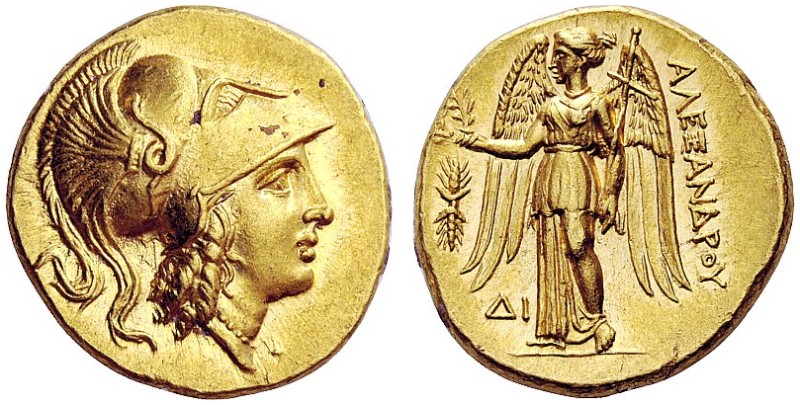
- Coins. The “Alexander types” — Heracles in the lion skin, Zeus enthroned — were struck in Alexander’s name during his life and for centuries after; the famous horned-Alexander portraits are Lysimachus’ posthumous issues. Coins are contemporary evidence for administration, iconography, and propaganda — not for what Alexander looked like.
- The Babylonian astronomical diaries. Cuneiform tablets that record, among much else, the battle of Gaugamela — a genuinely contemporary, non-Greek witness. The great exception to the rule that our sources are all late and all Macedonian.
- The Alexander Mosaic (Pompeii, c. 100 BC, copying a Hellenistic painting of c. 300 BC). The closest thing to a contemporary image — still two centuries after his death.
- The “Alexander Sarcophagus” (Sidon, late 4th century BC). Genuinely of Alexander’s era; not his tomb.
- Inscriptions. Decrees, dedications, and the Priene dedication (“King Alexander dedicates…”) — small, solid, contemporary facts amid the literary ocean.
What does not exist
No contemporary portrait verifiable as from life. No memoir. No letters in his hand (the “letters” in the tradition are literary compositions). No Persian-side narrative history. No archive of the Royal Journals beyond the quotations in Arrian and Plutarch.
Provenance
See the image captions for credits and context. Illustrated character art is a dramatization.
Source notes
- On the sources generally: A. B. Bosworth, From Arrian to Alexander (1988); the introduction to the Landmark Arrian.
- The Babylonian diary on Gaugamela: Sachs–Hunger, Astronomical Diaries; discussed in most modern Gaugamela treatments.
Limitations
- This page describes the sources; the sources problem analyzes what their lateness and biases do to the history.
- Papyrology keeps producing scraps; a new fragment could revise any paragraph above. The page is current as of 2026-09-26.