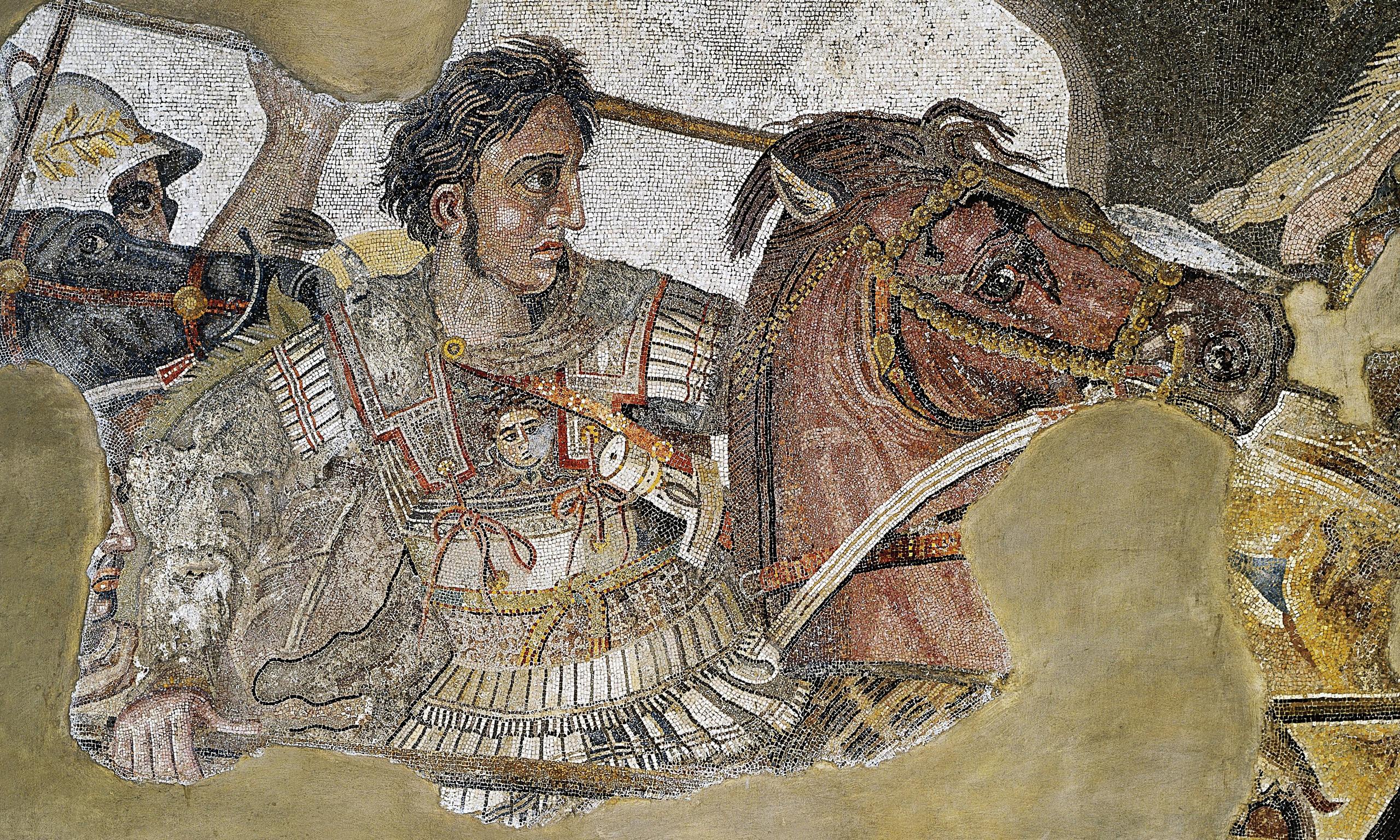
Alexander the Great
Everything you need to know about Alexander III of Macedon (356–323 BC) — the conqueror who built an empire from Greece to India before his thirty-third birthday, and the legend that swallowed the man.
The problem with Alexander
No contemporary account of Alexander survives. No letter in his hand, no portrait made in his lifetime that we can verify, no official history written while he lived. Everything we know comes from writers who lived three to five centuries after his death — working from earlier accounts that are themselves lost. This site is built around that problem: it tells you what the sources say, how far each claim is from Alexander himself, and where the honest gaps are.
What you’ll find here
- Start here — the five-minute orientation: who he was, why he matters, how to read this site.
- Biography — the life, as the sources report it.
- Timeline — every major date, with a certainty label on each one.
- Campaigns & deeds — the conquests, battle by battle, with what each source actually claims.
- Sayings — the famous lines. Almost all are reported anecdotes, not verified quotations — and the fabrications get their own clearly-labeled section.
- The sources problem — why Arrian, Plutarch, Diodorus, and Curtius Rufus disagree, and what we lost.
- Deep dives — the three great battles, the death mystery, the Gordian knot, Bucephalas, the lost tomb, the successors, the Alexander Romance, Alexander and Aristotle, Alexander’s cities.
- The stream — the dramatized character-stream concept, honestly labeled as dramatization.
The honest summary
Alexander III of Macedon inherited his father Philip II’s army at twenty, crossed into Asia in 334 BC, destroyed the Persian Empire in three great battles (Granicus, Issus, Gaugamela), marched to the Indus, turned back at his army’s refusal to go further, and died at Babylon in 323 BC at thirty-two. He founded cities across three continents, spread Greek culture from Egypt to Central Asia (the Hellenistic age), and became the most imitated conqueror in history — from the Roman generals who wept at his tomb to the medieval romances that turned him into a knight, a prophet, and an explorer of the ocean floor.
He also burned Persepolis, destroyed Thebes, executed trusted generals, and drank himself into the illness that may have killed him. Both halves are on this site, sourced.
A note on images
Every image on this site is labeled by kind: real artifacts (Roman mosaics, coins, ruins — all later than Alexander himself), period artwork (paintings from the Renaissance onward — imagination, not evidence), and AI-generated dramatization art (the stream’s animated character — clearly marked, never presented as history). See sources and methodology.
Source notes
- Core narrative follows Arrian’s Anabasis, Plutarch’s Life of Alexander, Diodorus Siculus Book 17, and Quintus Curtius Rufus, cross-checked where possible. See the sources problem and sources.
- Death date convention: 10/11 June 323 BC; the Royal Journals give Daisios 29. See timeline and the death mystery.
Limitations
- This site is a reference digest, not a substitute for the ancient sources or modern scholarship (Bosworth, Lane Fox, Hammond, Briant). Where scholars disagree, this site says so rather than picking a winner.
- No claim on this site is presented as certain unless the evidence is stated. Certainty labels on the timeline show the method for every date.