Start Here
Alexander in five minutes — plus the one rule that makes this site different from every quote page and documentary you've seen.
Who he was
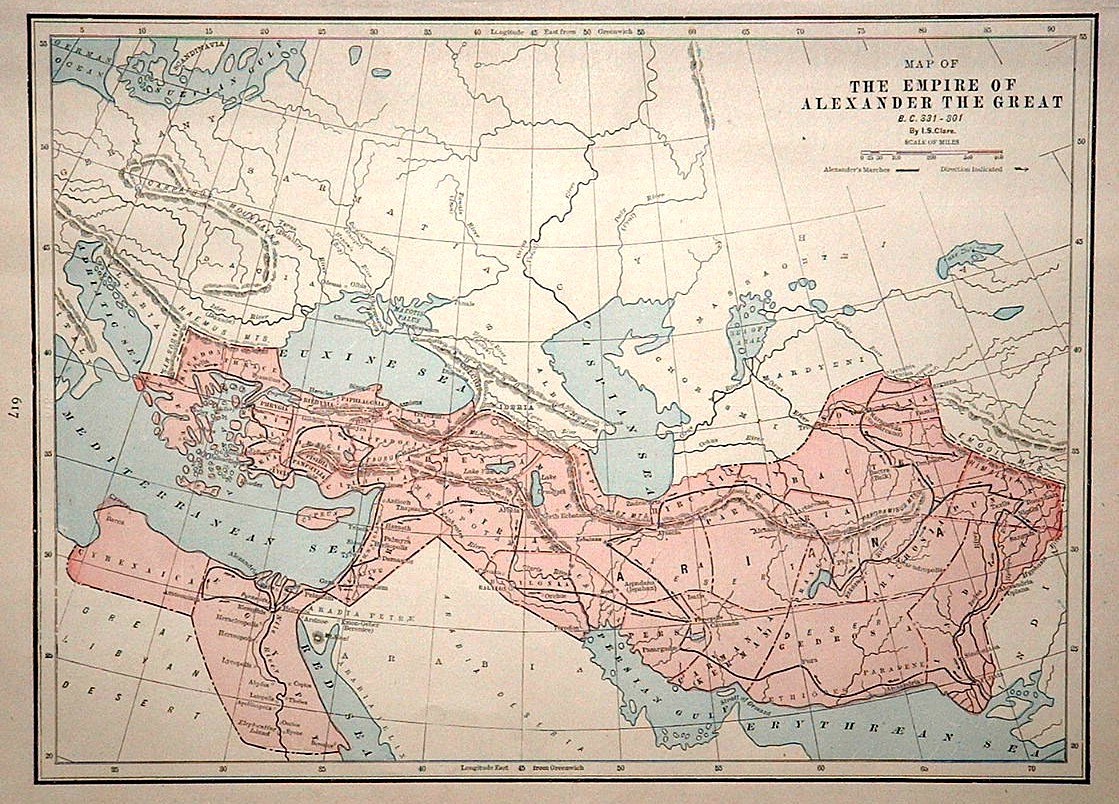
Alexander III of Macedon (356–323 BC) became king of Macedon at twenty, after his father Philip II was assassinated. Within twelve years he had conquered the Persian Empire — the superpower of its age — marched his army to the Indus river, and founded a string of cities from Egypt to Central Asia. He died at Babylon at thirty-two, before he could consolidate any of it. His generals tore the empire apart in the Wars of the Diadochi; the cultural world he left behind — Greek-speaking, city-building, stretching to India — is called the Hellenistic age.
Why he matters
- Militarily: three set-piece victories — Granicus (334), Issus (333), Gaugamela (331) — destroyed an empire that had ruled the Near East for two centuries.
- Culturally: he founded or renamed dozens of cities (Alexandria in Egypt is the famous survivor), planted Greek institutions across Asia, and fused Macedonian, Greek, and Persian practice in ways that shaped the next three centuries.
- As legend: no conqueror has been imitated more. Julius Caesar wept at his statue in Spain; medieval Europe turned him into a chivalric hero (the Romance); he appears in the Qur’an as a figure many identify with Dhul-Qarnayn.
The one rule
Every quote, portrait, and story about Alexander is later than Alexander. There is no contemporary portrait we can verify, no memoir, no letter in his hand. His court historian Callisthenes’ work is lost; what survives was written centuries later from lost earlier sources. This site’s rule:
- Reported anecdote — a story the ancient sources tell. It may be true; it is not verified.
- Astronomically fixed — a date pinned by an eclipse or cuneiform diary. Rare, and marked when it happens.
- Narrative date — the date the sources give, accepted by modern convention.
- Misattributed — a famous “quote” with no ancient source. These live in their own section of sayings, never mixed with the real material.
How to use this site
- Read the biography for the narrative.
- Check the timeline for dates with certainty labels.
- Go deep on any episode: the death mystery, the Gordian knot, Bucephalas, the lost tomb.
- Read the sources problem before you trust anything — including this site.
Source notes
- Biographical framework: Plutarch, Life of Alexander; Arrian, Anabasis; Diodorus Siculus 17; Quintus Curtius Rufus 3–10.
- The certainty-label system is this site’s own editorial device, documented in methodology.
Limitations
- This orientation compresses contested scholarship. The pages it links to carry the full qualifications.