Sayings
No verified verbatim quotation of Alexander exists. What follows are reported anecdotes — things ancient writers say he said — each with its source, and the fabrications quarantined in their own section.
Reported anecdotes
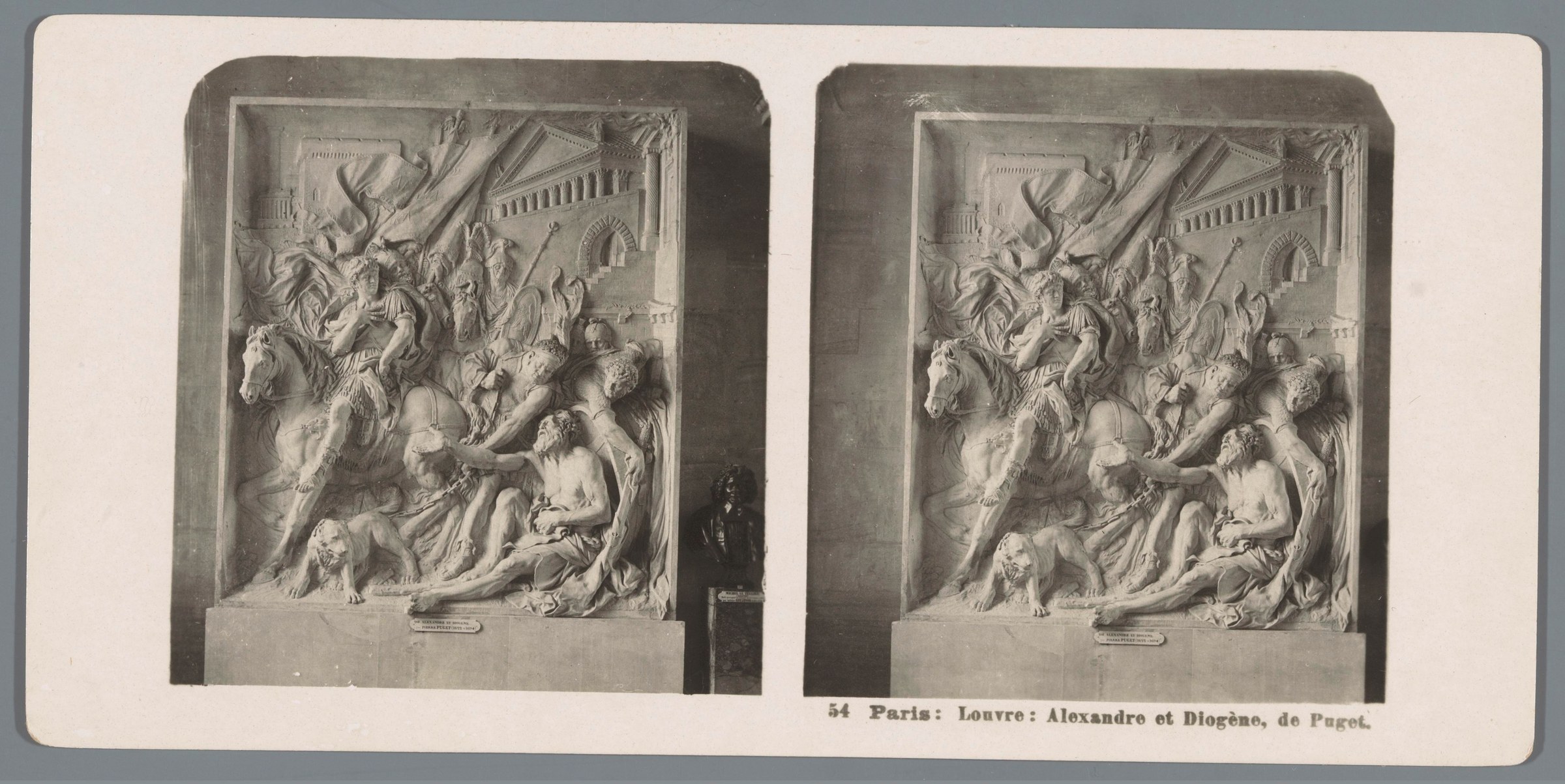
1. “But truly, if I were not Alexander, I would be Diogenes.”
Reported anecdote. Plutarch, Life of Alexander 14.4 (c. AD 100–120). After Diogenes told him to move out of his sunlight, Alexander said this to his laughing followers as they walked away. Also in Diogenes Laërtius (6.32).
2. “O my son, look thee out a kingdom equal to and worthy of thyself, for Macedonia is too little for thee.”
Reported anecdote — spoken by Philip II, not Alexander. Plutarch, Life of Alexander 6. Philip’s remark after the young Alexander tamed Bucephalas. Included because it is the most famous line about Alexander in the tradition.
3. “O fortunate youth, to have found Homer as the herald of your glory!”
Reported anecdote. Plutarch, Life of Alexander 15. At the tomb of Achilles at Troy, Alexander envied Achilles his poet. The annotated Iliad he carried (Plutarch, Alex. 8) makes the sentiment plausible; the wording is Plutarch’s.
4. “Are you still to learn that the end and perfection of our victories is to avoid the vices and infirmities of those whom we subdue?”
Reported anecdote. Plutarch, Life of Alexander (Arthur Hugh Clough translation). Spoken to his officers — the moral program of the conquests, in one sentence.
5. “I will not steal a victory.”
Reported anecdote. Plutarch, Life of Alexander 31. When Parmenion suggested a night attack before Gaugamela, Alexander refused — “I will not steal a victory” (ou klepsō tēn nikēn). The Greek phrasing is Plutarch’s.
6. “Heaven cannot brook two suns, nor earth two masters.”
Reported anecdote. Plutarch, Regum et imperatorum apophthegmata (Sayings of Kings and Commanders). Alexander’s reply to Darius’ offer of half his kingdom and his daughter’s hand in marriage (cf. Arrian 2.14 for the exchange itself).
7. “I had rather excel others in the knowledge of what is excellent, than in the extent of my power and possession.”
Reported anecdote. Plutarch, Regum et imperatorum apophthegmata. The Aristotle-pupil speaking — or Plutarch’s idea of him.
8. “O Athenians, what labours I undergo to please you!”
Reported anecdote. Plutarch, Regum et imperatorum apophthegmata. On the burdens of winning glory — with an eye on his Greek audience.
9. “Do you not think it a matter worthy of lamentation that when there is such a vast multitude of them [worlds], we have not yet conquered one?”
Reported anecdote. Plutarch, Moralia (“On Tranquillity of Mind,” 466d). The famous weeping-for-more-worlds story, in its source form: it is about the philosophers’ doctrine of infinite worlds, not a tantrum.
10. “A king does not kill messengers.”
From the Alexander Romance — legend, not history. Pseudo-Callisthenes, Historia Alexandri Magni 1.37. Alexander’s reported reply when urged to execute envoys. It belongs to the fictional tradition (see the Alexander Romance), not to the historical record.
11. “To the strongest!” (tôi kratistôi)
Reported, disputed. Diodorus 17.117; Curtius 10.5.5; Justin 12.15. Alexander’s reported deathbed answer when asked to whom he left his kingdom. It has been suggested his voice was indistinct and he said “to Craterus” (Kraterôi) — one of his generals, who was not present. Either reading changed history; neither can be verified.
12. “Stand a little out of my sun.”
Reported anecdote — spoken by Diogenes, not Alexander. Plutarch, Life of Alexander 14.4; Diogenes Laërtius 6.38 (“Stand out of my light”). The other half of the most famous encounter in the tradition. Included because it is inseparable from no. 1.
Misattributed or unverifiable
The lines below are widely shared as Alexander’s. None has an ancient source. They are presented here so you can recognize them — not to repeat them as history.
13. “There is nothing impossible to him who will try.”
Misattributed. No ancient source. The earliest known printing is Orison Swett Marden’s self-help book Pushing to the Front (1896), “on taking charge of an attack on a fortress.” Some quote-books claim it renders a line from Plutarch’s Apothegms; the Greek sometimes cited cannot be verified in standard editions of Plutarch. Treat as a Victorian-era attribution, not an ancient saying.
14. “I am not afraid of an army of lions led by a sheep; I am afraid of an army of sheep led by a lion.”
Unverifiable. No ancient source. A fine line about leadership that has been attached to Alexander (and to others) by modern quote collections. It expresses something Alexander might have believed — it is not something any ancient author records him saying.
15. “I would rather live a short life of glory than a long one of obscurity.”
Unverifiable. No ancient source. The sentiment echoes Achilles’ choice in the Iliad — which Alexander certainly knew — but no ancient writer attributes these words to him. Modern invention in ancient dress.
16. “With the right attitude, self-imposed limitations vanish.”
Fabricated. No ancient source, no 19th-century source, no source at all before the internet era. Modern motivational writing wearing a famous name.
17. “I send you a kaffis of mustard seed, that you may taste and acknowledge the bitterness of my victory.”
From the Alexander Romance — legend, not history. Part of the fictional correspondence between Alexander and Darius in the Romance tradition. Colorful; not evidence.
18. “I consider not what Parmenio should receive, but what Alexander should give.”
Unverifiable. Quoted in Brewer’s Dictionary of Phrase and Fable (1905) and ascribed by some to Plutarch’s Apothegms; it cannot be verified in standard editions. Possibly a genuine stray from the tradition, possibly not — which is exactly why it lives in this section.
Source notes
- Plutarch citations follow the Loeb/Perrin numbering; translations are Dryden/Clough as revised in modern editions. Exact wording varies by translator — the Greek underneath is itself Plutarch’s composition, not a transcript.
- The Apothegms (Regum et imperatorum apophthegmata) is a collection attributed to Plutarch; its authorship and date are debated, which adds another layer of distance.
- On the misattributed lines: the 1896 Marden printing of “There is nothing impossible…” is documented via Wikiquote’s sourcing; the others are absent from the TLG-searchable corpus of ancient Alexander material and from the standard modern quote-verification literature.
Limitations
- Translation is interpretation: “stand a little out of my sun” (Perrin) vs. “stand out of my light” (Hicks, translating Diogenes Laërtius) shows how the same anecdote shifts between sources and translators.
- This page covers the famous lines, not every stray attributed sentence in the Romance tradition — that would be a book, and the Romance has its own page.