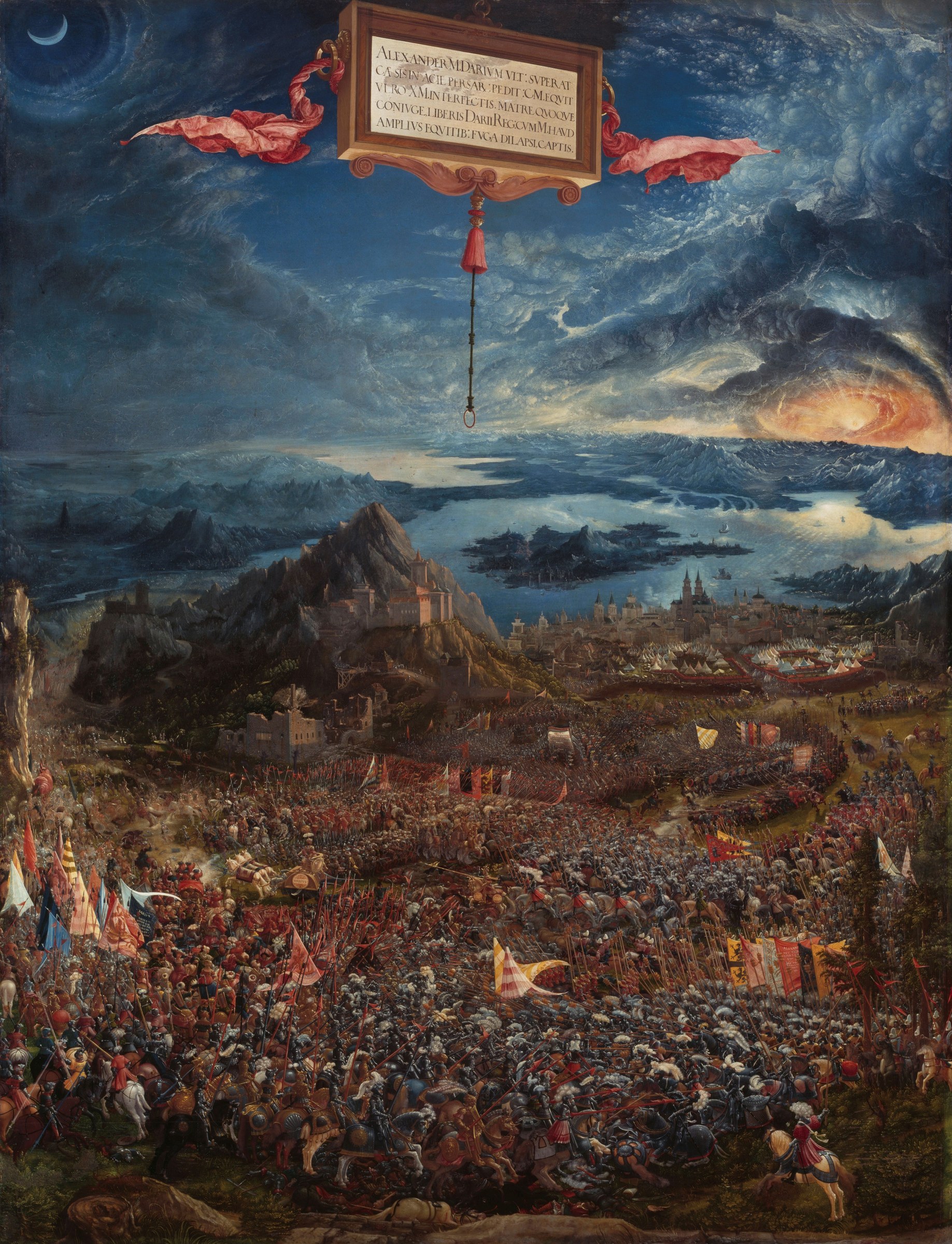
Campaigns & Deeds
Twelve years, three continents, and a trail of numbers no ancient source can be trusted on. The campaigns as the sources report them — with the arithmetic flagged.
The northern and Greek campaigns (336–335 BC)
Before Asia, Alexander secured his base. He campaigned north against the Triballians, Getae, and Illyrians (spring–summer 335), then force-marched south when Thebes revolted. The destruction of Thebes (autumn 335) — the city razed, some 6,000 killed and 30,000 enslaved per Diodorus (17.14) — was deliberate terror, and it worked: Greece stayed quiet. The figures are ancient claims; treat them as order-of-magnitude at most.
The invasion force
Alexander crossed the Hellespont in spring 334 BC with, by the usual modern reckoning from Arrian and Diodorus, roughly 32,000–43,000 infantry and 5,000+ cavalry — Macedonian phalangites with the 18-foot sarissa, hypaspists, Agrianians, Thessalian and allied Greek cavalry, and the elite Companion cavalry Alexander personally led. The Persian Empire could field vastly larger armies; Alexander’s edge was discipline, the combined-arms phalanx, and his own tactical audacity. Every strength figure in this section is an ancient claim — ancient armies’ numbers are systematically inflated, and modern estimates vary.
Granicus (May 334 BC)
The Persian satraps of Asia Minor met Alexander at the Granicus river with — Arrian says — 20,000 cavalry and 20,000 Greek mercenary infantry (1.14). Alexander forced a contested river crossing uphill, personally led the Companion charge, and nearly died: his helmet was cleft by the axe of Rhoesaces (or Spithridates — the sources differ on who struck), and Cleitus the Black severed the attacker’s arm. The mercenaries, surrounded, were slaughtered almost to a man — Alexander’s warning to Greeks who fought for Persia. Asia Minor lay open; Sardis surrendered, Miletus and Halicarnassus were taken by siege. See the three great battles.
Issus (November 333 BC)
Darius III took personal command and maneuvered behind Alexander into the narrow coastal plain at Issus — terrain that neutralized Persian numbers (Arrian 2.6–11 gives Darius 600,000; modern historians suggest 60,000–100,000). Alexander’s oblique attack — refusing his left, smashing with his right — collapsed the Persian line. Darius fled in his chariot, then on horseback, abandoning his family, chariot, bow, and cloak. The Macedonians captured Darius’ mother Sisygambis, wife Stateira, and children, whom Alexander treated with conspicuous honor — the subject of Veronese’s famous painting (and of Arrian 2.12, Diodorus 17.37–38).
Tyre, Gaza, Egypt (332–331 BC)
The seven-month siege of Tyre (January–August 332) was an engineering epic: Alexander built a causeway to the island city, brought up ship-mounted siege towers, and when the walls fell, crucified some 2,000 defenders and sold 30,000 into slavery (the numbers are Diodorus’/Arrian’s). Gaza fell after two months. Egypt then surrendered without a fight — the Persian satrap Mazaces had no army to resist with.
In Egypt Alexander founded Alexandria (winter 332/331), the city that would outlive everything else he built, and made the desert pilgrimage to the oracle of Ammon at Siwa. What the oracle said is unrecoverable; the sources offer competing versions (Arrian 3.3–4; Plutarch, Alex. 27; Diodorus 17.50–51). What is certain is the political use Alexander made of it: from 331 he increasingly presented himself as the son of Ammon/Zeus.
Gaugamela (1 October 331 BC)
The decisive battle of the Persian war, on an open plain where Darius had leveled the ground for his chariots and deployed perhaps 100,000+ men (ancient figures run to a million; all inflated) with scythed chariots and fifteen elephants — the first elephants a European army ever faced. Alexander’s oblique advance, the feigned gap in his line that swallowed the chariot charge, and the wedge charge of the Companions straight at Darius broke the Persian center. Darius fled; his army dissolved. Babylon and Susa surrendered; Persepolis was taken in January 330, and its palaces were burned that winter — by drunken accident per Diodorus (17.72) and Curtius (5.7), or by policy per some modern readings. The burning’s meaning is genuinely disputed.
The hunt for Bessus and the eastern wars (330–327 BC)
Darius was murdered by his satrap Bessus in July 330. Alexander — who had wanted Darius alive — pursued Bessus across Parthia, captured and executed him, and proclaimed himself the legitimate King of Asia. Then came three years of grinding counterinsurgency in Bactria and Sogdiana (329–327): sieges of mountain fortresses (the “Sogdian Rock,” taken by rock-climbing troops), revolts, massacres, and the founding of garrison-cities including Alexandria Eschate (“the Farthest”) on the Jaxartes. Here too Alexander married Roxana (327), killed Cleitus in a drunken quarrel (328), and broke with Callisthenes over proskynesis.
India (326 BC)
Crossing the Indus in spring 326, Alexander defeated King Porus at the Hydaspes (May/June) in one of the most admired set-piece battles of antiquity: a secret upstream crossing in monsoon-swollen flood, elephants met with disciplined infantry tactics, and a cavalry envelopment. Porus fought bravely; Alexander, impressed, restored his kingdom and added territory. Bucephalas died in June 326, after the battle.
Then, at the Hyphasis, the army mutinied: eight years from home, facing reports of even larger kingdoms beyond (the Nanda empire of the Ganges), the men refused to march east. Alexander’s three-day sulk in his tent is one of the tradition’s most human scenes (Arrian 5.25–28). He turned back — and sacrificed to the gods, leaving altars marking the easternmost point of his advance.
The return (326–324 BC)
The voyage down the Indus was a rolling campaign against the Malli and others; storming a Mallian town, Alexander was struck in the lung by an arrow and nearly died — his men thought him dead, and the army’s grief reportedly turned to fury. Then the Gedrosian desert crossing (late 325): attempting to march an army along the Makran coast where, tradition says, only Semiramis and Cyrus had gone before, Alexander lost thousands to thirst and flash floods. Whether it was punishment, emulation, or logistical failure is debated; the human cost is not.
Nearchus’ fleet, meanwhile, sailed from the Indus to the Persian Gulf — a voyage of exploration recorded in Arrian’s Indica from Nearchus’ own account.
Deeds beyond battle
- Cities: Alexander founded or refounded dozens of cities — Alexandria in Egypt, Alexandria Eschate, Bucephala (for his horse), Alexandria Ariana (Herat), and many more. Most vanished; a few became great. See Alexander’s cities.
- Fusion policy: the Susa mass weddings (324), Persian dress at court, Persians admitted to the Companion cavalry and the phalanx (the Epigoni), the proskynesis controversy. His Macedonians increasingly read all of it as betrayal.
- Administration: Alexander largely kept the Persian satrapy system, replacing satraps with Macedonians and Greeks but preserving the machinery — the empire was conquered, not rebuilt.
Source notes
- Campaign narrative: Arrian, Anabasis 1–7 (the most systematic); Diodorus 17; Curtius 3–10; Plutarch, Alex. 15–77.
- Numbers: ancient figures from Arrian and Diodorus; modern reductions per A. B. Bosworth and others. No figure on this page should be treated as exact.
- Tyre: Arrian 2.15–24; Diodorus 17.40–46; Curtius 4.2–4.
- Gedrosia: Arrian 6.21–27; the death toll is ancient rhetoric, not a count.
Limitations
- Ancient battle numbers are propaganda as much as record. Where modern scholars have proposed serious alternative figures, the page gives the range; where they haven’t, it says the figure is an ancient claim.
- Persian-side sources for the campaigns are essentially nonexistent — the narrative is Macedonian/Greek throughout. The Babylonian diary entry on Gaugamela is the great exception.