The Gordian Knot
The most famous problem-solving anecdote in history — and the sources can't agree whether he untied it, cut it, or cheated.
The setup
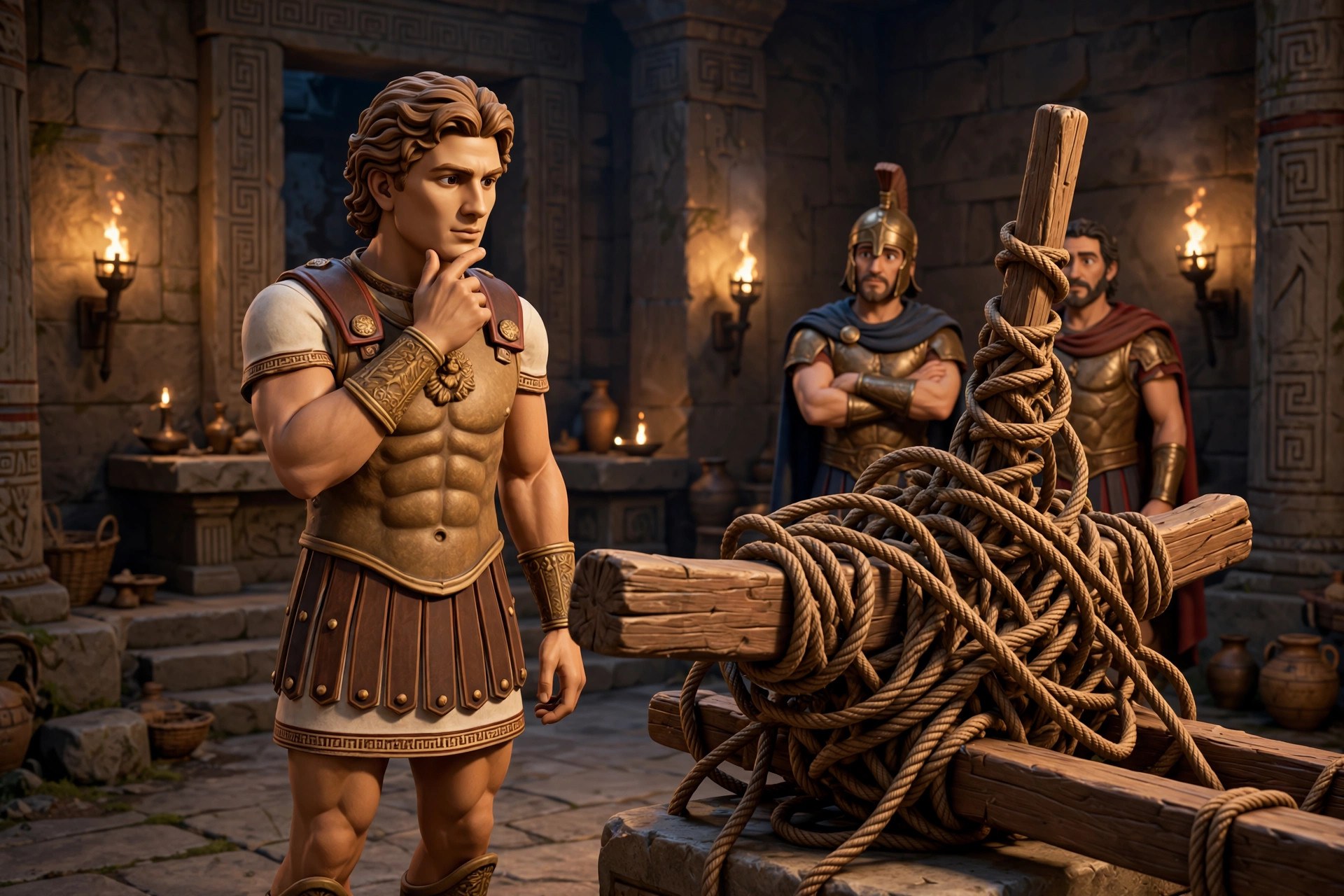
At Gordium in Phrygia (winter 334/333 BC), Alexander was shown the wagon of Gordius, the legendary founder of the Phrygian kingdom. The yoke was fastened to the pole with a knot of cornel bark — no ends visible, no way to see how it was tied. Local prophecy, reported by all our sources: whoever loosed the knot would rule Asia.
The two versions
Arrian (2.3), following Aristobulus: Alexander studied the knot, worked the pin out of the yoke-pole — the pin that held the knot in place — and thereby loosened it enough to pull the yoke apart. No sword. A clever reading of the mechanism.
The vulgate tradition (Curtius 3.1; Plutarch, Alex. 18, reporting the common story): Alexander drew his sword and cut the knot in two. Plutarch adds the detail that some said he worked the pin out (citing Aristobulus), but the sword version is the one the world remembers — it gave the English language the phrase “cutting the Gordian knot.”
Arrian’s version has the better source (an eyewitness engineer); the sword version has the better story. Modern historians mostly follow Arrian — while noting that the prophecy’s fulfillment needed no particular method, only the telling.
Why the story matters
The knot is the Alexander legend in miniature: an impossible problem, a dramatic solution, a prophecy conveniently fulfilled. It shows how the tradition works — the sources agree something happened at Gordium involving a knot and a prophecy, and disagree on the one detail that makes the story. For this site’s purposes it is a textbook reported anecdote: real event behind it, unrecoverable details, perfect propaganda value.
It also pairs with the Diogenes anecdote as the two stories everyone knows — one about power meeting wisdom, one about power meeting impossibility. Both are probably too good to be entirely true, and both are too embedded in the tradition to discard.
Source notes
- Arrian 2.3 (Aristobulus’ version); Plutarch, Alex. 18; Curtius 3.1.18–19; Justin 11.7.
- The Phrygian background: Gordium’s archaeology (the “Midas Mound” tumulus) is real; the wagon and knot are not archaeologically attested.
Limitations
- No contemporary account of the Gordium episode exists; the earliest versions are 300+ years later.
- The prophecy’s wording varies between sources; “rule Asia” is the consensus rendering.