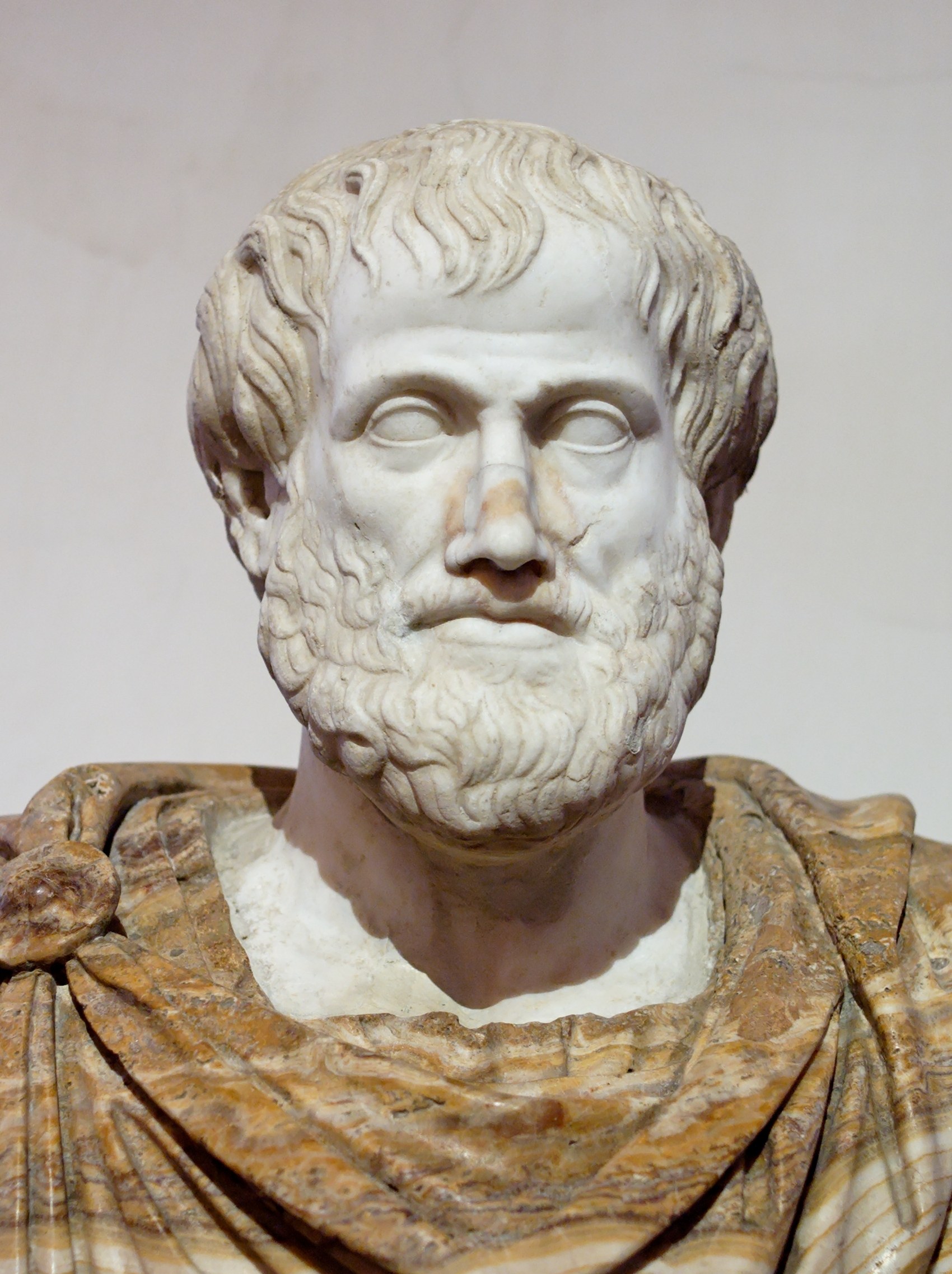
Alexander & Aristotle
The most famous teacher-pupil pair in history — and we can barely prove what was taught. The evidence, the legends, and the philosophical fallout.
Mieza (c. 343–340 BC)
Philip II hired Aristotle — then in his early forties, formerly of Plato’s Academy — to tutor the thirteen-year-old Alexander at the sanctuary of the nymphs at Mieza. Plutarch (Alex. 7–8) is our main source: Aristotle taught the prince ethics, politics, and (in the famous phrase) the “secret” doctrines; he gave him an annotated copy of the Iliad which Alexander carried on campaign and supposedly slept with under his pillow, alongside his dagger.
What did the curriculum actually contain? Plausibly: Homer and the poets, rhetoric, ethics, politics, natural science, medicine. Aristotle’s own school was intensely empirical — collecting constitutions, dissecting animals — and some historians see the campaign’s scientific staff (the surveyors, the naturalists, the bematists who measured marches) as Aristotle’s influence made institutional. That is attractive and unprovable.
The reported sayings
Two famous lines tie them together, both from Plutarch’s Apothegms — both reported anecdotes, not transcripts:
- “I am indebted to my father for living, but to my teacher for living well.”
- “I had rather excel others in the knowledge of what is excellent, than in the extent of my power and possession.”
See sayings. Whether Alexander said either, the tradition wanted him to have been Aristotle’s prize pupil.
The break
The relationship cooled — or ruptured. The flashpoint was Callisthenes, Aristotle’s nephew and Alexander’s court historian, executed (or left to die in chains) in 327 BC after opposing proskynesis. The tradition says Aristotle never forgave Alexander, and quoted him: that Alexander’s power would end with his life, or words to that effect (the exact remark is itself anecdotal).
Later gossip went further: the poisoning rumors at Alexander’s death implicated Aristotle as the poison’s supplier (Plutarch, Alex. 77, reporting the rumor to dismiss it). There is no evidence for it; it reads as the tradition’s way of closing the circle between teacher and pupil.
The philosophical question
Did Aristotle’s thought shape Alexander’s empire — or did the empire refute Aristotle’s thought? The sharp version: Aristotle’s Politics treats non-Greeks as “natural slaves” and advises Alexander (in a possibly spurious letter) to treat Greeks as a leader and barbarians as a master. Alexander’s actual practice — the Susa weddings, Persians in the phalanx, the Epigoni, ruling as King of Asia rather than merely avenger of Greece — points the opposite way. Scholars divide:
- The influence school: the scientific expedition, the city foundations, the syncretism all bear the school’s stamp.
- The rupture school: Alexander outgrew or rejected the teaching; the pupil became the refutation of the master.
- The minimalist school: we know so little about the Mieza years that the whole debate is built on air.
What is certain: Aristotle outlived his pupil by a year, dying in 322 BC — reportedly fleeing Athens “lest the Athenians sin twice against philosophy” (the remark is anecdotal; the flight, after Alexander’s death removed his protection, is historical).
Source notes
- Mieza and the Iliad: Plutarch, Alex. 7–8; Diogenes Laërtius 5.1 (Aristotle’s life).
- Callisthenes affair: Arrian 4.10–14; Plutarch, Alex. 53–55.
- The “natural slaves” doctrine: Aristotle, Politics 1; the letter of advice to Alexander is of disputed authenticity.
- Modern discussion: Bosworth, Conquest and Empire; Lane Fox, Alexander the Great (on the Mieza years).
Limitations
- No curriculum from Mieza survives; no letter between teacher and pupil is securely genuine.
- The “Aristotle the poisoner” story is rumor reported by hostile or sensational sources, dismissed by Arrian and Plutarch.