Reception & Debates
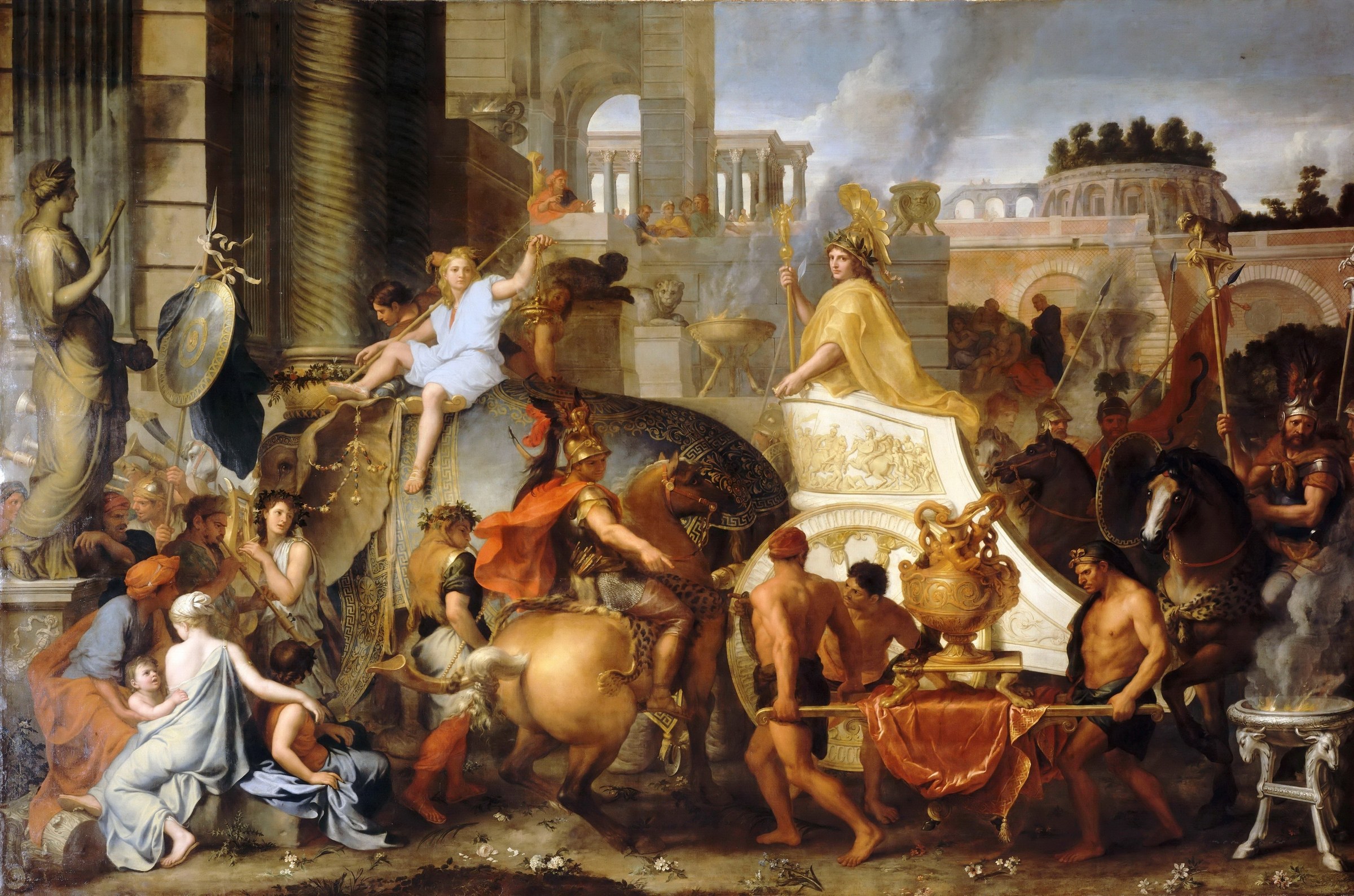
Every age gets the Alexander it needs. The conqueror has been a god, a knight, a philosopher-king, a war criminal, and a management guru — rarely all at once, never quite the man.
Antiquity: the first spin doctors
Alexander’s own court started it. Callisthenes wrote the official heroic narrative (lost); Onesicritus invented the Amazon queen Thalestris episode (his patron Lysimachus’ reported quip: “I wonder where I was at the time” — a rare ancient fact-check). After Alexander’s death, the Diadochi all claimed his legacy: Ptolemy wrote a sober history, Seleucus put Alexander’s deified face on coins, and everyone fought “for” his heir while carving up his empire.
The Romans were obsessed. Pompey took the cognomen Magnus (“the Great”) in imitation; Julius Caesar wept before Alexander’s statue at Gades, ashamed at how little he had done by the same age (Suetonius, Div. Iul. 7); Augustus visited the tomb at Alexandria and, asked if he wanted to see the Ptolemies too, reportedly said he came to see a king, not corpses. Caracalla raised a “Macedonian phalanx” in imitation. Roman moralists, meanwhile — Seneca, Lucan — used Alexander as the textbook tyrant drunk on fortune.
The medieval Alexander
Through the Alexander Romance, the Middle Ages got a chivalric Alexander: a knight-errant who flies in a griffin-drawn basket, dives to the ocean floor in a glass barrel, debates the Brahmins of India, and builds the Gates against Gog and Magog. He appears in Persian epic as Iskandar (Nizami, Ferdowsi), in Arabic tradition, and — in the identification many Muslim scholars make — as Dhul-Qarnayn (“the Two-Horned One”) of the Qur’an (18:83–98). The horns, notably, match the ram’s horns of Ammon on the Lysimachus coin portraits.
The modern debates
Serious historians argue about Alexander on several live fronts:
Was he “great”? W. W. Tarn’s idealized Alexander (a visionary of the brotherhood of mankind) dominated the early 20th century; later scholars — Ernst Badian, A. B. Bosworth — emphasized the purges, the massacres, the megalomania. Pierre Briant’s Alexander the Great and His Empire re-centered the Persian side. The field has largely settled on: brilliant general, ruthless ruler, and a man increasingly deformed by absolute power — but the temperature of the argument hasn’t dropped.
What did he intend? The “last plans” (conquest of Arabia, a fleet for the western Mediterranean, mass population transfers — Diodorus 18.4) suggest ambitions that ran to the edge of the map. Whether he had a coherent vision of a fused Greco-Persian empire or simply the next campaign is unknowable; the Susa weddings and the Epigoni point one way, the drinking and the purges the other.
How did he die? See the death mystery: malaria, typhoid, West Nile, Guillain-Barré, poison — the only thing scholars agree on is that the Royal Journals describe a real, days-long fever.
The “policy of fusion”: was Alexander genuinely trying to merge Macedonian and Persian elites, or was it ad hoc improvisation dressed up afterward? The evidence (Susa, the Epigoni, Persian dress, proskynesis) is real; the intention behind it is argued.
Alexander in modern culture
Hollywood (Oliver Stone’s Alexander, 2004), novels (Mary Renault’s Fire from Heaven and The Persian Boy — the best-selling Alexander of the 20th century), strategy games, business-leadership books that strip-mine him for aphorisms he never said (see sayings). The management-guru Alexander is the purest case of reception-as-distortion: a conqueror who executed his generals and burned cities, repackaged as a team-builder.
Source notes
- Roman reception: Suetonius, Divus Iulius 7; Dio Cassius 51.16 (Augustus at the tomb); Plutarch, Life of Pompey.
- Medieval material: the Romance tradition (see the Alexander Romance); Nizami’s Iskandarnameh; Qur’an 18:83–98 (Dhul-Qarnayn identification debated among scholars — presented as an identification, not a fact).
- Modern historiography: Tarn (1948), Badian, Bosworth (Conquest and Empire, 1988), Lane Fox (1973), Briant (2010/2017).
Limitations
- “Reception” is selective by nature; this page samples the turning points, not the full 2,300-year bibliography.
- The Dhul-Qarnayn identification is a scholarly and theological debate, not a settled fact; this site reports the identification as widely made, not as proven.