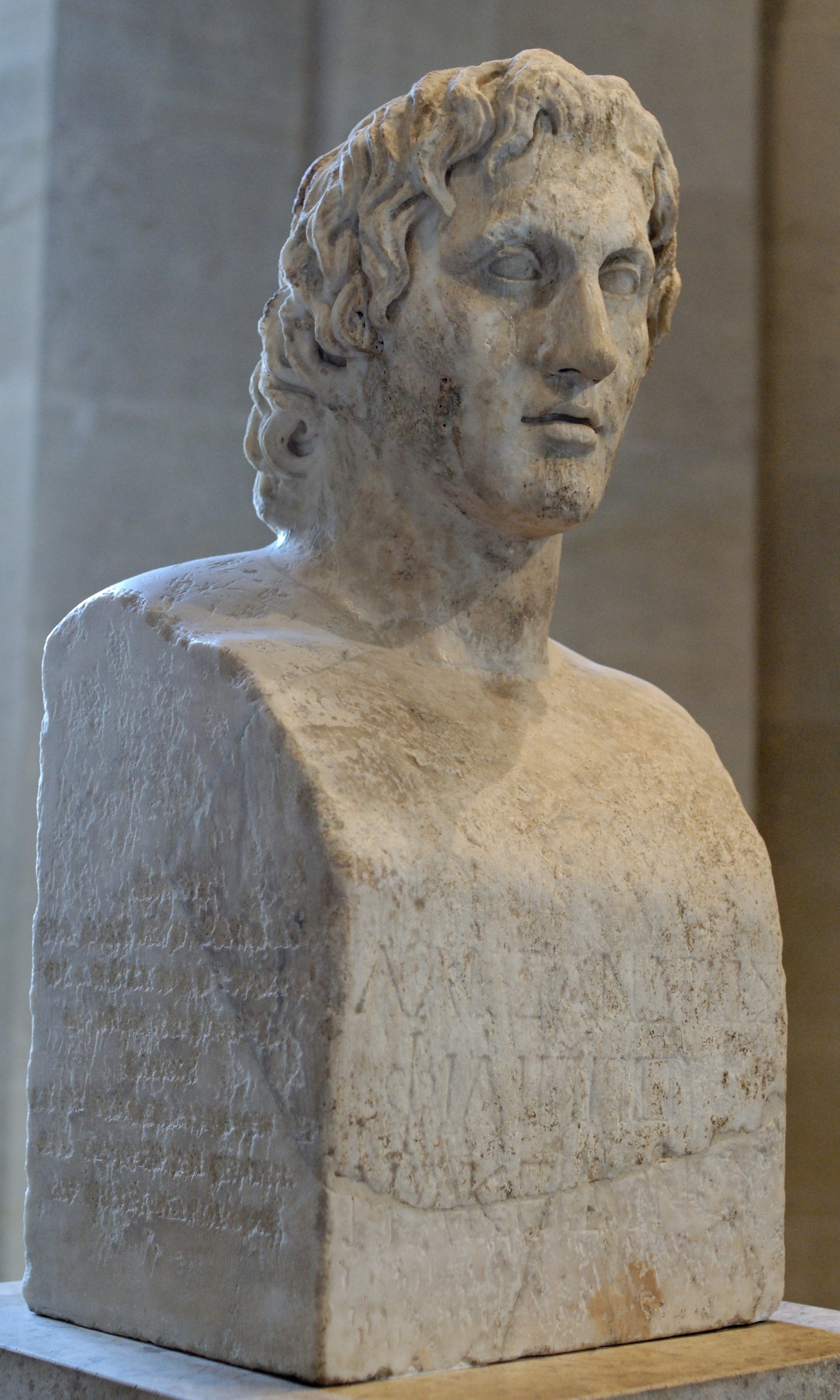
Biography
The life of Alexander III of Macedon, 356–323 BC: the sources' account, told straight, with the seams showing.
Childhood and youth (356–336 BC)
Alexander was born at Pella, the Macedonian capital, in the summer of 356 BC — traditionally 20 July (the month Hecatombaeon, per Plutarch, Life of Alexander 3). His father was Philip II, the king who had turned Macedon from a fractious backwater into the dominant power of Greece; his mother was Olympias, a formidable Epirote princess devoted to the cult of Dionysus. Plutarch records the omens that later writers attached to his birth — that the temple of Artemis at Ephesus burned down that night — the kind of story that grows around a legend.
As a boy Alexander was, by all accounts, precocious and difficult. The famous early anecdote is the taming of Bucephalas: a magnificent but unmanageable Thessalian horse, offered to Philip for thirteen talents (Plutarch, Alex. 6). The young Alexander noticed the horse was frightened by its own shadow and turned it to face the sun — then rode it. Philip, weeping with joy according to the story, told him: “O my son, look thee out a kingdom equal to and worthy of thyself, for Macedonia is too little for thee.” It is a reported anecdote, not a verified event — but it is the earliest character sketch we have, and ancient writers clearly believed it captured something real.
Around 343 BC Philip hired Aristotle to tutor the thirteen-year-old prince at Mieza, in a sanctuary of the nymphs. The relationship between the philosopher and the future conqueror is one of history’s great might-have-beens; see Alexander and Aristotle.
Alexander first tasted command at sixteen, left as regent when Philip campaigned against Byzantium (340 BC) — he put down a revolt of the Maedi and founded his first city, Alexandropolis. At eighteen he commanded the left wing at Chaeronea (338 BC), where Philip crushed the allied Greek city-states and ended classical Greek independence in all but name. Two years later, at a wedding feast at Aegae, Philip was stabbed to death by his bodyguard Pausanias. Alexander was twenty, and king.
King of Macedon (336–334 BC)
The succession was not secure: rival claimants, a suspicious army, Greek cities scenting freedom. Alexander moved fast. He executed or sidelined rivals (including his cousin Amyntas and, by most accounts, the infant son of Philip’s new wife Cleopatra), secured the army’s acclamation, and marched south to have himself confirmed as hegemon of the League of Corinth — the alliance Philip had built for the war against Persia.
When Thebes revolted in 335 BC, Alexander razed the city — killing thousands, enslaving the rest — and spared only the house of the poet Pindar. The message was unmistakable, and Greece stayed quiet for the rest of his life. The destruction of Thebes is one of the fixed moral facts of his career: brilliant statecraft or atrocity, depending on the teller.
The Persian war: Granicus to Gaugamela (334–331 BC)
In spring 334 BC Alexander crossed the Hellespont with roughly 40,000–50,000 men. He made straight for the symbolic gestures first: sacrifices at Troy, a wreath laid at the tomb of Achilles — the hero he modeled himself on, whose Iliad he supposedly slept with under his pillow (Plutarch, Alex. 8, 15; the annotated copy was Aristotle’s).
Then came the three battles that destroyed the Achaemenid Empire, covered in detail on the three great battles page:
- Granicus (May 334): Alexander forced a river crossing against the Persian satraps of Asia Minor and won a cavalry battle that opened Anatolia to him. He nearly died in the fighting — his helmet was split by an axe, and Cleitus the Black saved his life.
- Issus (November 333): Darius III himself led a huge army into a narrow coastal plain in Cilicia. Alexander’s oblique attack collapsed the Persian line; Darius fled, abandoning his family, his chariot, and his bow.
- Gaugamela (1 October 331): the decisive battle, on an open plain near Arbela. Outnumbered several times over, Alexander’s wedge charge punched through to Darius, who fled again. The Persian Empire’s field army was finished.
Between Issus and Gaugamela came the sieges — Halicarnassus, the brutal seven-month siege of Tyre (332), Gaza — then Egypt, where he founded Alexandria (331) and made the famous desert journey to the oracle of Ammon at Siwa, which hailed him (in some sense) as the god’s son. Whatever the oracle said — the sources disagree, and the priests’ words are lost — Alexander treated divine sonship as useful politics from then on.
After Gaugamela he took Babylon, Susa, and Persepolis, the ceremonial heart of the Persian Empire, and burned its palaces in the winter of 330 BC — in a drunken revel, says the tradition (Diodorus 17.72, Curtius 5.7, Plutarch Alex. 38), at the instigation of the Athenian courtesan Thaïs. Whether accident, revenge for Xerxes’ burning of Athens, or policy, the burning is one of the most debated acts of his reign. Darius III, meanwhile, was murdered by his own satrap Bessus in July 330. Alexander hunted Bessus down, executed him, and was now — by his own claim — the legitimate king of Asia.
The eastern campaigns (330–326 BC)
The war was supposed to be over. It wasn’t. Alexander spent three grinding years (329–327) in Bactria and Sogdiana (modern Afghanistan and Central Asia) fighting guerrilla resistance, founding garrisons, and marrying Roxana, a Bactrian noblewoman — a political marriage his Macedonians resented.
This period also produced the darkest episodes of his reign. In 328, at Maracanda (Samarkand), in a drunken quarrel, Alexander killed Cleitus the Black — the man who had saved his life at the Granicus — with a spear. He was reportedly inconsolable afterward. Around the same time he had his court historian Callisthenes executed (or left to die in chains — the sources differ) after Callisthenes resisted the introduction of proskynesis, the Persian court ritual of prostration, which Greeks read as worship due only to gods.
In 326 he crossed the Indus and defeated the Indian king Porus at the Hydaspes — a masterpiece of a river-crossing battle — then treated Porus with famous magnanimity, restoring his kingdom. But at the Hyphasis (Beas) river his exhausted army refused to march further east. Alexander sulked in his tent for three days, then turned back. He had reached the edge of the known world, and his men would not follow him past it.
The return and the death (326–323 BC)
The return was brutal: a savage campaign down the Indus (Alexander was nearly killed storming a Mallian town, an arrow piercing his lung), then the catastrophic march through the Gedrosian desert (325), where thousands died of thirst and heat — a disaster some historians read as punishment for the Hyphasis mutiny, others as a failed attempt to outdo earlier conquerors.
In 324, at Ecbatana, Hephaestion — Alexander’s closest friend, possibly his lover, certainly his second self — died of a fever. Alexander’s grief was extravagant and terrifying: he ordered mourning across the empire, executed Hephaestion’s doctor, and petitioned the oracle at Siwa to grant his friend divine honors. The same year he staged the mass Susa weddings, marrying his officers to Persian noblewomen and taking two Persian wives himself — the fusion policy made flesh.
He died at Babylon in June 323 BC, aged thirty-two, after about ten days of fever that followed a drinking party at the house of Medius of Larissa. The Royal Journals — the closest thing to a contemporary record we possess — logged his decline day by day. What killed him is genuinely unknown: malaria, typhoid, poisoning, and a neurological syndrome have all been argued by serious scholars. See the death mystery. His last reported words, when asked to whom he left his kingdom: “tôi kratistôi” — “to the strongest.” The saying is reported by Diodorus and Curtius; it may be a mishearing of “to Craterus,” one of his generals.
He left no undisputed heir — only the unborn child of Roxana (the future Alexander IV) and a mentally disabled half-brother, Philip Arrhidaeus. The empire immediately began to tear itself apart in the Wars of the Diadochi.
Source notes
- Framework: Arrian, Anabasis 1–7; Plutarch, Life of Alexander; Diodorus 17; Curtius 3–10; Justin’s epitome of Trogus.
- Bucephalas taming and Philip’s remark: Plutarch, Alex. 6 (Dryden/Clough translation).
- Achilles’ tomb and the annotated Iliad: Plutarch, Alex. 8, 15.
- Cleitus’ death: Arrian 4.8–9; Plutarch, Alex. 50–52; Curtius 8.1–2.
- Callisthenes: Arrian 4.10–14; Plutarch, Alex. 53–55.
- Death and last words: Arrian 7.24–28 (Royal Journals); Diodorus 17.117; Curtius 10.5.
Limitations
- Every anecdote above comes from writers centuries later; the “character” of Alexander is partly their construction. See the sources problem.
- Numbers (army sizes, casualties) are ancient claims, not verified counts; see campaigns and the three great battles.
- The nature of Alexander’s relationship with Hephaestion is disputed; the sources call Hephaestion his dearest friend, and later tradition reads more into it. This site reports what the sources say.