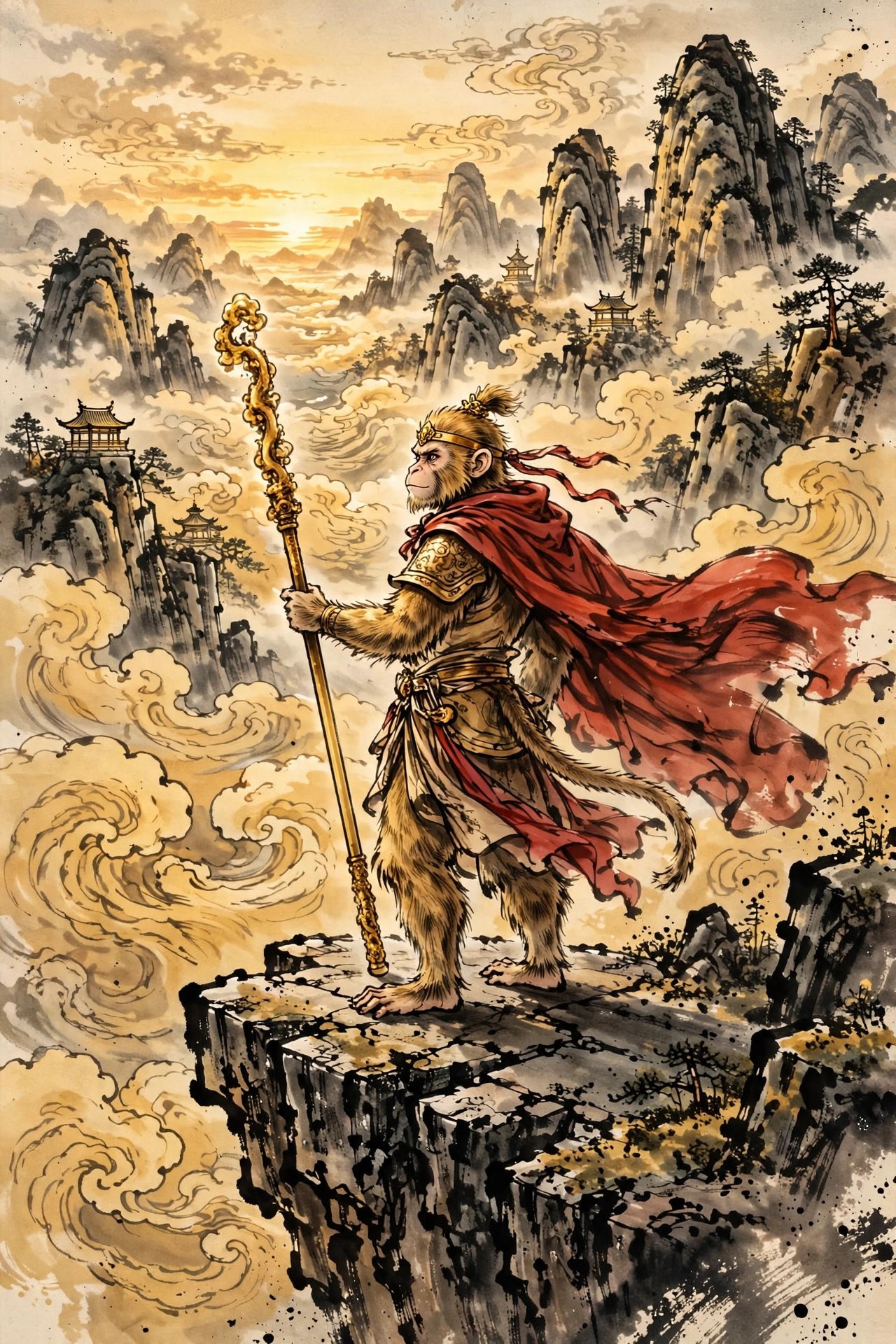
Who Is Sun Wukong?
A stone-born monkey who learned the Dao, outfought Heaven, spent 500 years under a mountain, and earned a Buddha's crown — the full story of literature's greatest rebel.
The biography of the Great Sage
Birth (chapters 1–2). On the Mountain of Flowers and Fruit, in the country of Ao-lai on the Eastern Continent of Superior Body, a stone egg sits atop the peak, drinking the essences of heaven and earth until — with a crack like thunder — a stone monkey bursts out. He bows to the four directions, and light shoots from his eyes all the way to Heaven’s palace, startling the Jade Emperor. See the stone egg.
Kingship (chapter 3). The young monkey proves his courage by leaping through the Water Curtain Cave’s waterfall, claiming the cave as his palace and the crown of the Flower-Fruit monkeys. Restless, he fears the one enemy no king escapes: death. At 342 years old he leaves the mountain to find a master who can teach him the way past death.
The training (chapters 1–2). In the Western Continent he finds the Patriarch Subodhi (Xuputi) at the Cave of the Slanting Moon and Three Stars. Wukong learns the 72 Earthly Transformations, the art of the somersault cloud, and the secrets of immortality — in seven years. Then he’s expelled: Subodhi, foreseeing trouble, forbids him from ever naming his teacher.
Havoc in Heaven (chapters 3–7). Armed with the Ruyi Jingu Bang (seized from the Dragon King of the Eastern Sea) and drunk on the immortality peaches and Laozi’s elixir pills, Wukong rebels when Heaven offers him the insulting post of “Protector of the Horses.” He takes the title Qitian Dasheng — Great Sage, Equal of Heaven — and defeats every army Heaven sends. The Buddha finally appears, wins the famous wager (Wukong’s fastest somersault cannot leave the Buddha’s palm), and pins him beneath Five Elements Mountain for 500 years. See havoc in heaven.
The pilgrimage (chapters 13–99). The Tang monk Sanzang frees him; Guanyin’s golden headband makes obedience enforceable. For fourteen years across deserts, kingdoms, and demon-haunted mountains, Wukong fights, tricks, begs Heaven for help, and — three times — quits in a fury, only to return. He meets 81 predestined tribulations with his brothers Zhu Bajie and Sha Wujing.
Buddhahood (chapter 100). At Vulture Peak, the Buddha removes the headband and names him Victorious Fighting Buddha (Douzhansheng Fo). The rebel is canonized — not for obedience, but for fighting all the way through.
Why he endures
Wukong is two characters in one: the untamed trickster who says no to every authority, and the disciplined disciple who finishes the road. Chinese readers have loved the first and needed the second for four hundred years. Western readers met him as “Monkey” through Arthur Waley’s beloved abridgment (1942) — see sources.
Source notes
- Plot summary follows the 100-chapter Xiyouji (chapters 1–7 for the origins/rebellion; 8–100 for the pilgrimage).
- The Waley abridgment (1942) translates roughly the first 30 chapters; full translation: Anthony C. Yu (4 vols., revised 2012), copyrighted.
- Allegorical reading (“mind-monkey”): standard Buddhist interpretation; see symbolism.