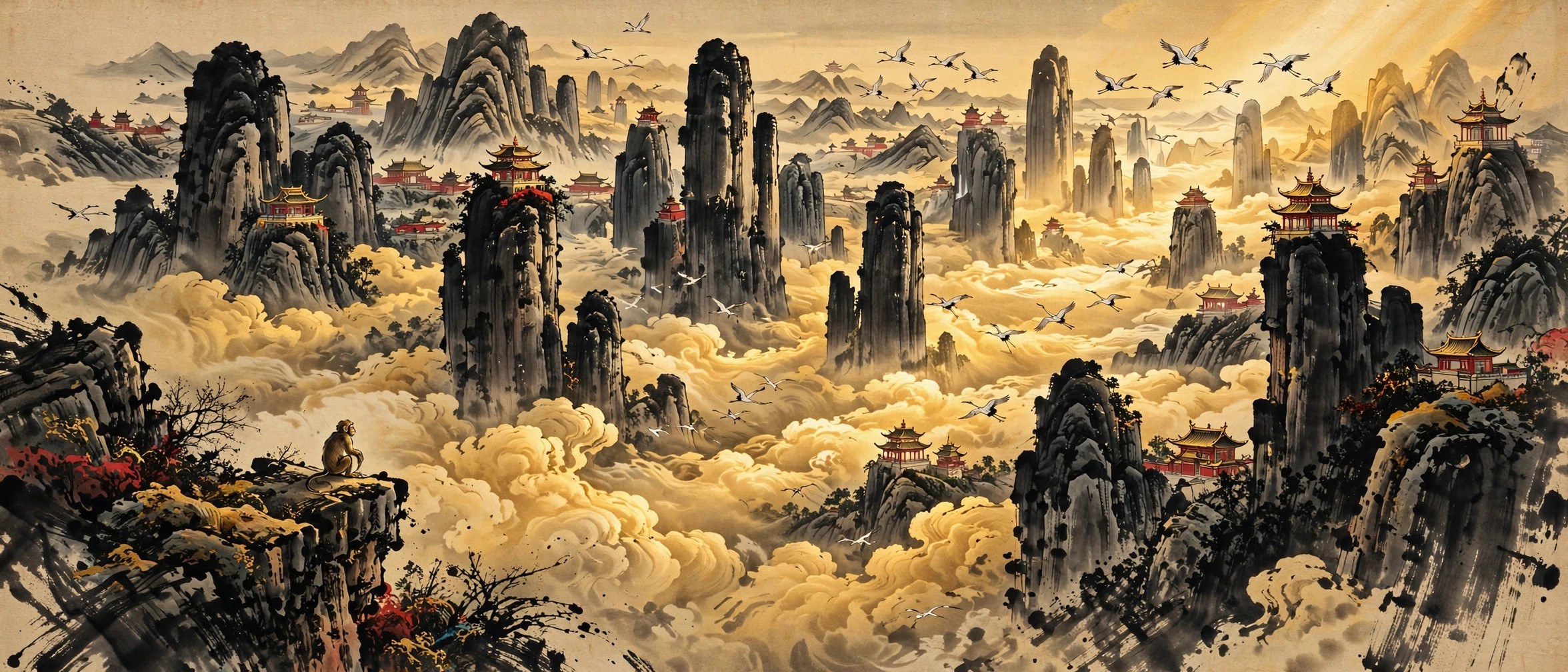
The Cloud Mountains
A traveler's guide to the novel's world — from the Water Curtain Cave to the Thunder Monastery, by cloud, by staff, and by foot.
The world in three realms
The novel’s cosmos is the traditional Chinese three-tiered universe — Heaven above, Earth in the middle, the Underworld below — with a Buddhist Western Paradise off the map’s western edge. Wukong has, at various points, trespassed in all of them.
Key places
The Mountain of Flowers and Fruit (花果山)
Wukong’s home and kingdom: an island mountain of the Eastern Continent, crowned by the stone that bore him and veiled by the Water Curtain Cave. It is the Daoist “blessed land” — perfect, self-sufficient, and worth defending forever. Wukong returns here between adventures and at the novel’s end; every exile is measured by distance from this mountain.
The Heavenly Palace (天宮)
The Jade Emperor’s Cloud Palace: bureaucratic, gilded, and — in the novel’s satire — comically incompetent at its one job. Wukong’s Havoc exposed it; the pilgrimage keeps calling on it for help. Heaven in this novel is less a paradise than a civil service with thunder.
The Eastern Sea Dragon Palace (東海龍宮)
Beneath the waves, the Dragon King Ao Guang keeps his treasury — including the world-stabilizing pillar Wukong requisitioned as a staff. The sea kingdoms (four dragons, four seas) recur as allies, victims, and occasional obstacles.
The Flaming Mountains (火焰山)
A range that burns perpetually, crossable only with Princess Iron Fan’s banana-leaf fan. The novel’s most famous landscape: hell as geography, extinguished by negotiation (and one borrowed fan) rather than force.
The Kingdom of Women (女兒國)
A queendom where the pilgrims’ maleness makes them the marvels. The novel’s gentlest satire — and one of its most quoted episodes.
The Thunder Monastery (雷音寺)
The destination: the Buddha’s Western Paradise on Vulture Peak, where the scriptures are kept and the promotions conferred. Fourteen years and 81 tribulations from Chang’an. The road’s end is a library.
How the world works
- Distance is moral. The westward road is measured in suffering, not li; demons cluster where the pilgrims’ virtue is weakest.
- Every place has a bureaucracy. Mountains have gods, rivers have dragon kings, even the underworld keeps ledgers (which Wukong burned). The cosmos is administered — badly.
- Home is a cave behind a waterfall. For all the cosmic travel, the novel’s emotional center never moves: the Water Curtain Cave, where 47,000 monkeys wait for their king.
Source notes
- Place descriptions follow the 100-chapter novel; the three-realm cosmology is traditional Chinese, shared with Buddhist and Daoist texts.
- The Flaming Mountains and Kingdom of Women episodes: chapters 54–61.