Adaptations
The most-adapted character in Chinese culture: opera's greatest athlete, film's eternal trickster, television's beloved sage, and gaming's newest immortal.
The opera stage
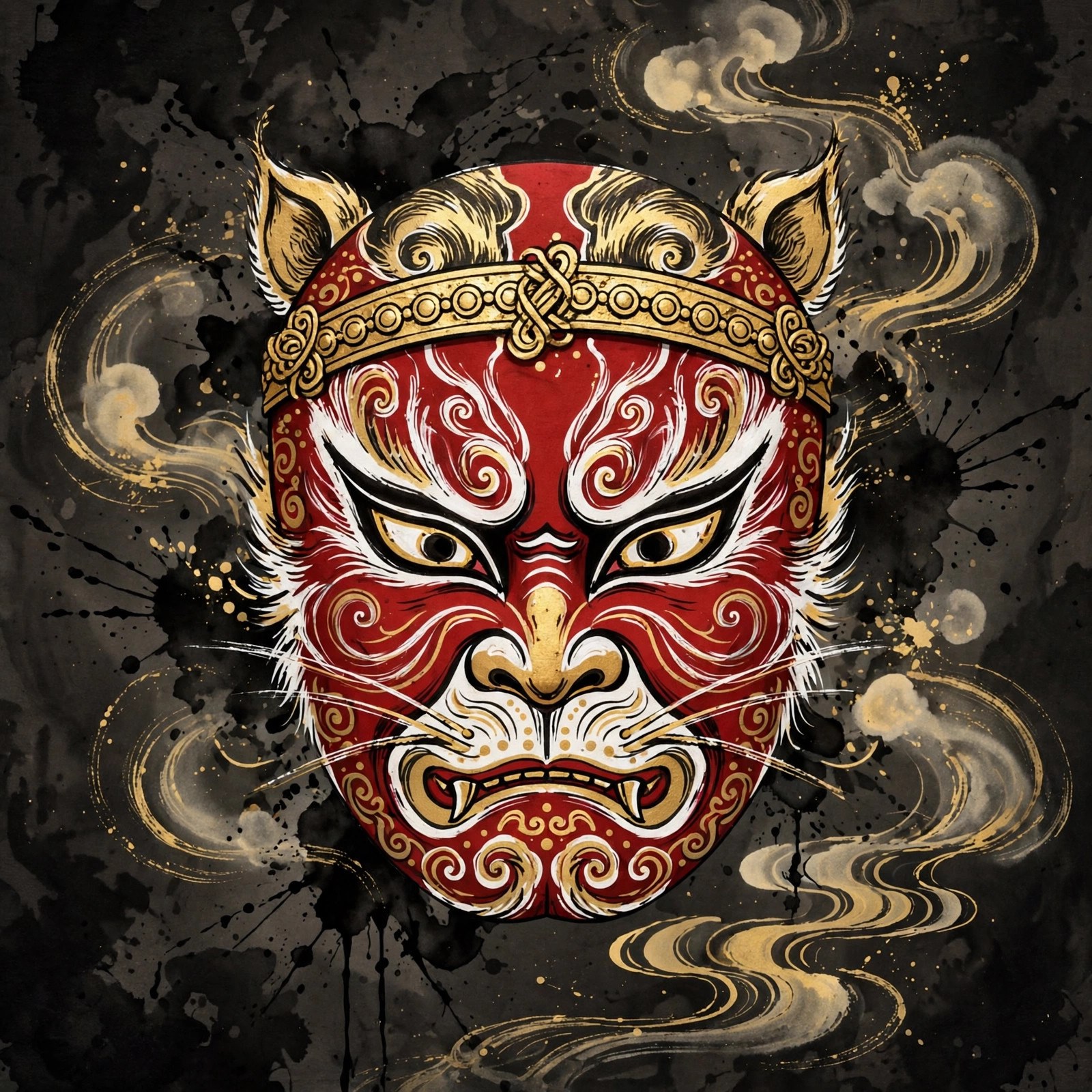
Long before film, Wukong belonged to the stage. Peking opera’s Monkey King (houxi) is the most physically demanding role in the repertoire: the actor trains in acrobatics, martial arts, and the monkey’s movement vocabulary — the scratch, the somersault, the staff-spinning — while wearing the embroidered costume, the pheasant-feathered or plain helmet, and the painted face that signals “monkey” to any Chinese audience. The great 20th-century monkey performers were stars in their own right; the role is a career, not a part.
Film landmarks
- Havoc in Heaven (Danao Tiangong, 1961–1964). The Shanghai Animation Film Studio’s two-part animated feature is the landmark: hand-drawn, scored with traditional opera music, and visually definitive for generations. Its Wukong — designed with opera-mask features — remains the image many Chinese viewers see first.
- The Shaw Brothers era. Hong Kong’s studios turned out exuberant live-action monkey films through the 1960s–70s, full of wire-work and comic-book color.
- A Chinese Odyssey (1995). Stephen Chow’s two-part Hong Kong comedy (Pandora’s Box / Cinderella) retold the pilgrimage as a time-travel romance — a box-office disappointment turned cult phenomenon, and the source of half the Wukong memes in the Chinese internet.
- Modern blockbusters. Big-budget retellings continue, from The Monkey King film series (2014–2018) to animated features, each generation re-measuring itself against the sage.
Television
The 1986 CCTV series Journey to the West — 25 episodes, Liu Xiao Ling Tong as Wukong — is the adaptation that raised a nation: broadcast repeatedly, quoted endlessly, its theme song instantly recognizable. Its Wukong, all mischief and pathos, is for hundreds of millions the Monkey King. Later versions (1998 sequel, 2011 Zhang Jizhong remake, animated series) all negotiate with its shadow.
Games
Wukong was born for games — transformations, a scaling staff, a cloud mount. Black Myth: Wukong (Game Science, 2024) became a global phenomenon: a AAA action RPG rooted in the novel’s mythology, selling millions and carrying the Monkey King to players who had never opened the book. It joins a long line of Wukong appearances in fighting games, MOBAs, and mobile titles — the sage as playable fantasy.
The pattern
Every era’s Wukong is a self-portrait of the era: the opera’s acrobat, the 1961 animation’s folk hero, the 1986 series’ beloved trickster, Chow’s lovesick clown, the game’s power fantasy. The stone monkey keeps hatching, because every generation needs something unbeatable on its side.
Source notes
- Dates and titles above are the standard reference facts for these landmark adaptations.
- This page surveys highlights, not a complete filmography; for sources on adaptation history see sources.