Powers
Seventy-two transformations, a staff that weighs 13,500 catties, a cloud that crosses 108,000 li in one leap, and eyes that see through every disguise. The full catalogue.
The 72 Earthly Transformations
Under the Patriarch Subodhi, Wukong learned the 72 Transformations (qishier bian, 七十二變) — the arts of the Earthly Fiends. With them he can change his shape, his size, and his substance: man, woman, child, demon, temple, tree, or a speck of dust. The standard demonstration — the one that still delights on stage — is shrinking into a fly to eavesdrop, or swelling into a giant to smash a gate. The transformations have one tell that no art can hide: his tail. Again and again, Wukong must tuck it away, coil it, or explain it — the body remembers what the spell forgets.
The Ruyi Jingu Bang
The As-You-Will Gold-Banded Cudgel (Ruyi Jingu Bang, 如意金箍棒) is Wukong’s signature weapon: an iron staff 13,500 catties (roughly eight tons), two rods thick, that obeys thought — growing to pierce the sky or shrinking to a needle he keeps behind his ear. He seized it from the Dragon King of the Eastern Sea, where it had served as the pillar stabilizing the ocean. It was cast, the novel says, by the sage-king Yu the Great to measure the depth of the floods — Wukong’s weapon is literally a tool of world-ordering, stolen and swung.
The somersault cloud
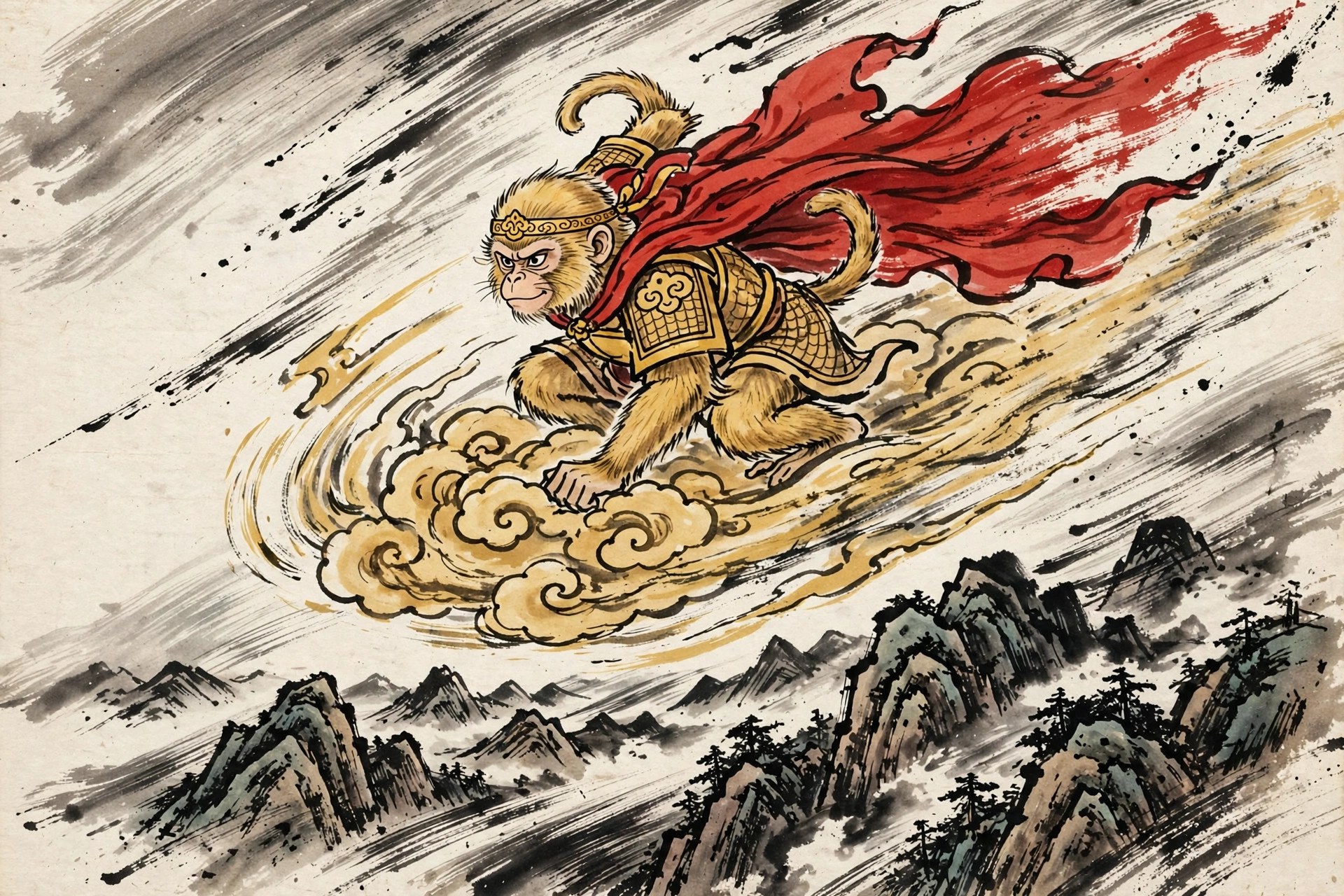
Wukong’s signature travel magic is the somersault (jindou yun, 筋斗雲): one flip carries him 108,000 li (about 54,000 kilometers — roughly once around the world). The Buddha’s wager turned on this: confident he had left the Buddha’s hand behind, Wukong wrote his name on a pillar at the world’s edge and urinated at its base — then learned the pillar was the Buddha’s finger.
Fiery golden eyes
Stewed in Laozi’s Eight Trigrams Furnace for 49 days (a punishment meant to refine him into an elixir), Wukong emerged with fiery golden eyes (huoyan jinjing, 火眼金睛) that see through every disguise, illusion, and transformation. The eyes are the novel’s truth-detector — and its irony engine: Wukong always sees the demon, and Sanzang almost never believes him.
The headband
Not a power but its opposite: the golden headband (jin’gu, 緊箍) Guanyin gave Sanzang. Once tricked onto Wukong’s skull, it tightens whenever the master chants the Tight-Fillet Spell — a headache that drops the Great Sage to his knees. Every power Wukong has bends to one small circlet of gold. Discipline, in this novel, is applied externally until it grows inward.
Source notes
- All powers: chapters 1–7 (acquisition) and used throughout the pilgrimage chapters. The staff’s weight (13,500 catties) and the cloud’s range (108,000 li) are the novel’s figures.
- The tail’s persistence as the transformation’s tell recurs across chapters (e.g., the temple transformation, ch. 4; the fly, ch. 61).