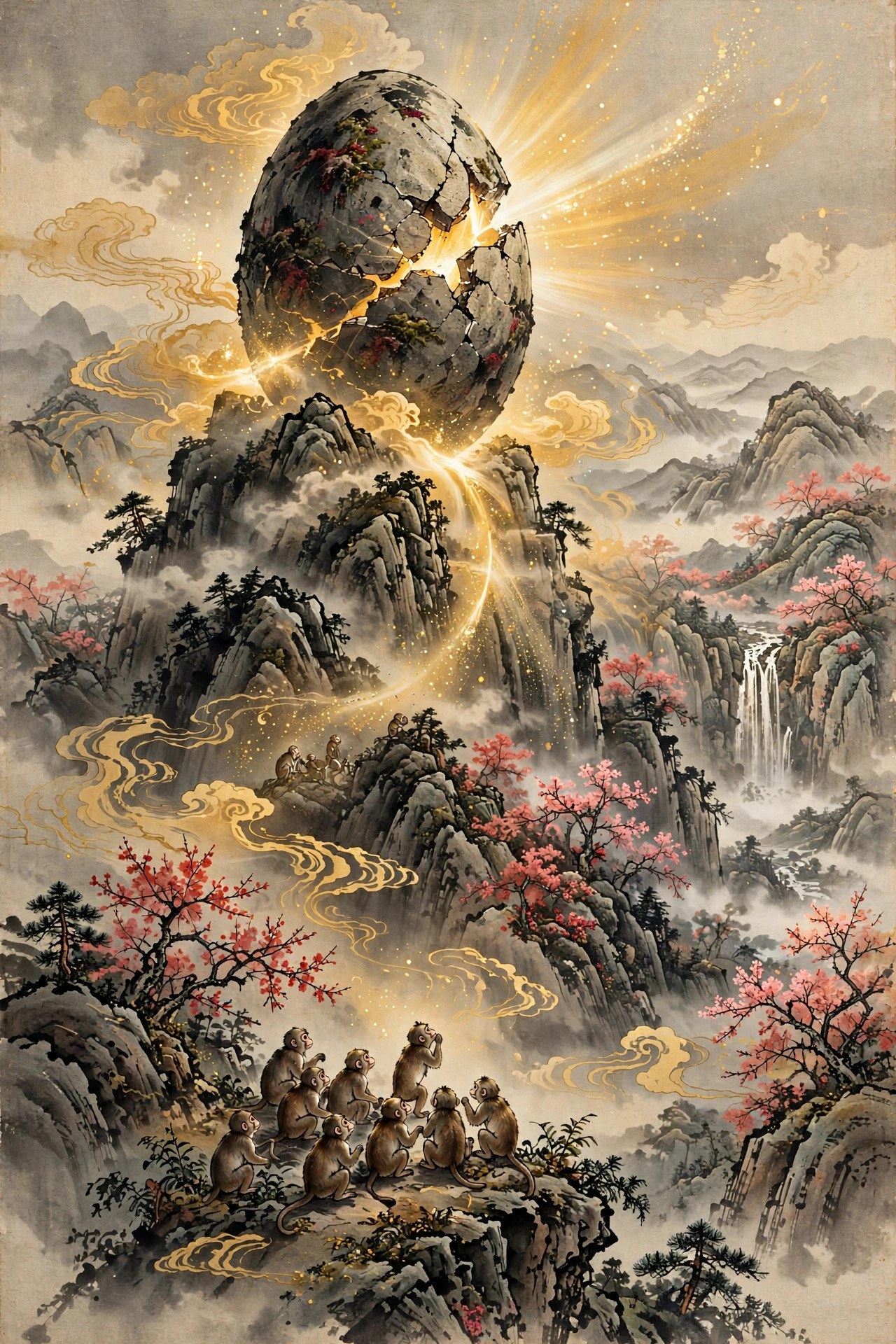
The Stone Egg
Before the staff, the cloud, or the rebellion — a stone egg on a mountain peak, drinking heaven and earth until it cracked open with a sound like thunder.
The birth of the Monkey King
The novel’s first chapter opens on the Mountain of Flowers and Fruit (Huaguoshan, 花果山), in the country of Ao-lai on the Eastern Continent of Superior Body. At its summit stands a magic stone — an immortal rock that has received the essences of heaven and earth since the world was divided from chaos. In time the rock “bore an immortal embryo,” and one day it burst apart “with a crash, producing a stone egg, about as round as a ball.” Wind carries the egg, and out of it hatches a stone monkey.
The newborn has everything in working order from the first breath: he crawls, walks, bows to the four quarters, and light beams shoot from his eyes — two golden flashes that reach straight into the Cloud Palace of the Jade Emperor, who calmly notes that “below us something has been born” and lets it be.
The Water Curtain Cave
The stone monkey grows up among the mountain’s monkeys, distinguished by strength, cleverness, and courage. When the troop finds a great waterfall and wonders where its water comes from, he volunteers to leap through — and finds behind the curtain the Water Curtain Cave (Shuilian Dong, 水簾洞), an iron-bridge paradise stocked with stone furniture, stone bowls, and a stone tablet reading “The Blessed Land of Flower-Fruit Mountain, the Cave Heaven of the Water Curtain.” The troop crowns him Handsome Monkey King (Mei Houwang, 美猴王), and he rules 47,000 monkeys.
What the birth means
- No parents, no past. Wukong is born of stone — of the world itself — which is why Heaven’s bureaucracy has no file on him, and why death’s ledgers (the registers he later burns in the underworld) never quite held him. He is outside every system, which is why every system must deal with him.
- Stone + monkey. The novel fuses two mythic images: the stone as primal matter, older than gods, and the monkey as quicksilver intelligence. One gives him weight; the other gives him motion. Together they make the novel’s thesis: raw spirit must be carved, and quickness must be disciplined.
- The mountain is a paradise. Flower-Fruit Mountain is the Daoist “cave heaven” — a perfected world Wukong will defend forever and return to at the novel’s end. It is the home the rebel never truly leaves; his final Buddhahood still has a throne-room behind a waterfall.
Source notes
- Birth narrative: Xiyouji, chapters 1 and 3 (Water Curtain Cave). The “light from the eyes” scene is chapter 1.
- Our sayings page gives original English renderings of the novel’s lines, labeled as such; see sayings.