Monkey Myths
Was the Monkey King borrowed from India? The Hanuman parallel is real and striking — and the honest scholarship is more interesting than the simple answer.
The Hanuman parallel
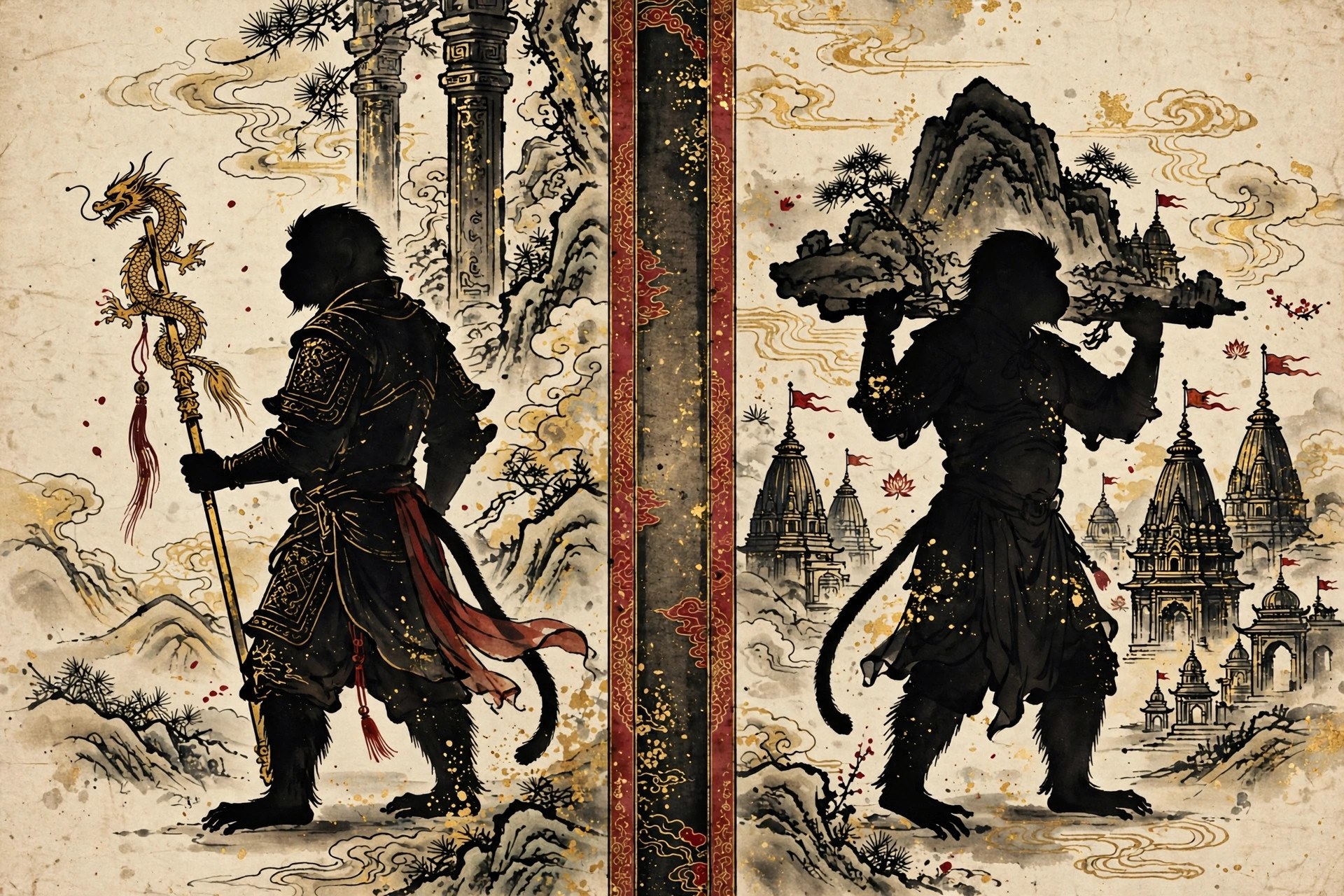
Readers of the Indian epic Ramayana (composed centuries before the Ming novel) meet Hanuman: a divine monkey, son of the wind god, possessor of immense strength, able to grow gigantic or shrink small, who leaps across the ocean to Lanka, carries a mountain of healing herbs, and serves the hero Rama with absolute devotion. The resemblance to Wukong — wind-born powers, size-changing, the ocean leap, the mountain-carrying, the service to a greater hero — is impossible to miss, and scholars have noted it for over a century.
What scholars actually claim
Here is where honesty matters. No text has been found that proves a direct borrowing. What scholarship supports is the weaker, better claim:
- Transmission is plausible. Buddhist monks, merchants, and storytellers moved between India and China for a millennium; the Ramayana’s stories circulated in Central Asia and reached China in Buddhist retellings. Monkey-hero motifs traveled with them.
- Chinese monkey lore is older than any single import. China had its own monkey spirits, gibbon immortals, and trickster-monkey tales centuries before the Ming novel. The Journey to the West monkey grew from Chinese storytellers’ Xuanzang legends (Song and Yuan dynasties), which already featured a monkey disciple.
- The responsible comparison is convergence. Two traditions, both with monkey gods, both with wind-paternity and mountain-feats, developing in contact zones over centuries. Scholars speak of shared motifs and possible influence, not of copying.
How this site handles it
We present the Hanuman parallel as scholarly comparison: the motifs are real, the contact is plausible, the proof of borrowing does not exist. Anyone telling you “Wukong is copied from Hanuman” — or “they have nothing to do with each other” — is selling you a certainty the evidence doesn’t support.
Other monkey kin
- The gibbon immortals of early Chinese lore: long-lived ape sages of the southern mountains, part of the native stock Wukong draws on.
- The White Ape of Chinese legend (the “white gibbon” sword-master tales): another native monkey-hero archetype.
- The monkey disciples of Song/Yuan “Journey to the West” storytelling: Wukong’s direct ancestors in the Chinese tradition, already protecting a pilgrim centuries before the Ming novel.
Source notes
- The Hanuman comparison: standard in comparative scholarship; direct-borrowing claims are not established.
- Song/Yuan antecedents: the Journey to the West storytelling and drama traditions predate the 1592 novel.
- Xuanzang’s historical pilgrimage (629–645 CE): see the novel.