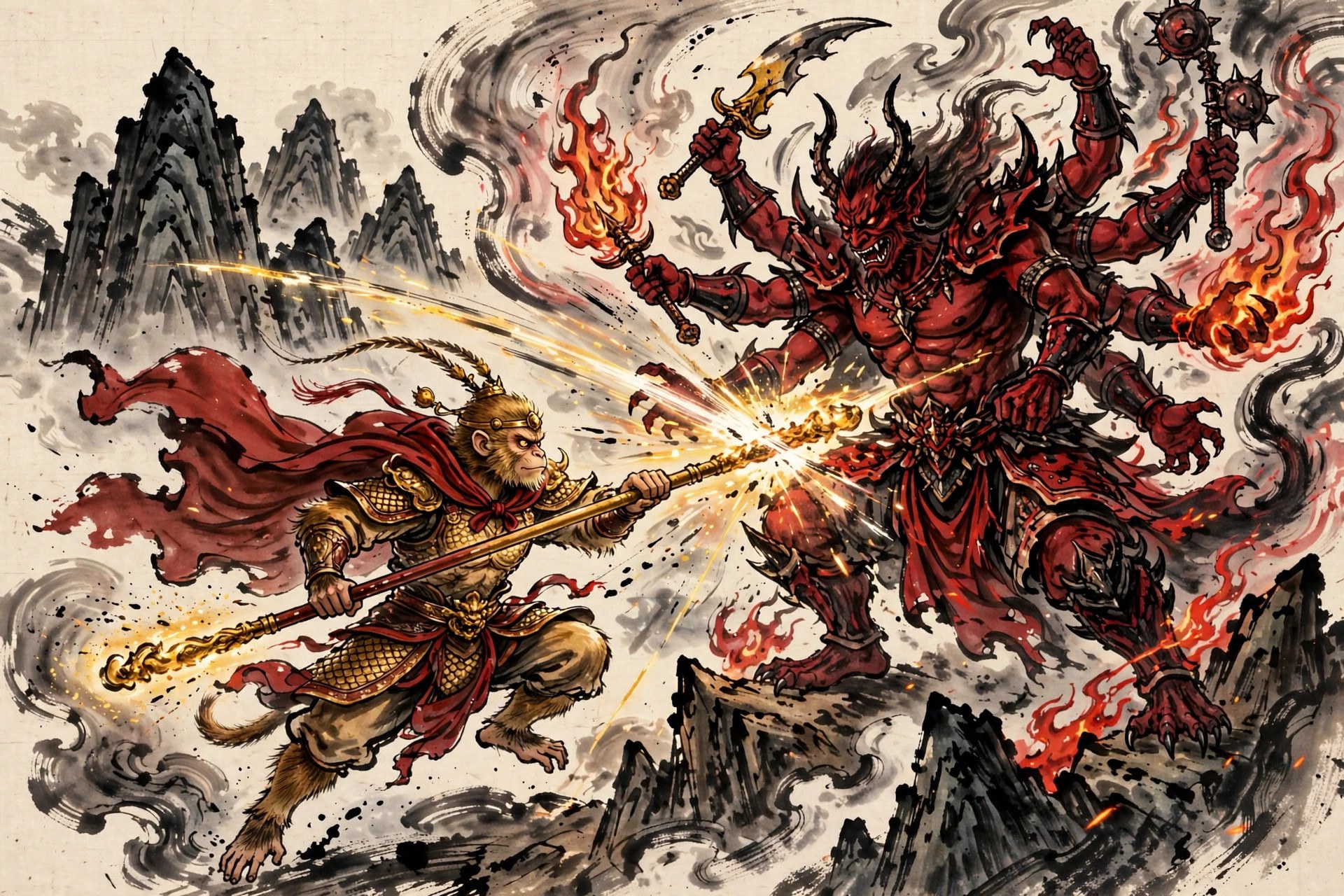
The 81 Tribulations
The Buddha decreed the scriptures must be earned through exactly 81 calamities. The pilgrims endured them all — demons, rivers, kingdoms, and one very wet final exam.
Why 81
When the pilgrims finally reach the Western Paradise, they’re told the number was fixed from the start: the scriptures are too precious to be given, only earned. Buddhism’s sacred numerology helps — 9 × 9, the number of completion. The novel is careful bookkeeping: at the end, the pilgrims have suffered exactly 81 named disasters. The last one is almost a joke: crossing the final river home, the scriptures get dunked and the pilgrims must dry them on a rock. Perfection requires paperwork.
The famous trials
- The Black Wind Mountain (chs. 16–17). The Black Bear Monster steals Sanzang’s cassock; Wukong must enlist Guanyin herself to recover it — an early lesson that not every fight is his to win alone.
- The Kingdom of Women (chs. 54–55). The pilgrims blunder into a queendom where men are a novelty; the queen proposes marriage to Sanzang. Comedy with an edge: desire is a tribulation too.
- The Flaming Mountains (chs. 59–61). To cross the burning range, Wukong must borrow Princess Iron Fan’s banana-leaf fan — which means bargaining with a demoness whose son he once tormented, while her husband the Bull Demon King intervenes. The novel’s longest, most operatic set-piece, and Wukong’s most famous extended fight.
- The White Bone Demon (chs. 27). Baigujing disguises herself as a maiden, an old woman, and an old man to trap Sanzang; each time Wukong sees through her and strikes, and each time Sanzang — who sees only an innocent dead — banishes him for murder. The cruelest chapter: being right and punished for it.
- The True-False Monkey (chs. 57–58). The Six-Eared Macaque — a copy of Wukong himself — impersonates him so perfectly that Heaven, Hell, and Guanyin can’t tell them apart. Only the Buddha sees the difference. Identity itself becomes a tribulation: which monkey is the real one?
The pattern
Nearly every tribulation runs the same engine: Sanzang is captured (or tempted, or lost), Bajie blunders, Wujing holds the line, and Wukong must solve the problem — usually by fighting, sometimes by diplomacy, occasionally by admitting he needs help from a Bodhisattva. The demons are almost all fallen servants of Heaven’s immortals, which is the novel’s quiet satire: the worst monsters on the road escaped from the gods’ own households.
Source notes
- The 81-tribulation count and its explanation appear in chapter 100; the “dunked scriptures” finale closes the novel.
- Chapter references follow the standard 100-chapter Ming edition.