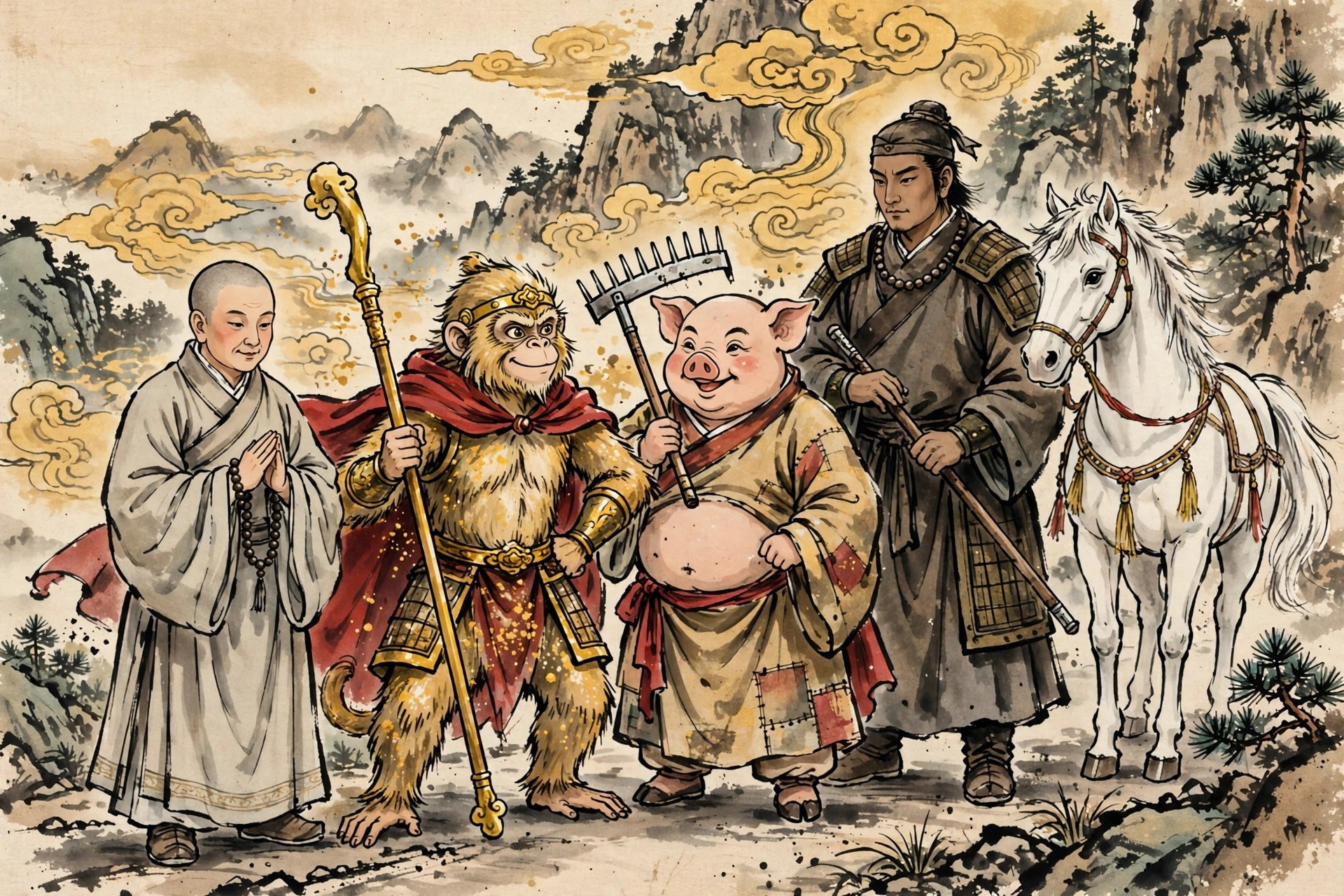
The Companions
A gentle monk, a greedy pig, a quiet giant, and a dragon in horse's clothing. Wukong is the muscle and the brains — but he never walks alone.
Tang Sanzang (唐三藏)
The master of the expedition — the novel’s version of the historical Xuanzang, recast as a gentle, learned, and catastrophically naive monk. Sanzang is the pilgrimage’s moral center and its comic liability: he cannot tell a demon from a maiden, faints at the sight of blood, and keeps banishing Wukong for “murder” every time the monkey sees through a disguise. Yet his unshakable compassion is the one thing none of the disciples can fake, and the novel is clear: the road exists because he insists on walking it. Final title: Buddha of Sandalwood Merit.
Zhu Bajie (豬八戒) — Pigsy
The former Marshal Tianpeng, commander of Heaven’s 80,000 river sailors, banished to earth for flirting with the Moon Goddess and reborn — by clerical error — as a pig monster. Bajie is appetite with a rake: he loves food, sleep, women, and complaining. He carries the nine-toothed rake, fears every fight, schemes to split up the luggage and go home, and is nonetheless indispensable — his very earthiness keeps the pilgrimage human. Arthur Waley’s abridgment renamed him “Pigsy,” and the nickname stuck in English. Final title: Cleaner of the Altars.
Sha Wujing (沙悟淨) — Sandy
The former Curtain-Raising General of Heaven, banished for smashing a crystal cup at a banquet and exiled to the Flowing Sands River, where he survived by eating travelers. Wujing is the quiet one: loyal, steady, strong, and almost entirely without jokes — the load-bearer of the group, literally carrying the luggage. Where Wukong is fire and Bajie is appetite, Wujing is patience. Final title: Golden-Bodied Arhat.
The White Dragon Horse (白龍馬)
The third son of the Dragon King of the Western Sea, sentenced to death for setting fire to a palace pearl, pardoned by Guanyin on condition of carrying Sanzang west. He spends most of the novel as a horse — and nearly every reader forgets he’s a dragon prince until the moments he briefly resumes his true form to save the day. Final title: Dragon Horse of the Eight Legions.
The band as a machine
The novel runs its five travelers as a single mechanism, and Buddhist commentary has long read them allegorically — Sanzang the believing heart, Wukong the restless mind, Bajie the appetites, Wujing the steady will, the horse the body that carries them all. But the comedy works because they’re also just people: Wukong and Bajie bicker like brothers, Sanzang parents them badly, Wujing mediates, and the horse says nothing, the way horses do.
Source notes
- Character introductions: Sanzang (chs. 8–12), Wukong (chs. 1–7), Bajie (chs. 18–19), Wujing (ch. 22), the horse (ch. 15).
- Final titles are conferred in chapter 100.
- The allegorical reading is the traditional Buddhist commentary; see symbolism.