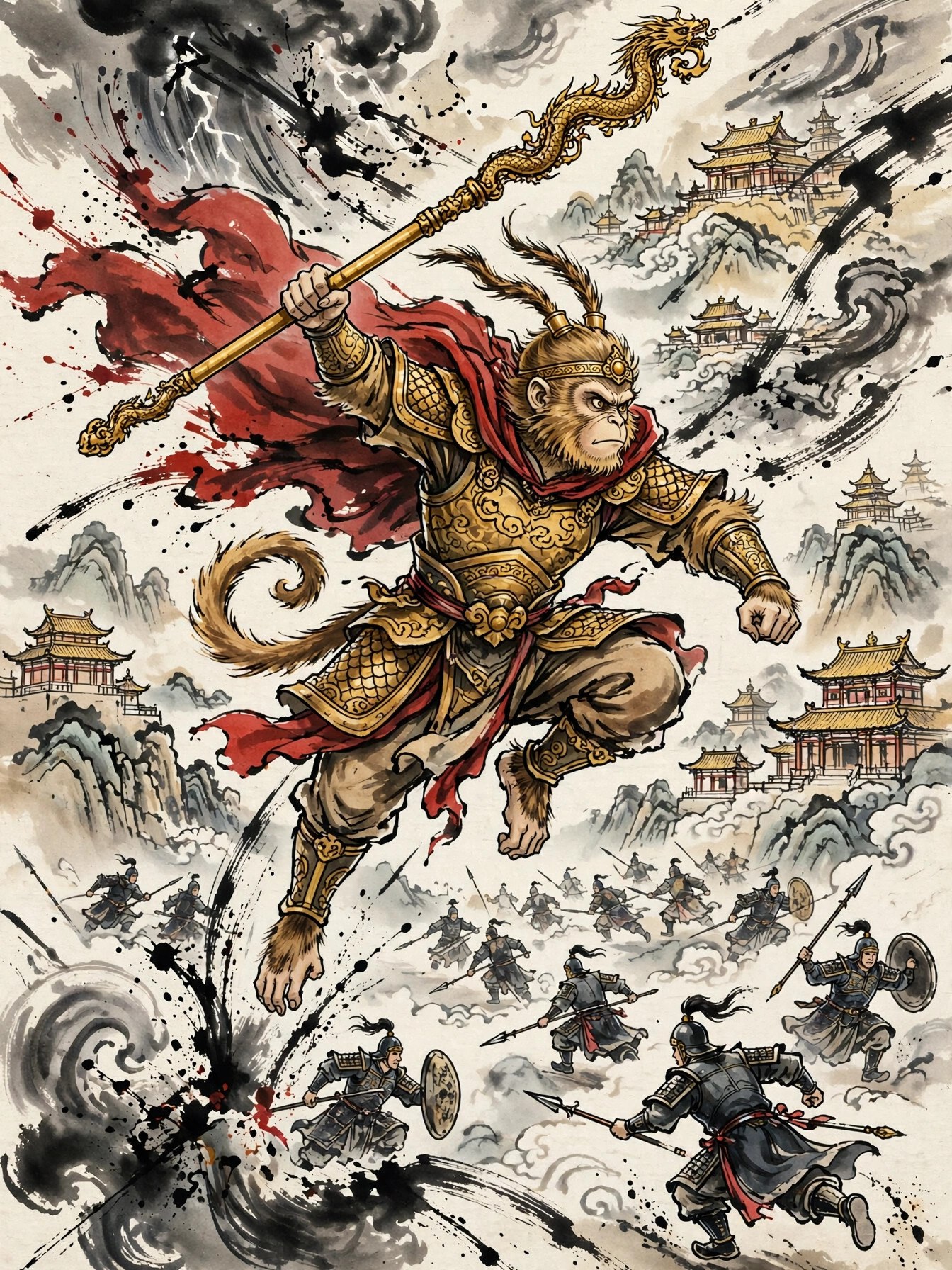
Havoc in Heaven
Offered a stable-boy's job by the Jade Emperor, the Monkey King took a better title for himself — Great Sage, Equal of Heaven — and fought the entire celestial army to keep it.
The insult
After Wukong erased his name from the registers of death (chapter 3) and seized the Ruyi Jingu Bang from the Dragon King, the Jade Emperor — advised that this stone monkey might be trouble — summoned him to Heaven with a title: Protector of the Horses (Bimawen, 弼馬溫), keeper of the celestial stables. Wukong accepted proudly until a courtier let slip it was the lowest rank in Heaven. He quit on the spot, returned to the Mountain of Flowers and Fruit, and raised his own banner: Qitian Dasheng — Great Sage, Equal of Heaven.
The war
Heaven’s response escalated in the novel’s most gleeful sequence. First the Jade Emperor tried appeasement, recognizing the empty title to keep Wukong quiet. Then, discovering the trick, he sent his armies — the pagoda-bearing Li Jing, Prince Nezha, the Four Heavenly Kings, and finally 100,000 heavenly soldiers under the star-god Erlang. Wukong fought them all to a standstill, duel after duel, transformation against transformation. The tide turned only when Laozi dropped his diamond snare from above and Erlang’s hound caught Wukong’s leg.
The punishments that failed
Heaven tried to execute him and discovered the problem: nothing worked. Knives broke on his skin, fire couldn’t catch him, lightning couldn’t find him — forty-nine days of immortality pills and celestial peaches had made him effectively indestructible. So Laozi proposed refining him alive in the Eight Trigrams Furnace. Wukong survived 49 days in the furnace, crouching in the wind corner where the smoke was thinnest — and emerged angrier, smokier, and with the fiery golden eyes. He smashed the furnace, fought his way back into the palace, and was wrecking Heaven itself when the Buddha arrived.
The wager
The Buddha didn’t fight. He proposed a bet: if Wukong could leap clear of his right palm, the Jade Emperor would abdicate the throne to him; if not, Wukong would return below as a demon and behave. Wukong somersaulted 108,000 li, reached five pillars at the world’s edge, signed his name, and leapt back — to find the Buddha smiling and the characters “Sun Wukong was here” on the Buddha’s own middle finger. One overturned palm later, Wukong was under Five Elements Mountain, where he would wait 500 years for a monk.
Why it matters
The Havoc in Heaven (chapters 3–7) is the novel’s founding myth and Chinese culture’s great rebellion story — the folk hero who told the cosmos its hierarchy was negotiable. Every later Wukong, from opera stages to video games, is measured against these chapters. It’s also the novel’s joke about power: the whole war ends not with a battle but with a bet, because the Buddha understood what Heaven’s armies didn’t — you don’t defeat the mind-monkey by force.
Source notes
- Chapters 3–7 of the 100-chapter edition; the Bimawen insult, the Qitian Dasheng banner, the furnace, and the wager are all in these chapters.
- Erlang (Yang Jian) is himself a great warrior of Chinese myth, which is why Wukong’s duel with him is the war’s centerpiece.