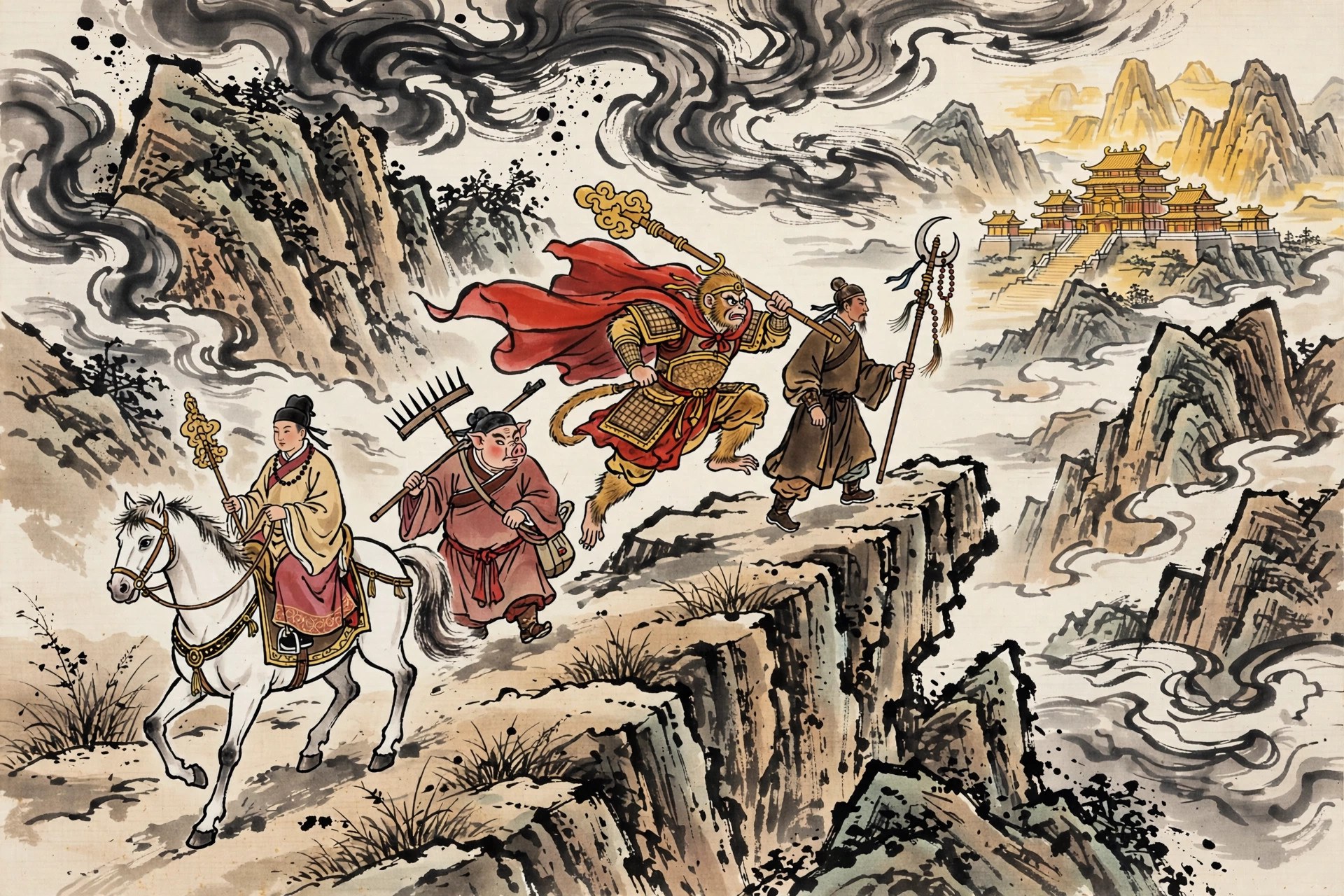
The Novel
One of China's Four Great Classical Novels — 100 chapters, fourteen years on the road, and the most beloved monkey in world literature. How the book is built.
One of the Four Greats
Journey to the West (Xiyouji, 西遊記) stands with Romance of the Three Kingdoms, Water Margin, and Dream of the Red Chamber as one of China’s Four Great Classical Novels. Published in its standard 100-chapter form in the Ming dynasty — the earliest known printed edition dates to 1592 — it is traditionally attributed to Wu Cheng’en (see the authorship question).
How the 100 chapters are built
| Part | Chapters | What happens |
|---|---|---|
| The Monkey’s rise | 1–7 | Stone birth, the training under Subodhi, the seizure of the staff, the havoc in Heaven, the Buddha’s wager, the mountain |
| The pilgrimage begins | 8–12 | The Buddha’s plan, Guanyin’s search for a scripture-seeker, the Tang emperor’s commission, Sanzang’s departure |
| The road west | 13–99 | The long journey: demons, kingdoms, rescues, quarrels, and the 81 tribulations |
| The arrival | 100 | The scriptures received at Vulture Peak, the return east, the promotions — including Wukong’s Buddhahood |
The true story underneath
The novel grows from real history. In 629 CE, the Tang-dynasty monk Xuanzang (602–664) slipped out of China without imperial permission, crossed the deserts of Central Asia, and spent sixteen years traveling to India and back, returning with 657 Buddhist texts. His own account, the Great Tang Records on the Western Regions, is a sober travelogue — but popular storytellers spent nine centuries turning his journey into legend, adding a magic monkey as his protector. By the Ming dynasty, the monkey had become the story.
The novel’s engine
Two forces drive every chapter. One is episodic adventure: each demon is a new obstacle, each kingdom a new satire, each rescue a showcase for Wukong’s transformations. The other is the allegory of cultivation: the pilgrimage is the mind’s training, Wukong the restless intellect, Bajie the appetites, Wujing the will, the horse the body, and Sanzang the ordinary believing heart they all serve. The book is a comedy, a quest romance, and a Buddhist manual at once — see symbolism.
Source notes
- Standard edition: 100 chapters; earliest extant printed edition 1592 (Shidetang). Attribution to Wu Cheng’en is traditional, not proven.
- Xuanzang’s dates (602–664) and sixteen-year journey are historical; the 657-texts figure comes from his biography.
- Anthony C. Yu’s complete English translation (4 vols., University of Chicago Press, rev. 2012) is the standard scholarly English text and is copyrighted; Arthur Waley’s Monkey (1942) is the classic abridgment.