Start Here
The 10-minute primer on the Monkey King — who he is, what the novel is, and why a stone-born monkey is still China's most beloved hero.
Wukong in 10 minutes
Who: Sun Wukong (孫悟空), the Monkey King, hero of the 16th-century Chinese novel Journey to the West (Xiyouji, 西遊記), traditionally attributed to Wu Cheng’en. A monkey born from a magic stone, crowned king of the monkeys, who studied the Dao, rebelled against Heaven, and was tamed into service as the chief disciple of the Tang-dynasty monk Xuanzang (in the novel, Tang Sanzang).
What: The novel is 100 chapters: Wukong’s origins and rebellion against Heaven (chapters 1–7), then the long pilgrimage from Chang’an to India to fetch the Buddhist scriptures (chapters 8–100), during which the band survives 81 predestined tribulations.
Powers: The 72 Earthly Transformations (qishier bian), the Ruyi Jingu Bang — a staff that shrinks to a needle or grows to a pillar — the somersault cloud that crosses 108,000 li in a single leap, and fiery golden eyes that see through all disguise. Details on powers.
Why he matters: Wukong is the archetypal trickster-rebel of world literature and the single most-adapted character in Chinese popular culture: Peking opera’s most athletic role, the star of landmark films and TV series, and the protagonist of modern games. Read adaptations and symbolism.
The five things to know first
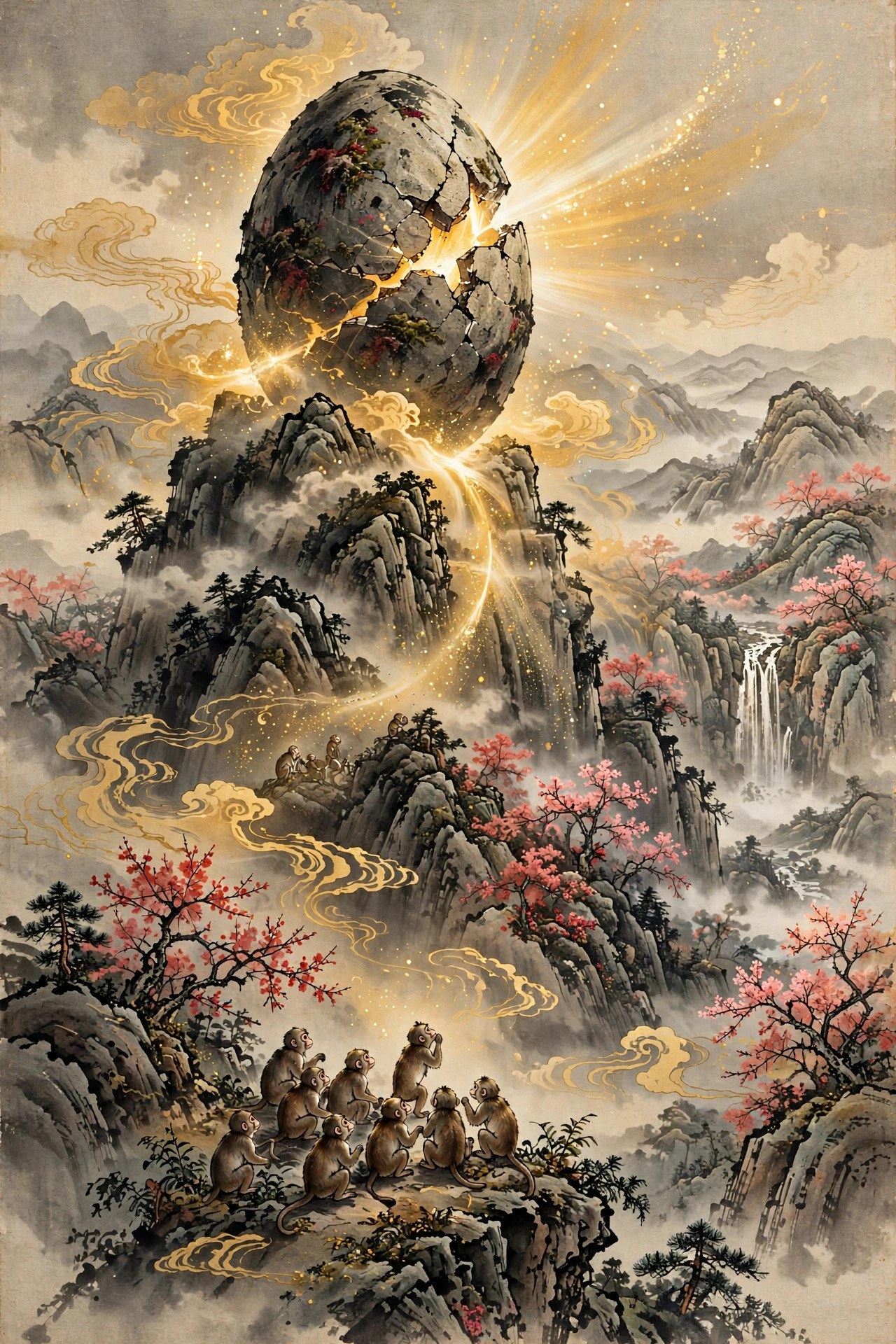
- He’s a stone, not an animal. Wukong hatches from a stone egg on the Mountain of Flowers and Fruit (Huaguoshan), nourished by heaven and earth. He has no parents, no species in the ordinary sense — he’s the mountain’s spirit given a monkey’s body. See the stone egg.
- Heaven tried everything. The Jade Emperor offered him jobs, then titles, then Heaven’s full army. Wukong beat them all and declared himself “Great Sage, Equal of Heaven” (Qitian Dasheng). Only the Buddha himself could stop him — by dropping a mountain on him. See havoc in heaven.
- The headband is the point. Freed after 500 years under Five Elements Mountain, Wukong serves the pilgrim Tang Sanzang only because the Bodhisattva Guanyin tricked a golden headband (the jin’gu, 緊箍) onto his skull. When the master chants the Tightening Spell, it squeezes. Discipline, the novel says, is a headache. See powers.
- He is the mind itself. Buddhist allegory reads Wukong as the restless mind (xinyuan, 心猿, “mind-monkey”): brilliant, violent, easily distracted, indispensable. The journey west is the taming of the mind on the road to enlightenment. See symbolism.
- Authorship is traditional, not certain. “By Wu Cheng’en” is the long-standing attribution; scholarship treats it as traditional rather than proven. Nothing on this site treats it as settled. See the authors.
Where to go next
- The character: Who is Wukong (narrative) or timeline (in order).
- The novel: Journey to the West for structure; the 81 tribulations for the road.
- The people: The companions; the cloud mountains for the world.
- The words: Sayings — our own renderings, honestly labeled; glossary for the Chinese terms.
Source notes
- Novel facts: the 100-chapter Ming edition of Xiyouji; chapter references follow the standard division.
- Authorship caution: the Wu Cheng’en attribution is traditional (see the authors).
- Images on this site are AI-generated dramatization art in an ink-painting style; the novel itself is the authority for facts.