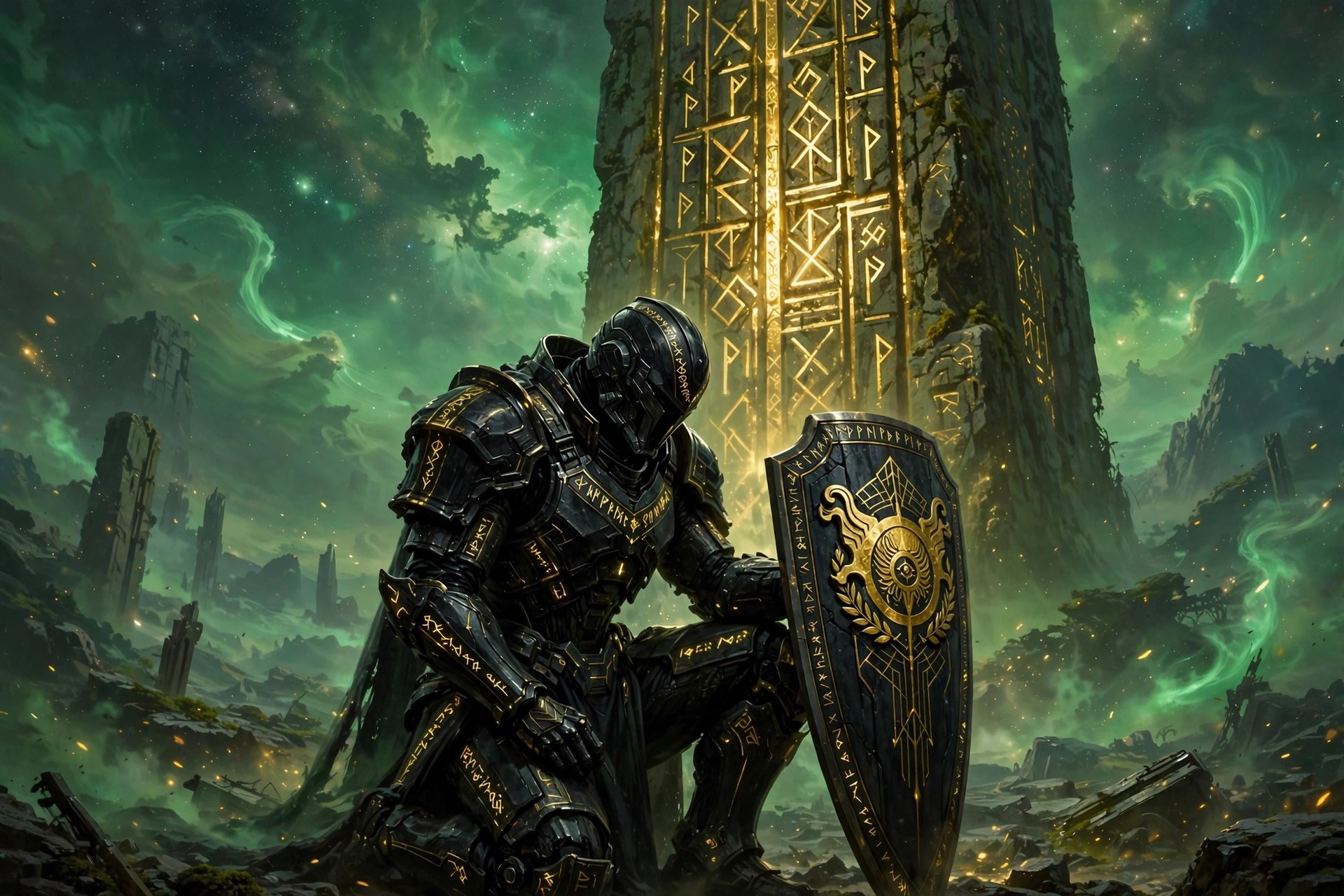
Lore
In-world backstory: the First Vigil, the Oath of the Aegis, and the three thousand cycles of a sentinel who would not move.
Everything below is in-world legend — fictional character lore written for this fan reference.
Before the Vigil
The Obsidian Wardens were the old order: sworn sentinels who guarded the trade lanes between the first star systems, armed with shields of black glass and bound by oaths older than the Pact. The future Guardian was the youngest Warden of their generation — chosen not for strength, but for stubbornness. Their instructors noted it in the Warden records: “Will not yield a position once taken. This is either the makings of a legend or a very early funeral.”
It became a legend.
The First Vigil
In the 40th cycle of the Pact, a dead world called Meridian Hollow went silent. A Shatterer war fleet had reduced its citadels to glass, and the evacuation fleets were six days out. The Wardens sent one sentinel ahead — the youngest — with orders to hold the beacon tower until the fleets arrived, then withdraw.
The fleets were eleven days late.
The sentinel did not withdraw. For eleven days the young Warden stood in the broken arch of the beacon tower, shield raised, turning back Shatterer raiders while the civilians gathered in the hollow below. When the evacuation fleets finally landed, they found the beacon still lit — and the sentinel still standing, armor cracked, runes burned out, shield split down the middle, refusing to fall down because nobody had given the order to stand down.
That was the First Vigil. Every Guardian story starts there.
The Oath of the Aegis
The surviving Wardens rebuilt the shield. They named it the Aegis — the first of its line — and the young sentinel spoke an oath over it that every Guardian has repeated since:
“No ground I guard shall fall. No ward I keep shall die alone. While I stand, the StarTeam stands.”
The Oath of the Aegis is more than words. In the lore, the gold runes etched into the Guardian’s armor are the words of the Oath, written in Old Staric and bound to the sentinel’s body. As long as the Oath holds, the runes hold; as long as the runes hold, the Emerald Surge flows. The abilities explained page traces this loop of vow, rune, and power.
The fall of the Obsidian Wardens
A hundred cycles after the First Vigil, the Warden order was broken — not by an enemy, but by politics. The Pact’s council voted to disband the Wardens and fold their duties into the new StarTeam, a combined force of heroes from every system. The old Wardens resisted. Some resigned. Most scattered to their home worlds.
One did not. The hero of the First Vigil knelt before the council and asked to take the Oath again — this time to the StarTeam itself. The council refused the title of Warden; the Guardian accepted, and took a new name in its place: the Star Team Guardian. The Oath stayed the same. Only the ward had grown larger: not one beacon tower, but a whole team, and the worlds behind it.
Three thousand cycles
What follows is the long quiet history of a sentinel who never sought glory. The timeline lists the major events; the missions archive holds the campaigns. A few threads:
- The Aegis line. The Guardian has carried eleven shields across the cycles, each reforged from the last. Every crack in every shield is recorded in the Star-Vault.
- The wards. Teammates have come and gone — some for decades, some for a single mission — but the Guardian has never lost a ward under their shield. This is the statistic the team itself repeats, half joke and half prayer: “Under the Guardian, nobody dies.”
- The Shatterer’s return. The old enemy came back three times. Three times the Guardian was waiting. The allies and rivals page names the rival who has hunted the Guardian across the cycles: the Shatterer’s champion, a mirror of everything the Oath stands against.
The Guardian today
In the current cycle, the Guardian is the StarTeam’s longest-serving member and its least certain legend. Younger teammates call the stories exaggerated. Older ones — the ones who were carried out of burning fields under a green dome — don’t bother arguing. They just point at the shield.
It has eleven reforgings. It has never once been left on a battlefield.
Source notes
All of the above is fictional character lore — original worldbuilding for the Vizlings “star team guardian” concept, written for this fan reference. Real-world source: the app card (description: “star team guardian”). No real people, places, or events are depicted. Images are AI-generated dramatization art.