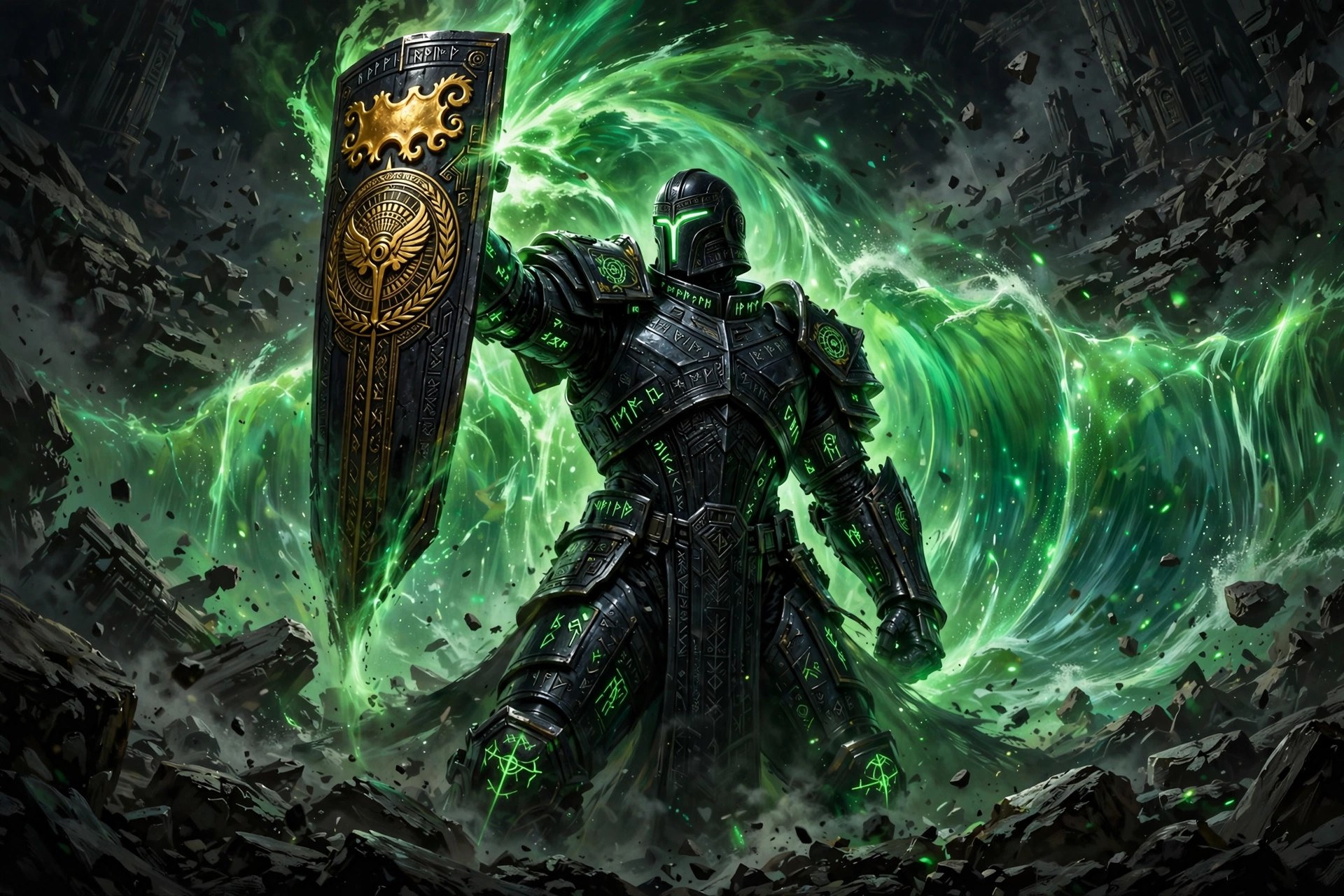
Abilities Explained
The in-world theory of the Guardian's powers — vow, rune, and surge, and the loop that binds them.
In-world power theory. All fictional character lore for the Vizlings “star team guardian” concept.
The loop
Everything the Guardian can do rests on a three-part loop, and the loop is the whole theory:
- The vow. The Oath of the Aegis — a promise spoken in full, meant in full, and kept in full across three thousand cycles.
- The rune. The Oath’s words, bound in Old Staric into the Guardian’s armor as gold runes. The runes are not a battery; they are a conduit — they give the vow a shape energy can follow.
- The surge. Emerald energy, drawn through the runes and the Aegis shield, shaped into domes, walls, waves, and lanterns.
Break any link and the power fails. This is why the lore insists the Guardian’s greatest strength is not the Surge but the keeping — three thousand cycles of never abandoning a ward. The power is the receipt. The vow is the purchase.
Why emerald?
In-world, the Surge’s color is not arbitrary: emerald is the color of the beacon fires, the growing things, the living worlds the Guardian protects. The old Warden texts — preserved in the Star-Vault — describe the Surge as “the color of what is worth standing in front of.” When the runes dim under strain, they dim toward gray; when the Surge burns brightest, it burns the green of new leaves. The team reads the Guardian’s condition in the color the way medics read a pulse.
The forms of the Surge
- Dome — the defensive ideal: a hemisphere of force, anchored at the shield’s rim. The Emberfall dome (settlement-sized, eleven days) is the theoretical maximum; the Guardian has never exceeded it and theorizes it cannot be exceeded by one sentinel alone.
- Wall — a plane of force for splitting battlefields or sealing breaches. Cheaper than a dome, harder to hold against sustained fire.
- Wave — the dome or wall released forward as offense. The Guardian dislikes this form on principle — “every wave is a wall unmade” — and has used it in recorded lore only when no wall could have saved the ward.
- Lantern — a point of emerald light: signaling, minor healing, and once, the relighting of a dead distress beacon at Outpost Venn. The gentlest form, and the Guardian’s favorite.
The limits, explained
- One sentinel, one shield, one wall. The Surge does not multiply. The StarTeam’s entire strategy is built around this: the Guardian holds one point, absolutely, and the team maneuvers around the point.
- Stamina is the fuel. The runes conduct; the body pays. Eleven days is the documented maximum, and the Guardian paid for it with two days of unconsciousness and a month of dimmed runes.
- The dead stay dead. The Surge can mend, shield, and sustain — it cannot reverse death. The Oath’s promise, “no ward I keep shall die alone,” is about presence, and the lore is strict that this is not a loophole but the point.
- The Oath can be tested. No enemy has ever broken the Guardian’s body. All of them, eventually, try to break the Oath instead — by forcing a choice between two wards, by offering a bargain, by making the keeping cost more than any one sentinel should pay. The lore’s answer, every time: the Guardian finds a third option, or pays the price, or both. The runes have never gone dark.
Why the theory matters to the story
The loop is the character. A hero whose power comes from keeping promises cannot be corrupted by power, only by despair — and the Guardian’s three thousand cycles are the story of despair being offered, repeatedly, and refused. The theory isn’t physics. It’s ethics with special effects. That’s the point.
Source notes
All power theory is fictional character lore — original worldbuilding for the Vizlings “star team guardian” concept. Images are AI-generated dramatization art.