Timeline
Two intertwined histories — the character's invented past and the real gothic tradition, told side by side.
c. 1600s — The Hall is raised (character invention)
The Blackmoor family builds the first house on the cliff — stone, slate, and ambition in roughly equal measure.
1764 — The Castle of Otranto (real history)
Horace Walpole publishes the first gothic novel: a giant helmet falls from the sky and an entire genre is born.
1789 — The fire (character invention)
Blackmoor Hall burns in the winter of 1789. The family rebuilds within the decade. The cause is recorded as “a candle”; the family has never believed the record.
1794 — The Mysteries of Udolpho (real history)
Ann Radcliffe’s masterpiece makes the gothic the bestselling fiction of its age — and makes the explained supernatural famous.
1796 — The Monk (real history)
Matthew Lewis publishes his lurid tale of demonic temptation; it scandalizes England and delights it in equal measure.
1812 — Childe Harold’s Pilgrimage (real history)
Lord Byron publishes the first cantos and, as he put it, wakes to find himself famous — the Byronic hero enters the culture.
1818 — Frankenstein (real history)
Mary Shelley, eighteen years old, publishes the modern gothic’s founding myth of creation and abandonment.
1839 — “The Fall of the House of Usher” (real history)
Edgar Allan Poe publishes his great tale of a house, a family, and a crack running through both.
1841 — The conservatory fails (character invention)
The last plant dies in the Hall’s conservatory. The Gothic Male orders it watered anyway. It has been watered, empty, ever since.
1845 — “The Raven” (real history)
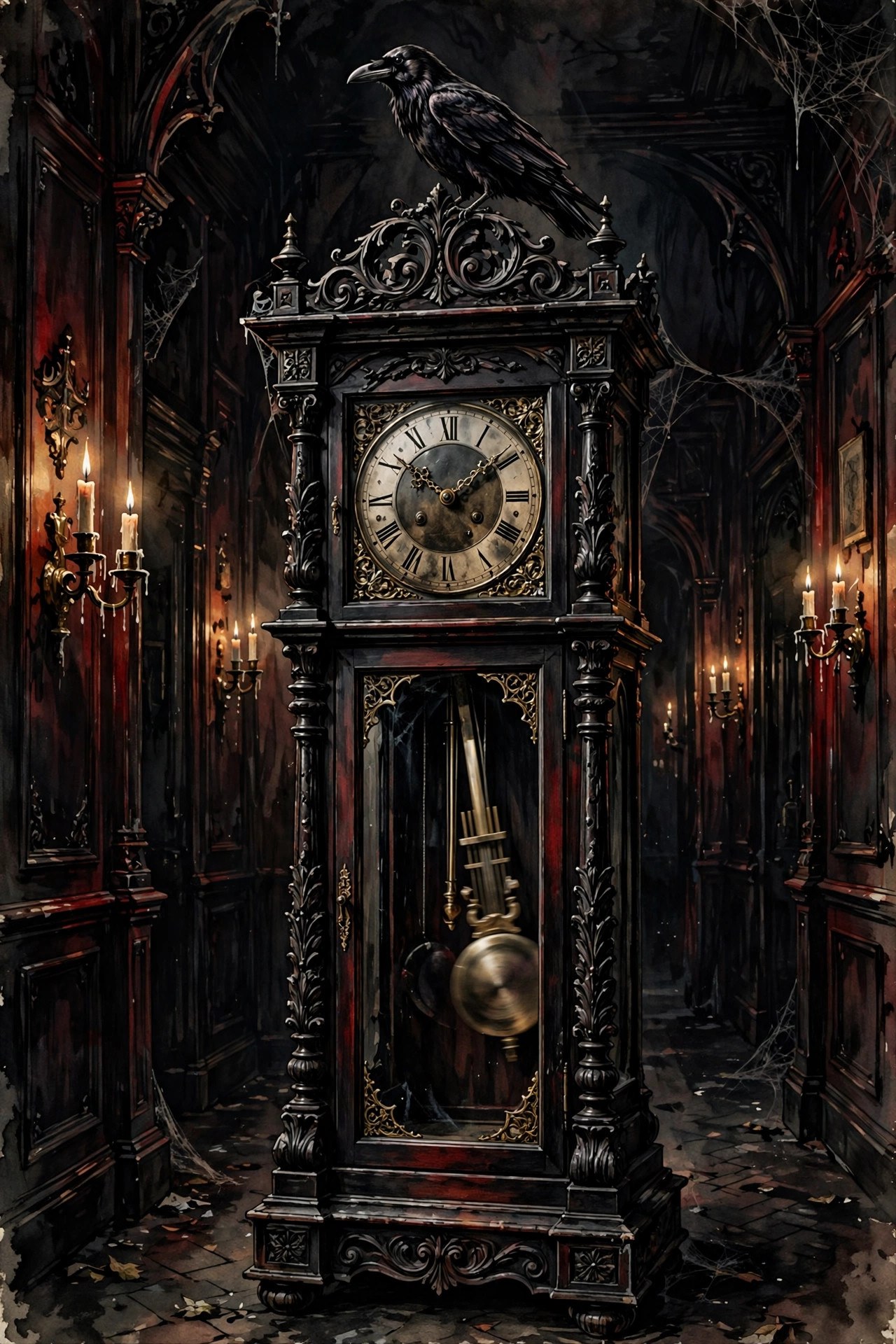
Poe’s poem makes melancholy musical and the raven immortal. The Gothic Male keeps a stuffed raven in the library; he claims it is decorative.
1862 — The brother leaves (character invention)
The Gothic Male’s younger brother departs Blackmoor Hall after the quarrel no one will describe. He does not return.
1890 — The Picture of Dorian Gray (real history)
Oscar Wilde publishes his gothic novel of the portrait that ages while the man does not — the gallery trope perfected.
1897 — Dracula (real history)
Bram Stoker’s epistolary novel codifies the Victorian gothic: the count, the castle, the modern world pushing back.
1901 — The east wing is closed (character invention)
After the incident — the nature of which is not recorded, by order — the east wing of Blackmoor Hall is closed. It remains closed.
1931 — The vicar’s invitations begin (character invention)
The vicar of Graylock begins his annual Christmas invitation to the Hall. Every reply is a masterpiece of courteous refusal. He frames them.
1973 — The last portrait is hung (character invention)
A portrait of the Gothic Male himself joins the gallery — painted from life, the artist insists, though she will not say over how many sittings, or in which decade.
2026 — The character goes public (character canon)
“Gothic male” appears in the Vizlings app’s Nocturnals collection. This reference site is built to document him.
Tonight — The candles are lit (character invention)
Dusk, as always. Forty-seven rooms; nine in use; candles in all of them. The gate is open. He is waiting — politely, patiently — to see if you come.
Source notes
- Real-history entries: standard publication facts for the works named (Walpole 1764; Radcliffe 1794; Lewis 1796; Byron 1812; Shelley 1818; Poe 1839, 1845; Wilde 1890; Stoker 1897).
- Character-invention entries: imagined backstory for the Vizlings character.
- App canon: the character’s 2026 appearance in the Vizlings Nocturnals collection — app roster data.