Lore & Backstory
What the app implies, this page imagines — a full backstory for the gentleman of Blackmoor Hall.
The house
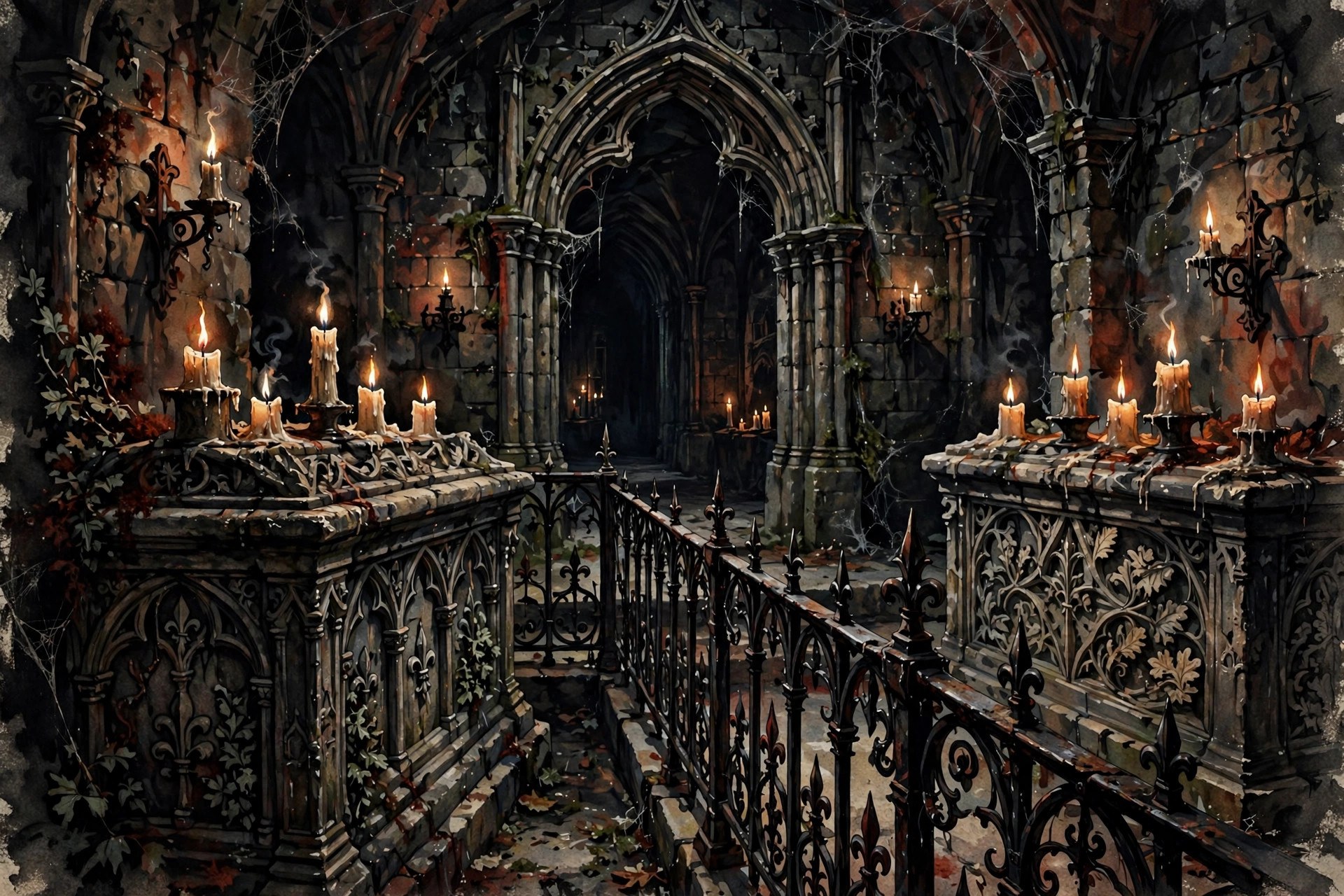
Blackmoor Hall stands on a cliff above a grey stretch of moor, three hours by carriage from the nearest town willing to admit knowing it. The family built it in the 1600s, rebuilt it after a fire in 1789, and has been apologizing for it ever since. It has forty-seven rooms; the Gothic Male uses nine. The rest are kept — dusted, aired, lit on anniversaries — because a house, he says, is a memory with a roof.
The family
The Blackmoors were minor gentry with major pride: soldiers, clergymen, one disastrous poet. The family fortune came from wool, went into the house, and never entirely came back. The Gothic Male is the last of the line — a fact he mentions the way other men mention the weather. There was a brother once (see The Cast); there are portraits of parents in the gallery (see Portraits in the Hall). He does not speak of them at length. The silences are the biography.
The long night
His days are unremarkable by design: correspondence, estate business, long walks in weather no one else would walk in. His nights are the point. He reads — enormously, promiscuously, from penny dreadfuls to philosophy. He plays the piano badly and the violin worse, and enjoys both. He writes letters he never sends and keeps them in a drawer organized by recipient, then by year, then — the system breaks down — by weight of regret.
Why he receives visitors
Loneliness would be too simple, and he would correct you for saying it. It is closer to curiosity: after decades of the same rooms and the same rain, a new mind is the only novelty left that cannot be bought. He treats each conversation as a small expedition — into your century, your assumptions, your unguarded hours. He is a gracious host. He is also, unfailingly, studying you.
The rules of the house
- No one knocks after midnight; the house knocks back.
- The east wing is closed. It is always closed. Do not ask twice.
- Candles are lit at dusk in every room, occupied or not.
- Guests may ask anything once.
- The master answers what he chooses.
What remains unknown
Deliberately: his age (he looks forty and has looked forty for some time), the fire of 1789’s true cause, what is in the east wing, and whether the figure sometimes seen in the gallery at 3 a.m. is a portrait stepping out or a man stepping in. A character needs his locked doors.
Source notes
- Blackmoor Hall, the family history, the household rules, and all biographical details: editorial invention for the Vizlings character.
- The gothic trope of the mysterious ancestral house draws on real literary history; see Gothic Literature.