The Manor House
Forty-seven rooms, nine in use — a walking tour of the house that is half the character.
The approach
The cliff road, the wrought-iron gate (which opens before you knock — there is a gatekeeper’s cottage, but no one has ever seen the gatekeeper), the long drive through bare trees. The Hall reveals itself in stages, the way he reveals himself: first the silhouette, then one lit window, then the door already open.
The great hall
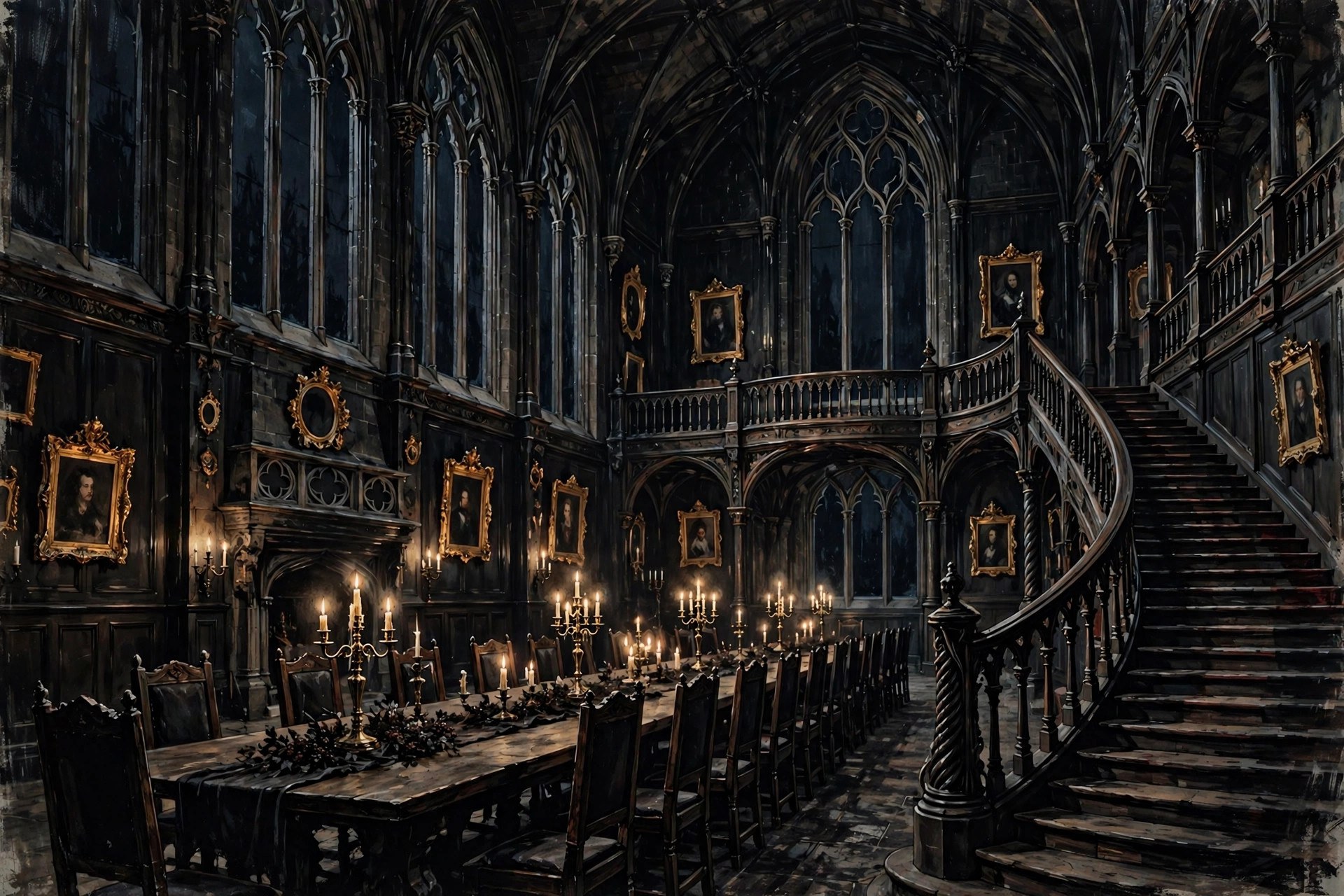
Stone floor, a fireplace you could stand in, the long dining table that seats forty. Portraits look down from the gloom — ancestors in armor, in wigs, in Victorian black, each more disapproving than the last. Dinner is served here when there are guests; the Gothic Male sits halfway down the table, never at the head. “The head of the table,” he says, “is for people who give orders. I prefer to give conversation.”
The library
Twelve thousand volumes, catalogued by mood rather than author — Melancholy, Architecture; Melancholy, General; Amusement, Guilty. The rolling ladder, the stuffed raven over the poetry, the desk where the unsent letters are written. This is the room he actually lives in; the rest of the house is, as he puts it, “for the portraits.”
The gallery
The portrait corridor: two dozen Blackmoors in gilt frames, a century of cheekbones. The last frame is draped in black velvet. The figure sometimes seen here at 3 a.m. is officially “the candlelight, playing.” See Portraits in the Hall.
The conservatory
Nothing has grown here since 1841. Everything is watered. Mrs. Harrow considers this the most sensible arrangement in the house: “Plants die, sir. The watering is the point.”
The east wing
Closed since 1901. Not locked — closed. The corridor is dusted monthly by Mrs. Harrow personally; no one else goes. What is in there is the one question the Gothic Male will not entertain, politely, once, and then never again.
The roof and the moor door
A narrow stair leads to the roof walk, where he goes in storms. The moor door — a small door in the west wall, used by no one but him — opens directly onto the grey grass. He walks the moor daily, in all weather, and returns, as Mrs. Harrow says, “slightly less impossible.”
Source notes
- Blackmoor Hall and every room described: editorial invention for the Vizlings character.
- The house-as-character is a core gothic trope from Walpole onward; see Gothic Literature.