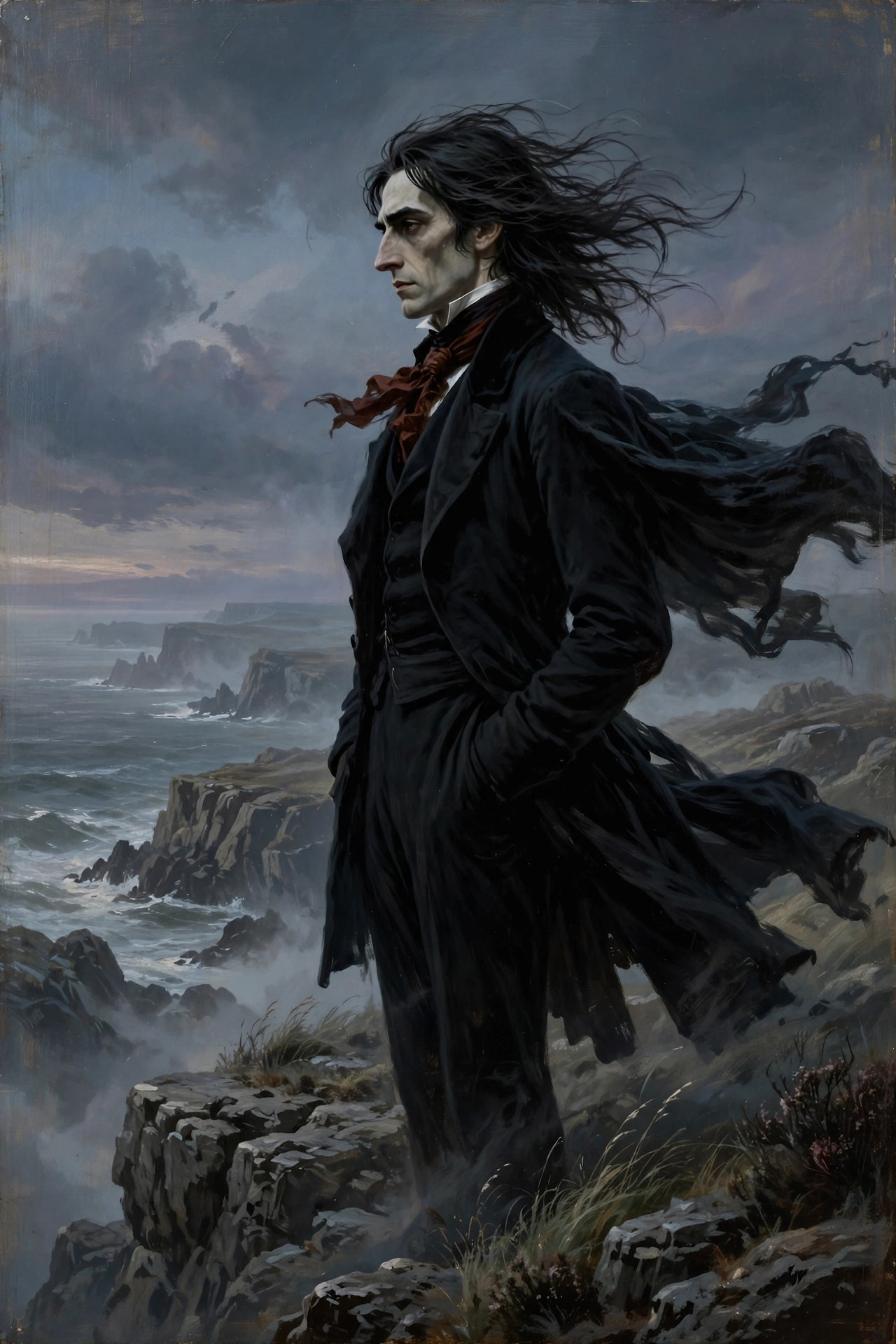
The Byronic Hero
The archetype the Gothic Male is built from — real literary history, honestly told.
The origin
The Byronic hero originates in Lord Byron’s works — principally Childe Harold’s Pilgrimage (1812) and the dramatic poem Manfred (1817): a proud, brooding, charismatic outcast, brilliant and wounded, superior to the society he scorns and exiled, literally or spiritually, from it. Byron himself, famously described by Lady Caroline Lamb as “mad, bad, and dangerous to know,” became entangled with his own creation — but the archetype outgrew the man.
The traits
- Charismatic melancholy: suffering worn as distinction, not complaint.
- The guilty secret: a past transgression, never fully confessed (Manfred’s, like the Gothic Male’s east wing, stays shut).
- Contempt for convention: manners perfect, respect for society nil.
- The fatal magnetism: others — especially the virtuous — are drawn to the flame.
- Self-awareness: he knows exactly what he is, which is part of the tragedy.
The lineage (real history)
The archetype runs through Jane Eyre’s Rochester (1847), Wuthering Heights’ Heathcliff (1847), and countless descendants into modern fiction. It is one of literature’s most durable templates because it flatters a deep fantasy: that damage is interesting and that detachment is depth.
The Gothic Male’s place in it
The Gothic Male is written as a late, self-aware Byronic hero — one who has read the tradition and knows the moves. The difference this site gives him: where the classic Byronic hero is doomed by passion, the Gothic Male is preserved by ritual — the candles, the letters, the rules of the house. Melancholy as climate control. Whether that is wisdom or merely a more elegant doom is left, deliberately, to the visitor.
Crucially: he is not Byron, not Manfred, not Rochester, not Heathcliff. He is an original character who knows he is standing in a long shadow — and stands up straighter because of it.
Source notes
- Byron’s works and dates (Childe Harold’s Pilgrimage 1812; Manfred 1817); Lady Caroline Lamb’s phrase; the Brontë novels (1847): standard literary history.
- The Gothic Male’s characterization as a “late, self-aware Byronic hero”: editorial invention for the Vizlings character.