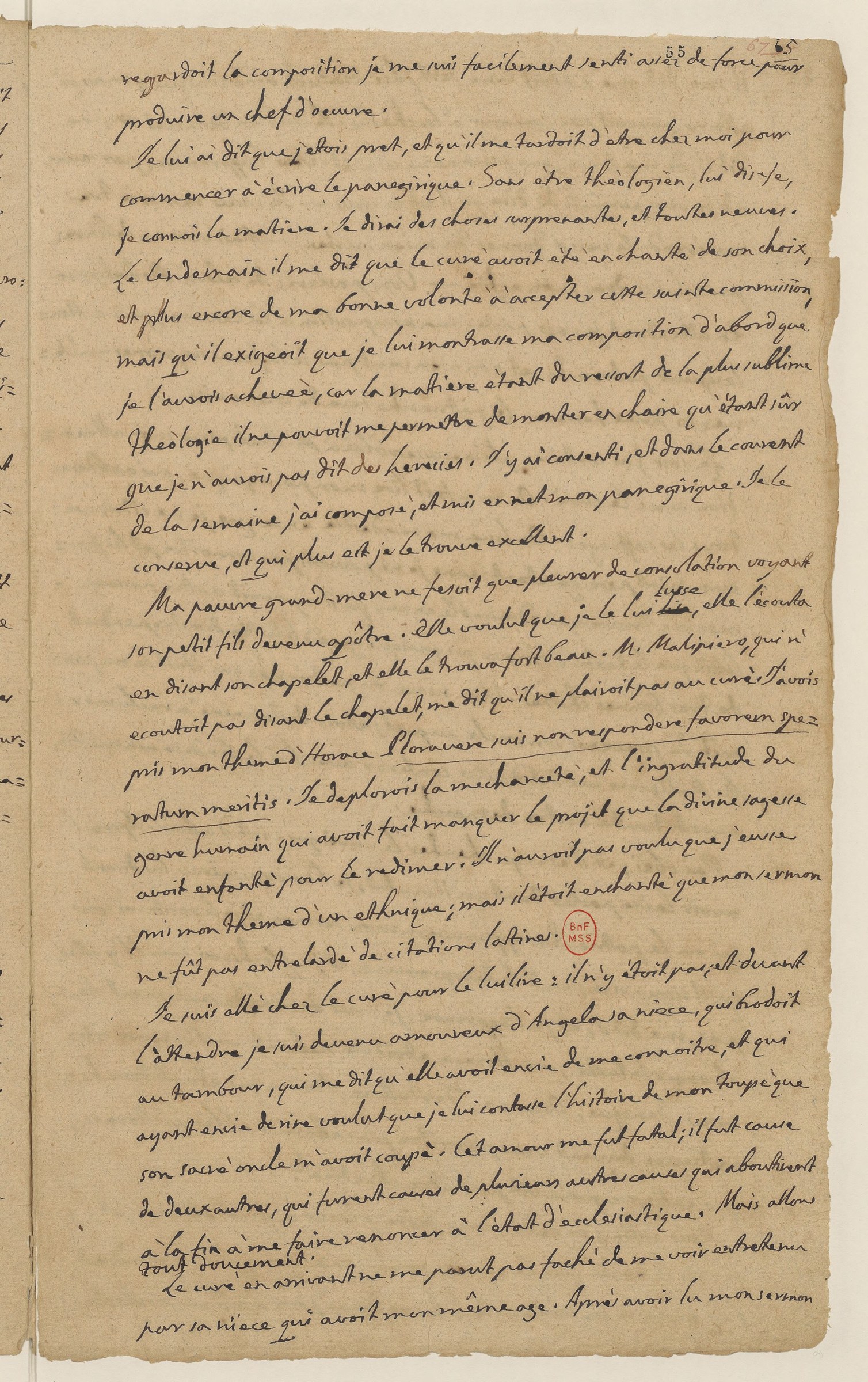
The Memoirs
<em>Histoire de ma vie</em> — 3,700 pages, written in French by a Venetian, covering a life only through 1774.
The book
The full title of the manuscript is Histoire de ma vie jusqu’à l’an 1797 — “Story of my life until the year 1797.” It is written in French, the language of the eighteenth-century European upper classes, by a Venetian who was proud of his adopted tongue.
Casanova wrote it at Dux between 1789 and 1798, in his sixties and early seventies, from memory — he kept no diary. The manuscript runs to roughly 3,700 pages and is divided into twelve “volumes” of his own arrangement. It is among the longest and most detailed autobiographies of the eighteenth century.
The scope — and the gap
Despite the title’s promise of 1797, the narrative breaks off abruptly in 1774. The fourth and fifth chapters of the twelfth volume are missing; the nineteenth-century editors judged that Casanova himself had withdrawn them intending to rewrite, and never found the time. The final twenty-four years of his life — the return to Venice, the second expulsion, the Dux librarianship — are therefore known only from other sources: letters, other people’s memoirs, and archives.
What it contains
The memoirs are not a confession and not an apology. Casanova announces the program in the preface:
“The reader of these Memoirs will discover that I never had any fixed aim before my eyes, and that my system, if it can be called a system, has been to glide away unconcernedly on the stream of life, trusting to the wind wherever it led.”
— Memoirs, preface; Arthur Machen’s 1894 English translation (Project Gutenberg ebook 2951). Verbatim from the public-domain text.
The book records, in order: childhood and education; the clerical and military years; the arrest and the escape from the Piombi; Paris and the lottery; the travels of the 1760s — Voltaire, London, Frederick the Great, Catherine the Great, Spain; and the return to Venice. Woven through are gambling, duels, occult experiments, literary quarrels, and the love affairs — scholars count roughly 120–126 named women — rendered with a novelist’s eye for dialogue and a lawyer’s eye for dates.
How reliable is it?
Casanova is his own principal witness, and the memoirs are selective by design: triumphs are detailed, humiliations compressed, some episodes certainly embroidered. But where archives allow a check — the arrest and escape, the lottery, the movements through Europe — he proves remarkably accurate on dates, places, and public persons. The modern scholarly editions (notably the Pléiade editions of 1958–60 and 2015) annotate the text against the archives; this site’s rule is simple: where the archives confirm him, we say so; where only he speaks, we say that too.
Source notes
- Manuscript extent (~3,700 pages), composition dates (1789–1798), and the break at 1774 follow the BnF “Fonds Casanova” documentation (manuscript NAF 28604, acquired February 2010) and the Pléiade edition (2015).
- The preface quotation is verbatim from Project Gutenberg ebook 2951 (Machen translation, 1894); line breaks joined, punctuation unchanged.