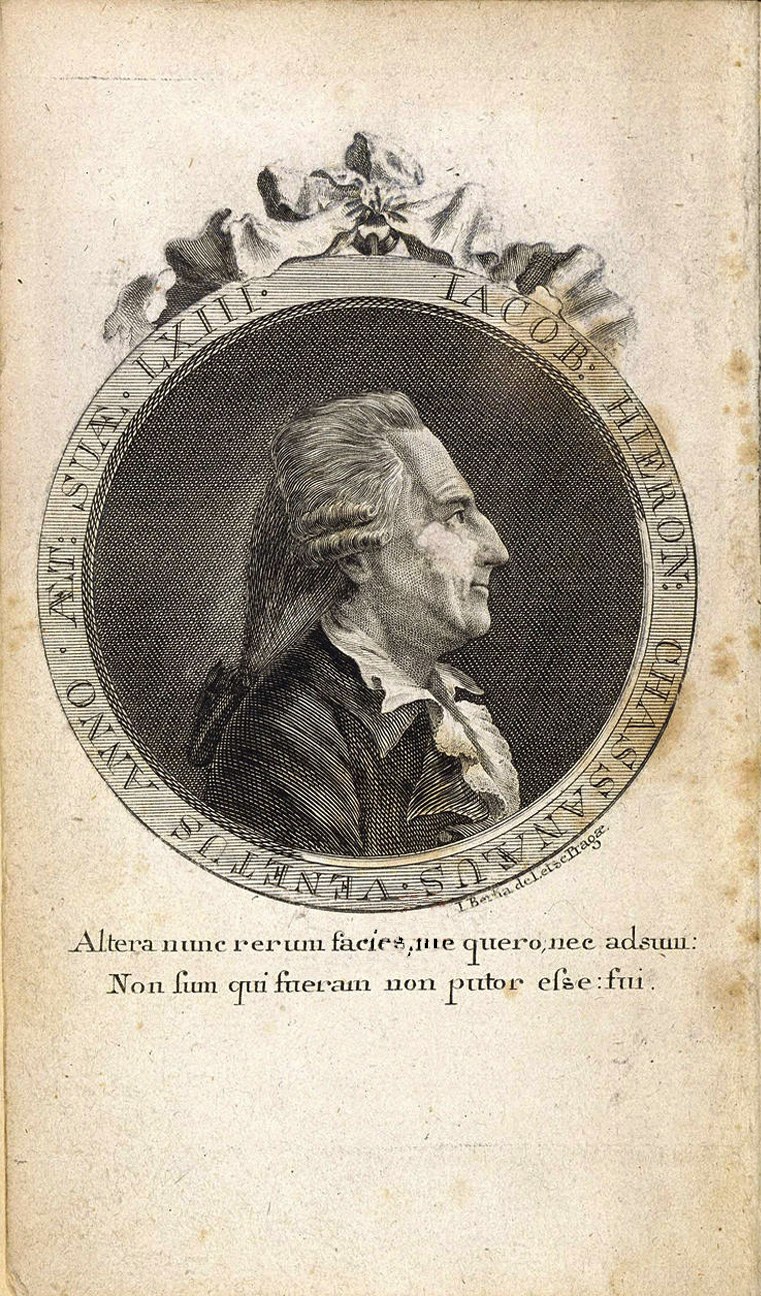
Biography
From a Venetian acting family to the lead cells of the Doge's Palace to a Bohemian library — the documented life.
Venice, 1725–1742
Giacomo Girolamo Casanova was born in Venice on 2 April 1725, the eldest surviving child of the actors Gaetano Giuseppe Casanova and Zanetta Farussi. His father died in 1733. Casanova himself later hinted — in the memoirs, without proof — that his true father may have been the Venetian patrician Michele Grimani, his godfather. The claim is unverifiable and is flagged as such wherever it matters.
A sickly child, he was sent at nine to a boarding school at Padua run by a Dr. Gozzi, and then to the University of Padua, where he took his doctorate in law (utroque iure) in November 1742, aged seventeen. He had already entered the clerical state, taking minor orders; in 1741 he was expelled from the seminary of San Cipriano on Murano after a scandal. The clerical career was effectively over before it began.
Rome, Naples, the army, 1743–1746
Through family connections Casanova became secretary to Cardinal Acquaviva in Rome (1743–44), a post he lost after a scandal. He then served briefly as an officer in the Venetian forces in Corfu and Constantinople (1744–45), and on returning to Venice played the violin in the orchestra of the San Samuele theatre (1745–46). The pattern of the next forty years was set: talent, patronage, scandal, departure.
The arrest and the escape, 1755–1756
On 26 July 1755 Casanova was arrested in Venice by order of the Inquisitori di Stato (State Inquisitors). The charges, as recorded, included affront to the holy religion, and were bound up with magic, freemasonry, and libertinism — Casanova had been dabbling in the occult with patrician protectors, notably the elderly senator Matteo Bragadin, who had effectively adopted him.
He was sentenced to five years in the Piombi, the cells directly under the lead roof of the Doge’s Palace, named for the lead (piombo) plates that made them ovens in summer and iceboxes in winter. On the night of 31 October to 1 November 1756, after months of preparation, he and the renegade priest Marino Balbi broke through the ceiling of the cell, crossed the palace roof, broke into the chancellery, and descended the outside wall on a rope of knotted sheets. They took a gondola to the mainland. The escape is recounted at length in the memoirs and is corroborated by Venetian prison records — it is the best-documented episode of his life.
Paris and the lottery, 1757–1760
Arriving in Paris, Casanova styled himself “Chevalier de Seingalt” — a title of his own invention, used from about 1757. Through the abbé de Bernis he proposed a state lottery to fund the new École militaire; the Loterie de l’École militaire was authorized in 1757, and as one of its receivers Casanova grew genuinely rich for the first time. He lived lavishly, gambled, and pursued occult schemes with the wealthy widow the Marquise d’Urfé, promising alchemical regeneration. When the schemes collapsed and arrest threatened, he fled France in 1760.
The great travels, 1760–1774
The 1760s and early 1770s are the memoirs’ richest territory:
- August 1760 — visits Voltaire at Ferney; the two debate religion and literature. The account rests on Casanova’s memoirs.
- 1763 — London, including the destructive affair with the young courtesan Marie Charpillon.
- 1764 — audience with Frederick the Great at Sans-Souci.
- 1764–65 — St. Petersburg and the court of Catherine the Great; his proposal for calendar reform was not adopted.
- 1767–68 — Spain; briefly imprisoned in Madrid, then expelled.
In 1774, after eighteen years of exile, he was pardoned and returned to Venice, where he worked — among other things — as a confidential informant for the Inquisitori di Stato, the same body that had imprisoned him.
Expulsion and Dux, 1782–1798
After a libel quarreled him out of Venice again in 1782–83, Casanova drifted through Paris, Vienna, and Prague. In 1785 Count Joseph Karl von Waldstein offered him the post of librarian at his château of Dux (Duchcov) in Bohemia. He accepted, and lived there for the remaining thirteen years of his life.
At Dux he wrote prolifically: the pamphlet Soliloque d’un penseur (1786), the account Histoire de ma fuite (1788), the five-volume utopian novel Icosameron (1788), and, from 1789 to 1798, the Histoire de ma vie — some 3,700 manuscript pages, breaking off in 1774. He died at Dux on 4 June 1798 and was buried there; the grave is unmarked and its exact location uncertain.
Source notes
- Dates and itinerary follow the Pléiade Histoire de ma vie (2015) chronology and the BnF “Fonds Casanova” documentation.
- The arrest charges and the escape are documented in Casanova’s memoirs (Gutenberg ebook 2960, “under the Leads”) and confirmed against Venetian archives by the scholarly editors.
- The “Chevalier de Seingalt” title is identified as self-styled in the scholarly literature; no Venetian record grants it.
- The Grimani paternity hint appears in the memoirs; it is uncorroborated and treated as anecdote.