Escape from the Piombi
Fifteen months in the lead cells — and the most famous prison break of the eighteenth century.
The arrest
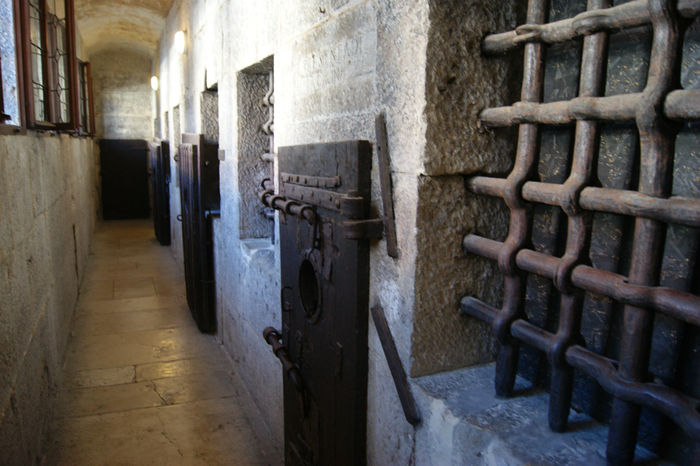
On 26 July 1755, Casanova was arrested in Venice by order of the Inquisitori di Stato. The recorded charges included affront to the holy religion; the dossier behind them involved magic, freemasonry, and libertinism — the occult dabbling he had shared with his patrician protector Matteo Bragadin and others. He was sentenced to five years in the Piombi: the cells directly beneath the lead (piombo) roof plates of the Doge’s Palace, ovens in summer and iceboxes in winter, reserved for prisoners of state.
The preparation
The memoirs describe months of preparation: a smuggled iron spike, sharpened into a tool; the slow piercing of the cell’s ceiling during the hours when the guards were absent; the enlistment of a fellow prisoner, the renegade priest Marino Balbi, whose cell adjoined the roof space. On the evening of 31 October 1756, Casanova left a farewell letter in the cell of another prisoner, Count Asquin — dated “an hour before midnight”:
“Our lords of state are bound to do all in their power to keep a prisoner under the Leads, and on the other hand the prisoner, who is fortunately not on parole, is bound also to make his escape. Their right to act thus is founded on justice, while the prisoner follows the voice of nature; and since they have not asked him whether he will be put in prison, so he ought not to ask them leave to escape.”
— Memoirs, “under the Leads” (Arthur Machen’s 1894 translation; Project Gutenberg ebook 2960). Verbatim from the public-domain text.
The night of 31 October – 1 November 1756
Through the pierced ceiling and onto the palace roof; across the lead plates with a pike for balance; through a dormer window into the chancellery; and down the outside wall on a rope made of knotted sheets and bedding. At the water’s edge a gondola — arranged beforehand — carried them to the mainland. No prisoner had ever escaped the Piombi before. Venetian prison records confirm the escape itself; the hour-by-hour detail is Casanova’s.
Aftermath
Casanova fled to Paris, where the escape made him famous — and where, in 1788, he published Histoire de ma fuite, the first printed version of the story. He would not see Venice again for eighteen years.
Source notes
- The escape letter and narrative are verbatim from Arthur Machen’s 1894 translation (Gutenberg ebook 2960); the translation derives from the expurgated Laforgue text, but the escape chapters are substantially consistent with the manuscript.
- The arrest date (26 July 1755), the sentence (five years), and the escape date are corroborated by Venetian state archives as summarized in the scholarly editions.