Glossary
The vocabulary of the memoirs — Venice's institutions, masks, and money.
Baùta
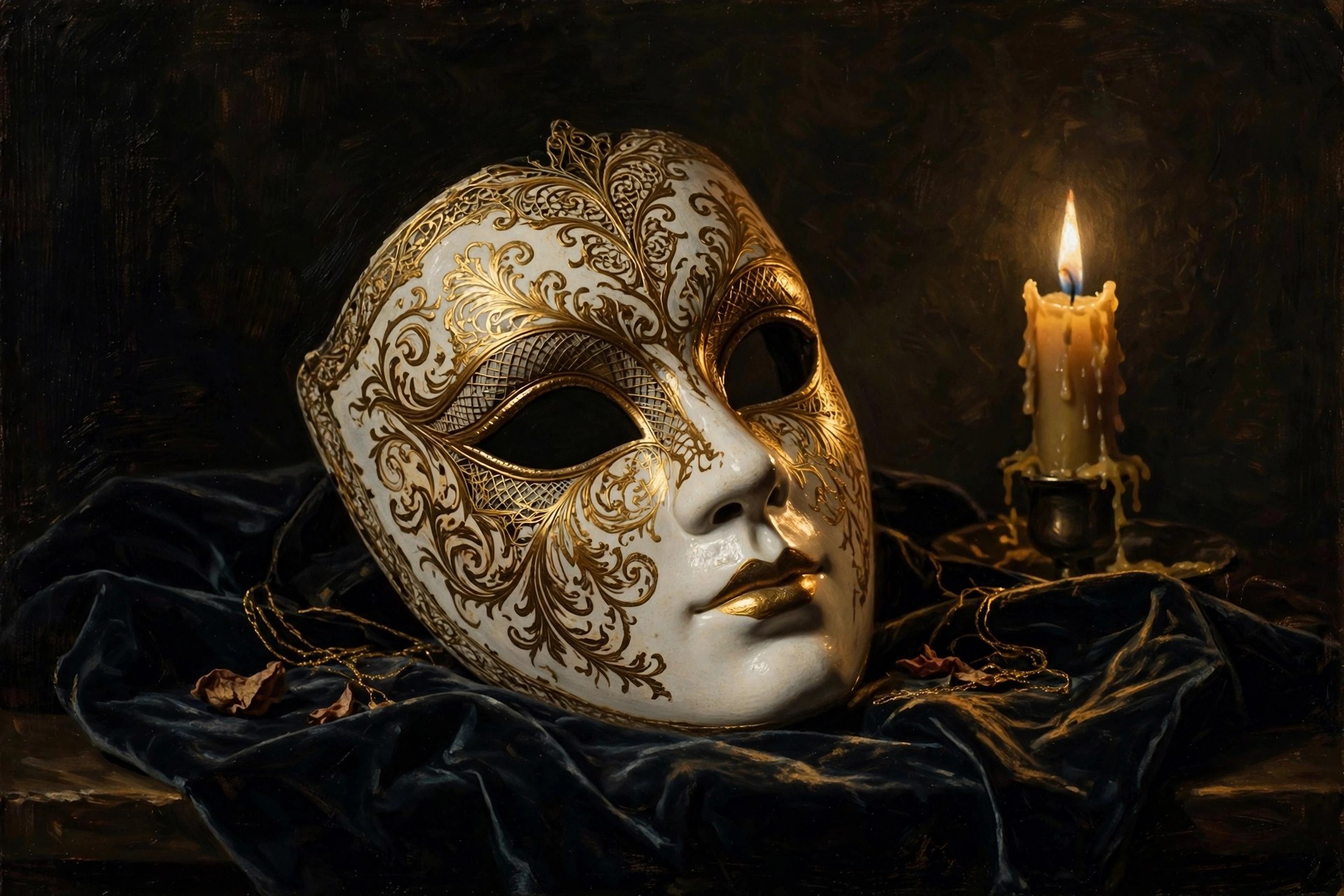
The white mask and black tricorn-and-cloak costume worn by Venetian gentlemen for months of the year — at carnival and beyond — granting anonymity across class lines. Casanova’s Venice ran on it.
Bragadin, Matteo (1689–1767)
Venetian senator who became Casanova’s patron and protector after Casanova attended him during a stroke (the memoirs’ account). Funded Casanova’s early career; their shared occult dabbling fed the 1755 arrest dossier.
Cicisbeo
The recognized gallant-companion of a married noblewoman in eighteenth-century Italy — an institutionalized role the memoirs describe matter-of-factly.
École militaire
The Paris military academy founded by Louis XV; Casanova’s 1757 state lottery, the Loterie de l’École militaire, was created to fund it, and made his one great fortune.
Faro
The card game of chance at which the fortunes of the ridotti — and of Casanova — were won and lost.
Grimani, Michele (1697–1775)
Venetian patrician, Casanova’s godfather, and — by Casanova’s uncorroborated hint — possibly his true father. Flagged as anecdote throughout this site.
Histoire de ma fuite
Histoire de ma fuite des prisons de la République de Venise qu’on appelle les Plombs — Casanova’s 1788 account of the escape, published in Leipzig; the first printed version of the story.
Histoire de ma vie
“Story of my life” — Casanova’s memoirs, full manuscript title Histoire de ma vie jusqu’à l’an 1797; written 1789–1798, ~3,700 pages, narrative breaking off in 1774. See the memoirs.
Icosameron
Casanova’s five-volume utopian novel (Prague, 1788); its frontispiece is Johann Berka’s engraving of Casanova drawn from life — the one certain lifetime portrait.
Inquisitori di Stato
The State Inquisitors of Venice (est. 1539): the secret tribunal running surveillance, informers, and state prisons. They arrested Casanova in 1755 — and later employed him as an informant after 1774.
Laforgue, Jean (1782–1852)
Editor of the 1826–1837 French edition of the memoirs; rewrote Casanova’s religious and political views and censored the text. His bowdlerization underlies every edition until 1960.
Libro d’oro
The “Golden Book” — the register of the Venetian patriciate. Casanova, born to actors, was outside it; the whole memoirs can be read as his long negotiation with the world it enclosed.
Machen, Arthur (1863–1947)
Welsh author whose 1894 English translation of the memoirs — made from Laforgue’s expurgated text — was the standard English version for decades and is the public-domain source quoted on this site.
Moretta
The small black velvet mask worn by Venetian women, held in place without ties — a fixture of the masked society the memoirs describe.
Piombi
“The Leads” — the prison cells directly under the lead roof-plates of the Doge’s Palace in Venice, reserved for prisoners of state. Casanova was held there 1755–56 and escaped on the night of 31 October – 1 November 1756.
Ridotto
Licensed Venetian gaming houses where nobles and adventurers met at the faro table — the economic and social engine of Casanova’s Venice.
Seingalt, Chevalier de
The self-styled title Casanova adopted around 1757 (“Jacques Casanova de Seingalt”); used on his own title pages, granted by no authority.
Serenissima, La
“The Most Serene” — the Republic of Venice, Casanova’s native state, dissolved by Napoleon in 1797, a year before Casanova’s death.
Utroque iure
“In both laws” (civil and canon) — the Padua law doctorate Casanova took in November 1742, aged seventeen.
Waldstein, Joseph Karl von (1755–1814)
Bohemian count; appointed Casanova librarian at Dux in 1785 and supported him for the last thirteen years of his life.
Source notes
- Definitions follow the Pléiade Histoire de ma vie (2015) notes, the standard histories of eighteenth-century Venice, and the BnF “Fonds Casanova” documentation.